

The latest county-level Census Bureau estimates confirm what the bureau’s statewide numbers suggested back in January: with immigrants no longer flooding across a wide-open southern border, New York’s post-COVID demographic rebound has come to an end.
The Big Apple’s population declined by 12,196 during the 12-month period ending in mid-2025, according to the new census data. At the same time, Long Island and the city’s northern suburbs last year gained a net 17,281 residents.
Both figures are just rounding errors in a city of 8.5 million and the surrounding New York suburban region with a combined population of 5.1 million people —but coupled with the ongoing slow and steady decline of upstate New York’s population (down another 4,007 in the latest annual count), they also spell demographic stagnation for the Empire State over the balance of the 2020s.
The latest census estimates cap a five-year period in which the statewide population seesawed from a record 20.2 million in the April 2020 census, sharply down to 19.7 million in 2022, and back up to just (barely) above 20 million in each of the last two years, including a barely perceptible gain of 1,007 people in 2025.
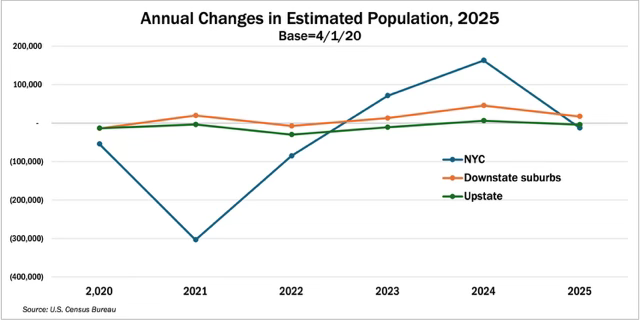
New York State’s population is still down a net 201,269, or about 1 percent, from the 2020 Census count—the biggest population decline of any state. By contrast, the latest national population estimate of nearly 342 million was up 10 million, or roughly 3.1 percent, from the 2020 census level.
Population growth has been weak almost everywhere in New York, but the main downward tug on the statewide number has come from New York City—a reversal of the pre-COVID trend.
After a concerted effort by the de Blasio administration to ensure a high rate of return for census questionnaires from every nook and cranny of the five boroughs, the final citywide count for 2020 produced a pleasant surprise. Contrary to projections based on annual estimates in the late 2010s, New York City’s population at the start of this decade had reached a new all-time high of 8.8 million, up 629,051 from the 2010 level. This accounted for fully three-quarters of the statewide gain during the decade.
But the news of the higher-than-expected 2020 total had barely settled in when the numbers headed (literally and figuratively) south. In the two years following the Census, the state lost 368,000 residents — thanks mainly to a temporary drop in foreign immigration and a surge in out-migration of New Yorkers to other states.
The city’s population then rebounded in 2022 and 2024 thanks to an influx of 375,000 immigrants—most of them undocumented border-crossers, who would be temporarily housed and fed at a cost to city and state taxpayers of more than $10 billion.
Reflecting President Trump’s renewed enforcement of immigration laws, foreign immigration to the city declined in the mid-2025 count to just 95,634 statewide and 65,824 in New York City—the lowest levels since the temporary Covid border shutdown of 2020-21, and among the lowest annual immigration figures on record in New York in recent decades.
With the overseas inflow slowed to a trickle, what’s driving New York’s renewed decline is the domestic migration outflow—the extent to which more New Yorkers are leaving the Empire State than moving in. Net domestic migration from the state last year came to 137,586 people—below peak pandemic levels, but roughly equivalent to the 2011-19 average of 151,000 out-migrants a year.
Where are those New Yorkers headed? Answers to that question can be gleaned from another recent federal data drop—migration data from the Internal Revenue Service for income tax returns filed in 2022 and 2023, which were posted late last week.
Consistent with long-standing trends, the most popular destinations for New Yorkers in 2022-23 were Florida and New Jersey, which accounted for nearly half the net outflow, followed by North Carolina, Pennsylvania, Connecticut, South Carolina, Texas, and Georgia.
What all these states have in common—even New Jersey and Connecticut, heavily taxed by national standards—is that individual tax burdens are generally lower than New York’s.
Preoccupied with national politics, the news media typically frames every state population uptick or downtick in terms of congressional seats gained or lost. However, the outlook for New York’s post-2032 headcount in the House of Representatives is far less important than the implications of demographic decline for public policy closer to home.
In the absence of economic growth, a flat or falling population inevitably depresses tax revenues. But if New York has entered a new era of decline, you wouldn’t know it from watching current deliberations over state and city finances.
Budgets at both levels are structurally unbalanced, dependent for now on revenues generated in recent capital gains boom years by the millionaire earners and profitable finance and related firms now targeted in different ways by Mayor Mamdani’s tax agenda.
Governor Hochul has resisted the mayor’s most extreme demands—but on spending and taxes, Hochul and Mamdani differ only by degree.
Both executives, along with majorities in the legislature and City Council, are committed to a big-government vision that can’t be sustainably financed by an economy—and a population—that isn’t growing.

The problem is much deeper than that - we could never afford to do what we've been doing. It is not just a matter of "it was ok for a while but now we have to stop." No, it was never okay.
Every state and city in the US with a budget problem has a spending problem.
It isn't just what Mamdani wants to do with the budget - frankly, the money is there for him to spend on new "free" things - it's just that they've already spent the money on other things.
Every state and city in the US has seen real per capita revenue increase by between 30-50% over the last 30 years. NYC municipal revenue has increased 104% since the 1975 fiscal crisis, which itself was caused by Lindsay increasing spending much faster than revenue was growing - which in fact it still was as of 1975. Real per capita NYC spending has increased 111% over the same period.
This is what many academics call "austerity!" Now, in the immediate period after the crisis, real per capita spending was cut - but not back to pre-Lindsay levels. So, if I start eating a hamburger every day, then ratchet that up to three, then I have cut back to two, is that a diet? No. So, we have never had austerity.
That we call living slightly beyond our means "austerity" shows the level of denial we're in.
NYC is like Amsterdam in the 1500s and 1600s - it's where the new money flows in. That gave us a multi-decade windfall. And every mayor just took it and spent it, except for Giuliani - love him or hate him, he kept real per capita spending at sustainable levels. Subsequent mayors did not recognize a windfall as a windfall and increased permanent spending. Bloomberg had a few one-timers to develop neighborhoods, but somehow total spending kept rising. And all those mayors congratulated themselves on having sort-of balanced their budgets. But you can't do that - you can't raise spending faster than inflation and population growth for decades hoping that a windfall will last forever.
They've done that at the federal, state and local level. They've done that in almost every other country too - UK has increased its national government spending 33% faster than the growth rate of their population and CPI since Thatcher left office. I'm not sure what the Tories were up to a decade or so ago, but it was not "austerity."
This is not just Mamdani. This is government. It's NYC and it's almost everywhere.
And that is democracy - the money is, let's be honest, spent to buy votes. Politicians are thinking about the next election. And they know that as long as the crash doesn't happen while they're in office, they won't be blamed. It was Breame's face on the papers, and Ford being blamed for initially saying there would be no bailout for the self-imposed fiscal crisis.
We don't need to "balance the budget." Because "balance" doesn't account for windfalls.
We need to cap spending growth in real per capita terms. Keep it below 0.25% per year - better yet, 0%-0.1%. Revenue will outpace that in some years- great, take that and pay the debt down, then build an emergency fund for the next pandemic or fire or flood, or market correction that puts you behind on your pension obligations. Then return some of that to the taxpayers.
But that would be responsible.
Good post, but I’d add that the Census has admitted the New York 2020 population was overcounted. So part of the explanation for population dips since 2020 is likely due to corrections for the 2020 overcount.