

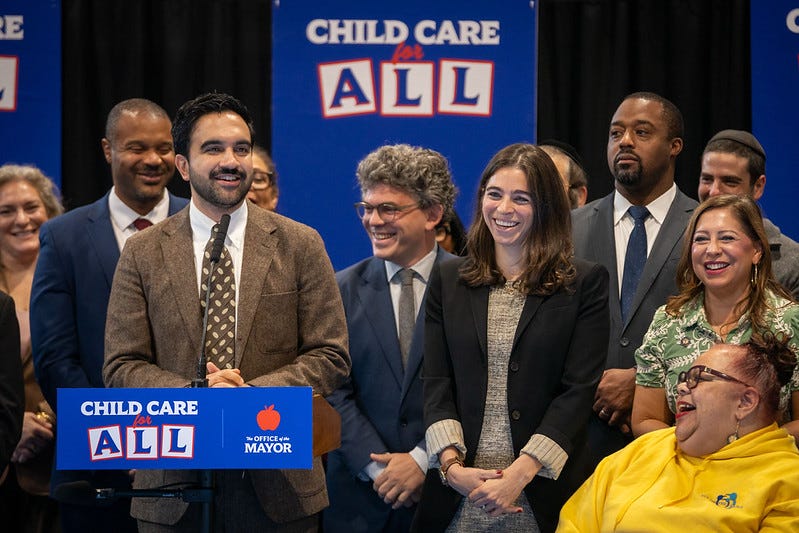
Universal free childcare is one of Mayor Zohran Mamdani’s signature proposals.
Since taking office, Mamdani’s focus has been on expanding the city’s free universal childcare program to two-year-olds (2-K), and this September he launched 2,000 seats, with plans for an additional 10,000 seats next year. This adds to the existing 3-K and Pre-K programs serving three- and four-year-olds, which are already struggling with implementation and enrollment problems.
So it was welcome news when on October 5, Mamdani announced that about 10,000 of the 29,000 children on the city’s childcare voucher list will now receive one.
But is the city spending money wisely?
In September, the mayor released his first Mayor’s Management Report (MMR), the city’s annual report card, providing insight into his progress toward his universal childcare commitment.
Pre-K and 3-K Update: 21,000 Empty Seats
Roughly 450,000 children under 5 live in the city, some of whom are cared for entirely by families, and some through a mix of city and private daycare providers.
The overall number of children continues to decline—there are 17% fewer four-year-olds in the city than in 2020.
Pre-K enrollment continues to decline as well, MMR shows.
Since 2023, Pre-K enrollment has fallen by 8%, from 59,687 to 55,042, and the city does not expect that trend to change, projecting next year’s enrollment at 53,117. 3-K enrollment has stabilized at around 44,000 children.
Meanwhile, the city continues to have more seats than children to fill them.
The share of filled Pre-K seats rose from 79% to 81%, but only “due to fewer seats being available.” Despite the city cutting about 7,600 Pre-K seats over the years, 12,609 sat empty last year. The city’s target for this fiscal year shows 15,138 empty Pre-K seats.
Together, nearly 21,000 seats went unfilled across the 3-K and Pre-K programs last year. The report attributes the enrollment decline to the previous administration’s disinvestment in outreach to families, lower birth rates, and families leaving the city.
The City Council found that some neighborhoods have many empty seats while others have shortages and blamed the rollout of 3-K—the program was expanded citywide quickly, using temporary federal stimulus money—for the misalignment.
But the empty seats are costing the city money: “lower total program utilization generally translates to higher per-participant costs,” the Comptroller explained. In other words, the city is paying for every seat whether it is filled or not, and the average 3-K seat costs $23,541.
Demand for Childcare Vouchers Up: 29,000 Waitlisted
The one program that has seen a significant increase in demand over the years, according to MMR, is the Child Care Assistance Program. CCAP provides low-income families with a subsidy (voucher) they can use at any licensed child provider, including home-based ones.
Since Albany raised the income limit for vouchers to 300% of the federal poverty level in 2022, the number of children using non-mandated low-income vouchers increased from about 9,400 in FY 2022 to 71,500 in FY2026. Counting the vouchers the city must issue to families on public assistance, total enrollment increased from 47,535 to 109,875.
In May 2025, the city and state fought over who would pay for that growth. The state, which, along with Washington, had historically funded nearly all of the program, offered $350 million on the condition that the city match it. The city stopped issuing new low-income vouchers and put newly eligible families on a waitlist, which, according to the mayor, had grown to more than 29,000 children by yesterday.
The average voucher costs about $19,075 and typically covers children under 13, with rates that vary by the child’s age.
In this year’s state budget, the governor offered the city up to $475 million in matching funds to fund vouchers. Neither the Governor nor the city explained how much each is contributing to pay for the 10,000 new vouchers.
Mamdani’s Choice
Mamdani inherited the voucher freeze and the empty 3-K and Pre-K seats. However, with both problems in front of him, he chose to build and expand universal childcare to 2,000 2-year-olds and add 2,000 additional 3-K seats first, with no permanent plan to fund them. Gov. Hochul is funding the first two years of the launch and has not committed further funding.
Since the problematic Pre-K and 3-K roll-outs, the city has lost 1,300 family-run day cares that could serve nearly 10,000 children, according to a Center for New York City Affairs report. Provision of 2-K will rely on community and family providers, and the community groups that run the city Pre-K and 3-K programs say the city pays them less than it costs to operate.
Lauren Melodia, director of economic and fiscal policy at the New School’s Center for New York City Affairs, told New York Magazine: “Most of the people who work in the field are like, ‘Please don’t do this. You have to fix the other problems we’re already dealing with first.”
In his press release, Mamdani called the vouchers “nothing short of transformational” and a “critical step” toward universal childcare, but he hadn’t mentioned them as a priority until now.
Universal programs, like the ones Mayor Mamdani has been advocating for, put the city in charge—it allocates seats, sets schedules, and chooses the providers. Many families want a choice of care, not just a seat in a city program, as the waitlist for childcare vouchers, which will still have 19,000 children on it, proves. A voucher follows the child to the provider that the family picks.
Putting up the money to fund vouchers is a prudent way for the mayor to work toward his promise of providing free childcare, and he should consider using the money spent on empty seats to eliminate the rest of the waitlist.

Excellent digest of what has been going on in the 3K, PreK and now expansion to 2Care programs. Socialist policy of funding and running government programs hasn't been working: misallocation of childcare seats, paying for empty seats, high cost per child, and most importantly not serving families. When it comes to childcare and education, families want choice and Mamdani is giving it to them.
Childcare is a subsidy to employers who don’t pay adequate wages at taxpayer expense.