

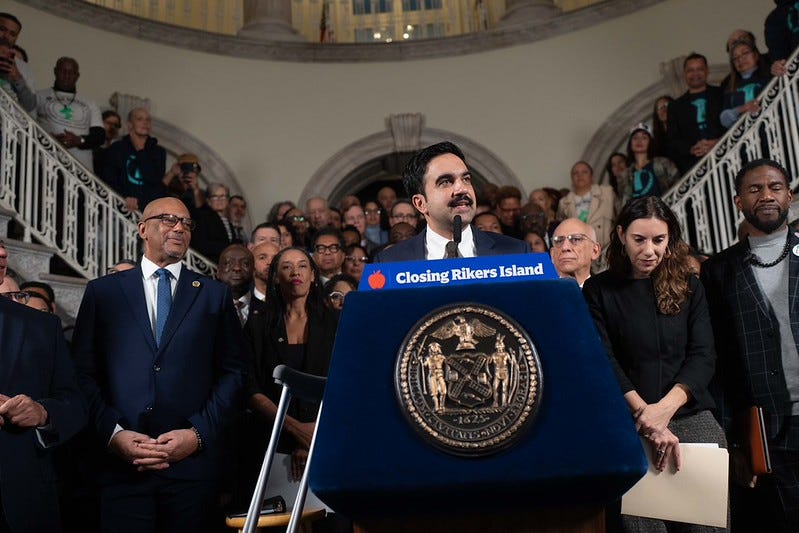
This morning, Mayor Zohran Mamdani committed to closing Rikers Island, with plans to cut the jail population from about 6,600 to no more than 4,100 by the end of 2032. Faster case processing is expected to bring down the current number by about 800, diversion by 500, releasing people sooner after they’re jailed by 700, and reducing recidivism by about 500.
The newly allocated money—$146 million next fiscal year—goes mostly to programs in jail, alternatives to jail, and reentry, with nothing new, according to the city’s November budget update, for prosecuting crimes.
MI’s fellows have written about the issues related to the proposed Rikers closure for years. In 2021, Nicole Gelinas urged the city to “rebuild gradually in place at Rikers.” Charles Fain Lehman’s 2022 report found that the bed target “had more to do with politics than with any reasonable projection,” and the city “must reckon seriously with where they will put criminals” afterward, as the local jails will not be enough.
“Rikers is one of those truly binary issues: You can maintain decent levels of public safety, or you can move forward with a plan that caps jail capacity at half of what the current jail population is today (and 30% of what it was 10 years ago, when—coincidentally, no doubt—the city was much safer than it is today). You cannot do both,” MI’s Rafael Mangual writes on X, “make no mistake about the fact that what he’s recommitting to is a radical experiment in decarceration.”
Mamdani promised the four replacement jails would open between 2029 and 2032 and have 4,160 beds. Rikers held as many as 7,700 people in the summer of 2025, and on Nov. 18 the number was 6,650.
Elizabeth Glazer, Mayor Bill de Blasio’s criminal justice adviser who helped draw up the plan to close Rikers and replace it with four jails in the boroughs, wrote earlier this week in The New York Times urging Mamdani to “rebuild or renovate the jails on Rikers into safe, humane facilities,” saying that the original plan had “fallen apart.”
“This experience taught me that treating a campaign slogan as the operating instructions for policymaking can do real harm. The “Close Rikers” campaign was successful in drawing attention to the conditions on the island, but the absolutism of the slogan obstructed what our plan was meant to achieve in the first place: decent and humane jails free from endemic violence.”
Related:
We Can’t Close Rikers. So What Now? by Elizabeth Glazer (The New York Times)
Shutting Down Rikers Island Must Advance by Jonathan Lippman (New York Daily News)
The Plan to Close Rikers Is Failing—But No One Will Admit It by MI’s Nicole Gelinas (City Journal, 2025)
Rikers Must Close in a Year—What’s the Plan? by MI’s Charles Fain Lehman (City Journal, August 2026)
Overwhelmed juvenile detention
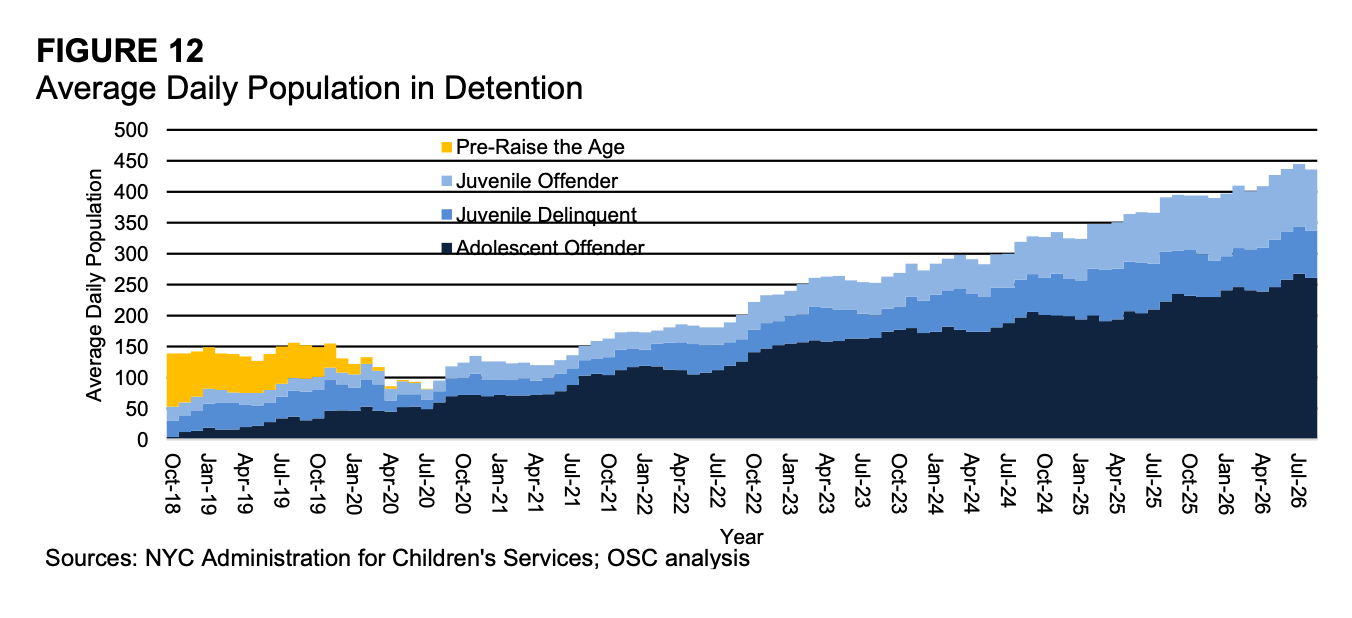
Rikers is not the only facility that has capacity issues. The number of youths in secure juvenile detention grew more than 400% from 2019 to 2025, and these centers do not have the space to properly accommodate them, according to a new state comptroller report on juvenile justice. Most of that growth came as Raise the Age moved 16- and 17-year-olds from Rikers into the juvenile system, and stays have nearly doubled since 2023, according to the report. Last year the city overspent its secure detention budget by $44 million.
While total arrests have declined, proportionally more youth are being arrested for more serious crimes, including shootings, the comptroller found. Shootings by youths under 18 made up 11% of the citywide total in 2025, up from 4% in 2019, the year Raise the Age, the law that raised the age of criminal responsibility to 18, was fully implemented, and remain historically high.
The schools dilemma: 23,000 fewer students, 23,000 more new seats
The number of children in the city has been falling and, according to preliminary figures, New York City’s public schools enrolled just 766,872 students in kindergarten through 12th grade this fall, 23,046 fewer than last year, a number that is expected to fall by another 26,344 next year. This is down from a peak of over a million just over a decade ago.
The city is struggling with the costly reality that the number of under-enrolled schools is rising rapidly and that the state’s class size mandates require building new facilities in the more overcrowded districts, where the student population is also expected to fall.
Almost two-thirds of the public schools lost students, and there are now 240 schools with 200 or fewer students, up from 219 schools last year, Chalkbeat reports.
Meanwhile, the city is adding 23,030 new seats between 2027 and 2032, about 14,700 of them opening in 2029 or later. The School Construction Authority’s own projections show pre-K–12 enrollment falling by about 90,000 between this school year and 2032-33, when the last of those seats open.
Related:
NYC public schools lose 23,000 students, deepening budget and closure pressures (Chalkbeat) ·
New York Has Too Many Schools for Too Few Students by MI’s John Ketcham (City Journal)
New York’s School-Spending Problem, in Five Charts (City Journal)
What free child care is worth?
Free care for children under five, 35 hours a week, would generate “up to $6.5 billion annually” in economic value, says a new report from Citizens Union’s 5Boro Institute and Boston Consulting Group, based on a survey of 2,716 parents who spend a median of $16,000 (average of $21,000) per child, per year on child care.
The administration estimates universal childcare would cost about $6 billion a year. A New School analysis puts it at $8.7 billion to $9.3 billion, largely because of the pledge to raise child care workers’ pay. The state comptroller estimates that covering every child under 5 could add up to $8.2 billion to the $3.2 billion the city already spends, before any raises for workers.
A survey of what parents say they would do does not mean that is what they will do when presented with available options.
Who else is in the classroom?
The man accused of killing a jogger worked as a substitute paraprofessional for the Education Department, which kept renewing him even after the NYPD refused to take him back and the Marines discharged him as psychologically unfit. Ten adults at Brooklyn’s P.S. 200 had warned about his erratic behavior.
“Low base pay makes it harder to attract and keep qualified paras, while weak oversight makes it harder to remove unfit ones,” MI’s Jennifer Weber and John Ketcham write in the New York Post. They want formal evaluations before any renewal, and the teachers union’s role included in the mayor’s promised review of hiring.
Since they wrote, two more paraprofessionals, one in the Bronx and one on Staten Island, have been arrested on charges involving young students; the Education Department says both were removed from their jobs.
MI work this week:
No such thing as a construction accident
Last week’s building collapse in Flatbush killed eight people. In the New York Post, MI’s Nicole Gelinas points out that the contractor next door already had a stop-work violation from April, and that the Buildings Department found at least 247 violations of stop-work orders last year, each carrying a $10,000 fine. If that’s just the cost of doing business, something is broken, she argues, and it is up to the city to fix it.
“There is no excuse for continuing work under a stop-work order, and the fact that this happens daily shows that a five-figure fine is not enough,” Gelinas writes. “The fine should be six figures — and should be raised until the scofflaws feel some pain.”
Mamdani’s opportunistic universalism
Mamdani says public benefits should go to everyone, not just people in need. MI’s Chris Pope argues in City Journal that this principle says nothing about where scarce money should go, which makes it a handy cover for spending aimed at political allies.
Disbanding the NYPD’s Strategic Response Group, Mamdani plays to his base
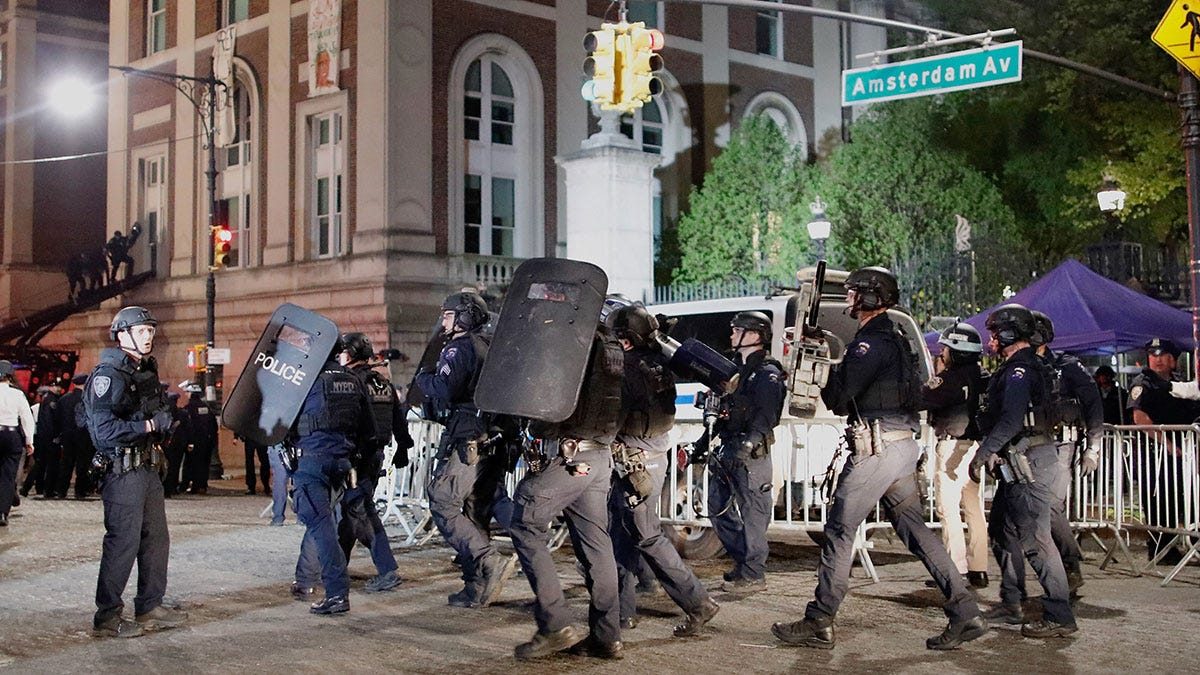
MI’s Rafael A. Mangual argues in City Journal that disbanding the SRG is mostly for show. Each part of the plan restates current practice or the 2023 NYCLU settlement, or moves duties around: the new Patrol Support Division will support major events and make protest arrests “in rare instances,” which “is essentially what the SRG already did.”
Police still handle most mental-health calls, the gang database remains, and Rikers is still open. The mayor’s premise, that protest response and counterterrorism are separate jobs, is wrong, Mangual writes. Protests can turn into riots or become targets, as when ISIS-inspired attackers threw pipe bombs at police at a protest outside Gracie Mansion in March.
“Mamdani’s announcement does send a clear message,” he writes. “One sure to embolden the protest coalition and demoralize those called upon to keep order.”
Yes, New York City protests can turn violent
The SRG’s critics call it a threat to free speech, MI’s Josh Appel and City Journal’s Stu Smith argue that the unit was usually sent in after a “protest” had already become violent.
In April 2024, activists at City College broke windows and set a roof on fire, causing more than $3 million in damage; the same day, protesters broke into Columbia’s Hamilton Hall and held custodians inside.
“The line between protesting and violent action is often blurred by the same people who most adamantly support disbanding the SRG,” they write.
What’s the point of New York’s Republican Party?
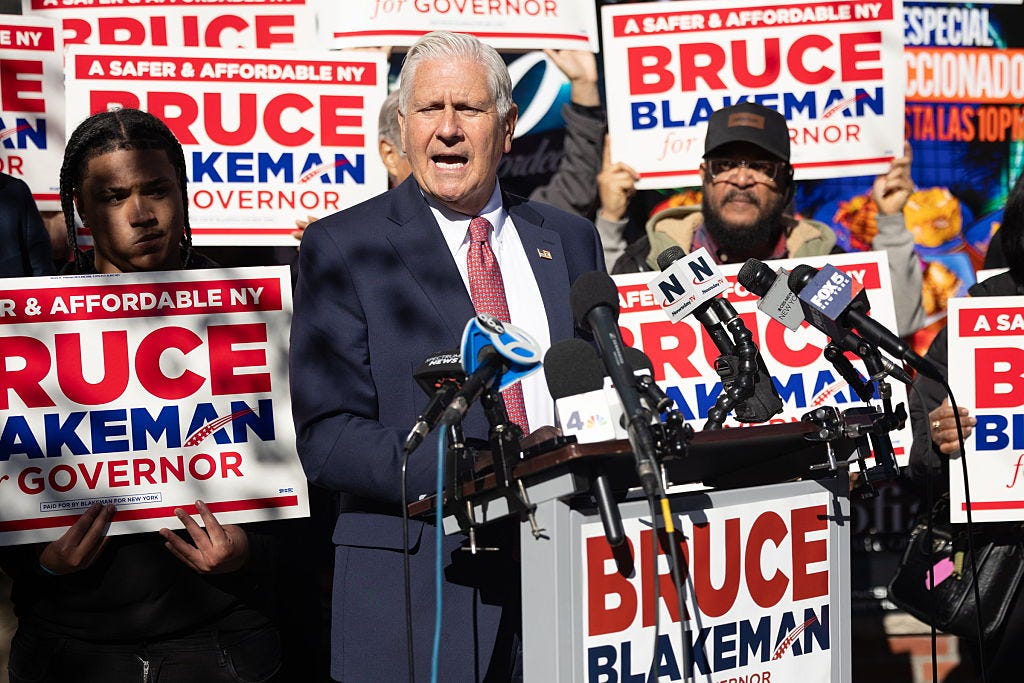
After Hochul’s massive win, MI adjunct fellow Christian Browne argues Republicans can matter here again only by becoming a New York party.
That means breaking with Trump and dropping the doom: the city will record about 85% fewer homicides this year than in 1990. And it means real policy, he writes.
Instead of reflexive opposition to any tax increase or vague attacks on “cashless bail,” Republicans should have plans that target repeat offenders and give judges more discretion on bail. They need answers on the education, housing and health care questions Blakeman’s campaign skipped. Republicans once checked the other party’s excesses in New York, Browne writes, and La Guardia, Dewey and Pataki show they can win here.
Lessons from elsewhere
Free child care for all, one year in.
A year ago, New Mexico became the first state to offer free child care, paid for largely out of a permanent fund built on oil and gas revenue. About half of the state’s roughly 67,000 children under 6 are now enrolled, NPR reports, but there aren’t enough slots: one popular Santa Fe center has a waitlist of nearly 700.
An inflation safeguard has also kicked in, so families earning more than $198,000 will soon pay up to $148.50 a month.
New York City has no oil fund to pay for its plan, and it is likely to hit similar challenge: not enough providers and workers to match demand.
Kansas City brings back the bus fare.
The first major U.S. city to make its buses free, in 2020, started charging $2 again in June, after the COVID money that paid for free rides ran out and the city and transit agency fought over who should pay.
It replaced universal free rides with a “functionally free” model for the city residents: free day, monthly and yearly passes handed out through nonprofits to low-income riders, plus a half-price fare. Eligible non-residents from neighboring counties need to apply to get the discounts.
Extra! Extra!
MTA falls further behind on $2B in upgrades to NYC subway signals, consultant finds (Gothamist)
Hochul open to reforming Scaffold Law (City & State)
Amazon-backed business group threatens to sue city if Delivery Protection Act passes (City & State)
Mamdani’s White Knight for Troubled Buildings Has Dismal Record of Violations (The City Reporter)
Raft of New Penalties Eat at Outdoor Dining Owners (The City Reporter)
Progress Stalls in Reducing 911 Calls for NYC Students in Emotional Distress (Chalkbeat via The City Reporter)
“It’s Called Fundraising Stupid,” Heastie Says. So Where’s the Proof? (NY Focus)
NYC Bodegas Get Reprieve From New SNAP Rules After Mamdani-Trump Call, Mayor Says (The City Reporter)
The juvenile crime figures are striking (especially at a time when "crime is down") but seem to have little political currency in the city.