

New York likes to tell itself a story about progress. But a new report from the nonprofit Available to All argues that the state’s school maps, which shadow the old redlining maps that once helped restrict access to housing in mostly minority areas, remain a major obstacle to equal educational opportunity.
The authors document striking gaps between schools just blocks apart and argue that making progress means expanding real school choice: fewer barriers based on address, more schools open to all, and a deliberate effort to grow the schools that already deliver for low-income students and students of color.
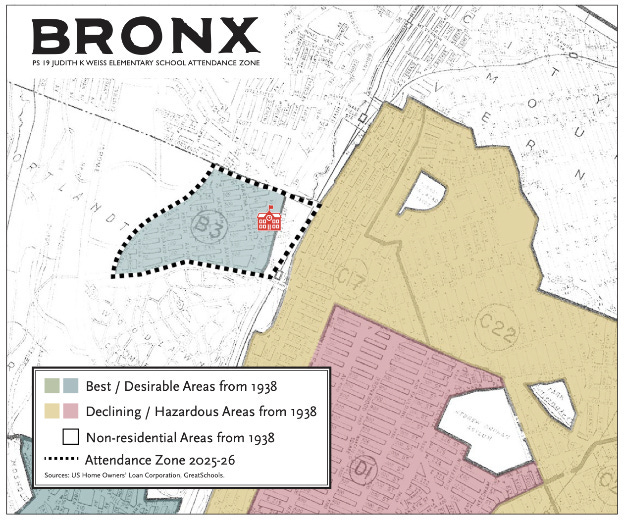
One example listed in the report is in the Bronx, where P.S. 19 Judith Weiss is located less than a mile from P.S. 16 Wakefield. While P.S. 19 has 63% of low-income students and 62% of students at or above reading proficiency, P.S. 16 has 95% of low-income students and 32% of students at or above reading proficiency. Not surprisingly, P.S. 16 enrollment has dropped 47% since 2010, while P.S. 19 enrollment has grown 27% during the same period.
Among the report’s suggestions, two key proposals stand out for NYC: reducing reliance on geography and expanding the number of schools open to all students, such as charters, magnets, and specialized high schools.
Allowing all students within a 3-mile radius to apply and requiring schools to accept them based on capacity would enable more transfers from lower- to higher-performing schools. Redrawing school districts and school zones is long overdue.
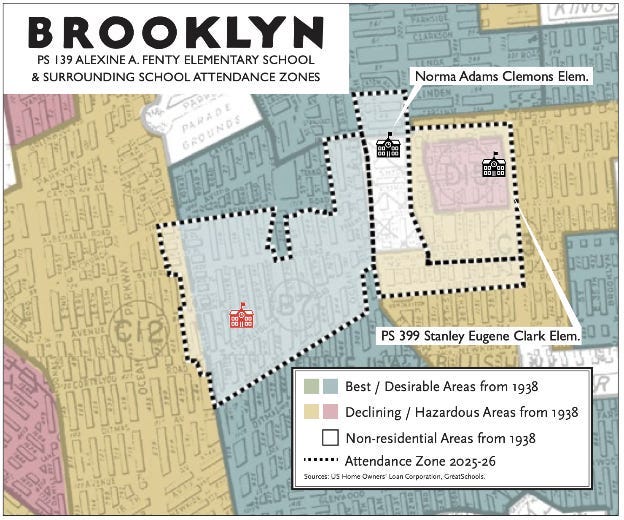
For example, the report shows that P.S. 139 in Brooklyn is located less than a mile from P.S. 309. P.S. 139 has lost 40% of its enrollment since 2010 and could presumably make more seats available to students outside its assignment zone.
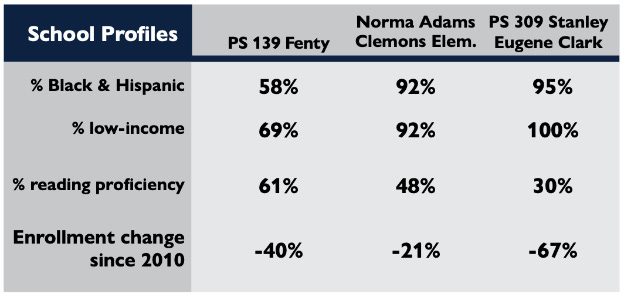
This proposal would likely hasten enrollment declines in low-performing schools and prompt the Department of Education to close under-enrolled schools, such as P.S. 309. Currently, 112 schools in the city have fewer than 150 students. P.S. 309 was projected to have just 170 students this school year, while the other two schools had over 500 each.
Removing the cap on charter schools would enable the expansion of schools that outperform expectations, given their demographics.

Chad Aldeman’s analysis shows that 138 New York schools with high concentrations of low-income students had 90% to 97% third-grade reading proficiency in 2024, compared to the state average of 43%.
Of these, 38.5% are charters, though charters represent only 9.5% of all state schools. Eight of the 10 highest-scoring schools were charters.
Specialized high schools in New York City, the most prestigious in the city, already enroll 55% low-income students. Expanding these schools would allow more low-income students to benefit.
This is especially important in Queens, where 32% of offers go to local students but only 3.2% of specialized high school seats are in the borough.
The city should open another SHSAT school in Queens to reduce long commutes. In March last year, Community Education Council 26 approved a resolution urging this expansion, noting that 4,000 Queens students travel up to two hours to attend specialized schools elsewhere.
The report shows that beyond reforms like open enrollment, New York needs full school choice to enable students in historically segregated areas to access the state’s best education.
Notably, just 1.1 miles from P.S. 16 Wakefield is Bronx Charter School for Excellence 3, with 512 students—96% Black and Hispanic and 80% proficient in reading. Rather than seeking access to another mediocre nearby public school, efforts should focus on expanding schools like Bronx Charter School for Excellence 3, which delivers excellent education to most low-income and minority students.
This report should prompt a state and city dialogue on expanding school choice and supporting top schools serving low-income students and students of color.
Thirty states have adopted this approach; New York should follow.

Thanks, Danyela. We worked hard on this report, and this is a thoughtful response. Just for the record: I don't believe there are any utopian solutions for the problems in our urban schools (including those in NYC).
But I do think that using a child's address to determine what type of school they will attend (thriving or failing) is bad policy that has negatively impacted the schools *and* the housing market.
Plus, I think it's just plain immoral and violates some of the most basic American beliefs. Our country, more than any other, has shown that a kid born on the wrong side of the tracks isn't destined to remain poor or illiterate. Our public schools should reflect that.
Curious if Danyela or or the Available for All folks have read the work of Freddie deBoer.
I won't oversimplify by saying that Freddie is "right" or "wrong". But I will say that anybody considering K-12 equity schemes is compelled to engage with him. Proponents of the idea that simply moving kids around like chess pieces closes racial achievement gaps have a lot of work to do.
In the 70 years since Brown v. Board, we have learned that kids dont learn by osmosis or telekinesis. The problems are far more complex than "put poor black kids in the same room with wealthier whites"
(The commenter Bicker alludes to this issue)
And what is going on with the poor/working class Asian kids who thrive regardless of the purported quality of the neighborhood school?