

New York City’s Penn Station is the ultimate transportation planner’s nightmare, dysfunctional on multiple levels and seemingly impossible to fix. At different times, the city, the states of New Jersey and New York, and the station’s owner, Amtrak, have developed plans to improve the station, only to be defeated by the eternal frustrations of cost, funding, and feasibility. Now, a new report from the Federal Railroad Administration, spearheaded by Amtrak’s special advisor (and former NYC transit chief) Andy Byford, offers a positive path forward.
Penn Station upgrade plans can be broadly divided into two categories: those focusing on the station’s appearance and public space, and those focusing on station operations. Both are important. The original station was one of the nation’s finest public buildings, replaced with a set of dingy, uninspiring underground passageways.
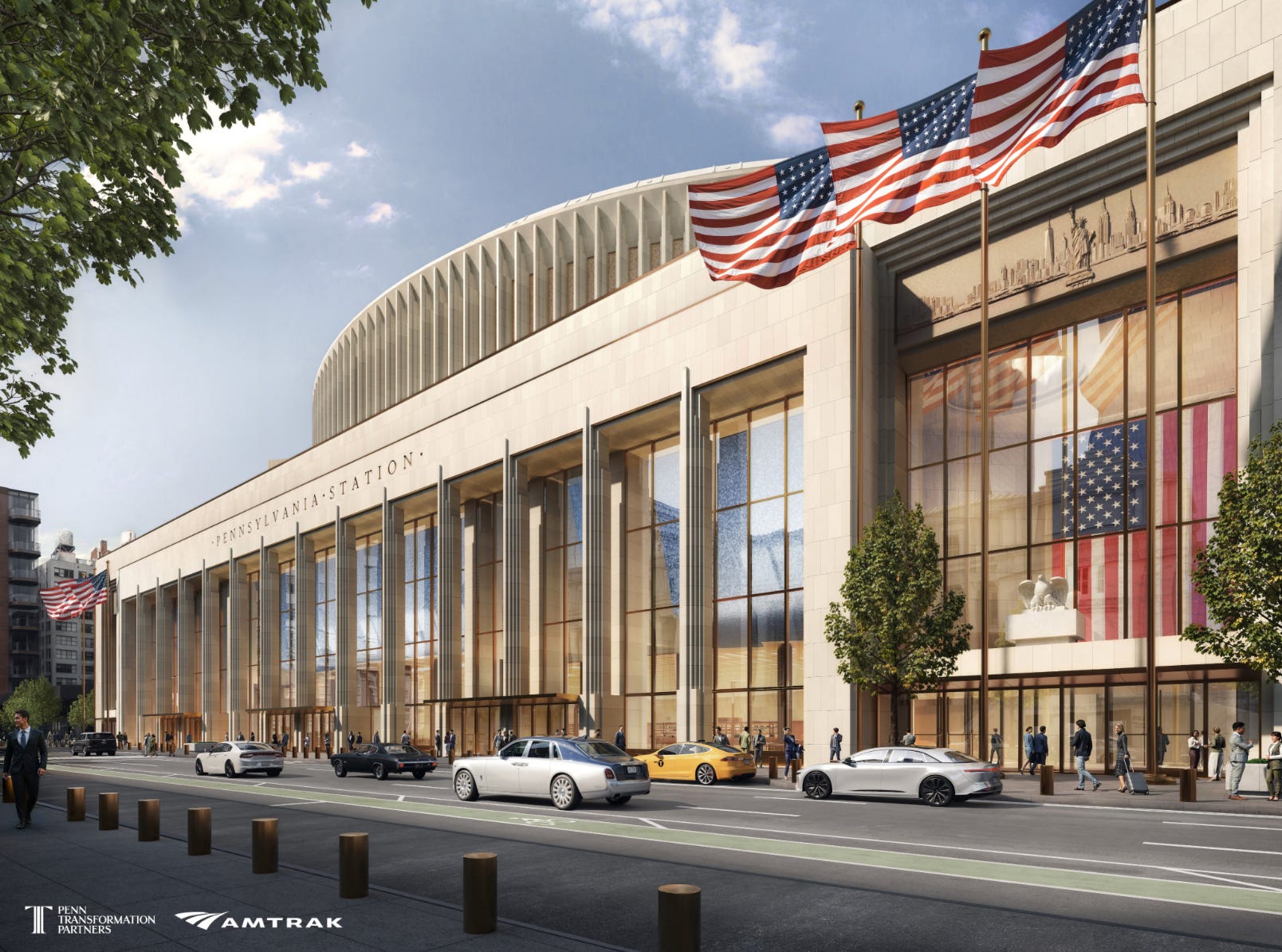
Planners have long sought to recapture a semblance of past splendor; most recently, U.S. Transportation Secretary Sean Duffy and Amtrak announced the designation of a developer who will, among other improvements, “construct a grand entrance on Eighth Avenue to a new train hall” and “replace cramped, decrepit walkways with open, beautiful concourses.”
That ambitious vision awaits clarity on, wait for it, costs, funding, and feasibility. However, when choices invariably need to be made, improving the station’s operations is much more important.
The need for such improvements is long-standing. Penn Station, at its completion in 1910, was operated by one railroad company (the Pennsylvania Railroad or PRR) and functioned primarily as an intercity station. To minimize the acquisition of private land, the station was wedged between the north side of West 33rd Street and the south side of West 31st Street.
Within this 580-foot north-south dimension are 11 platforms and 21 tracks (see Figure 1 below). Because most of the platforms are unusually narrow, compared to a typical big-city railroad station, passengers boarding trains must wait on the level above until departing passengers exit. That increases the “dwell time,” or the amount of time trains spend between arrival and departure.
That problem is exacerbated by the growth of commuter services as the old Pennsylvania Railroad system was carved up among three entities, Amtrak, New York’s MTA and New Jersey Transit.
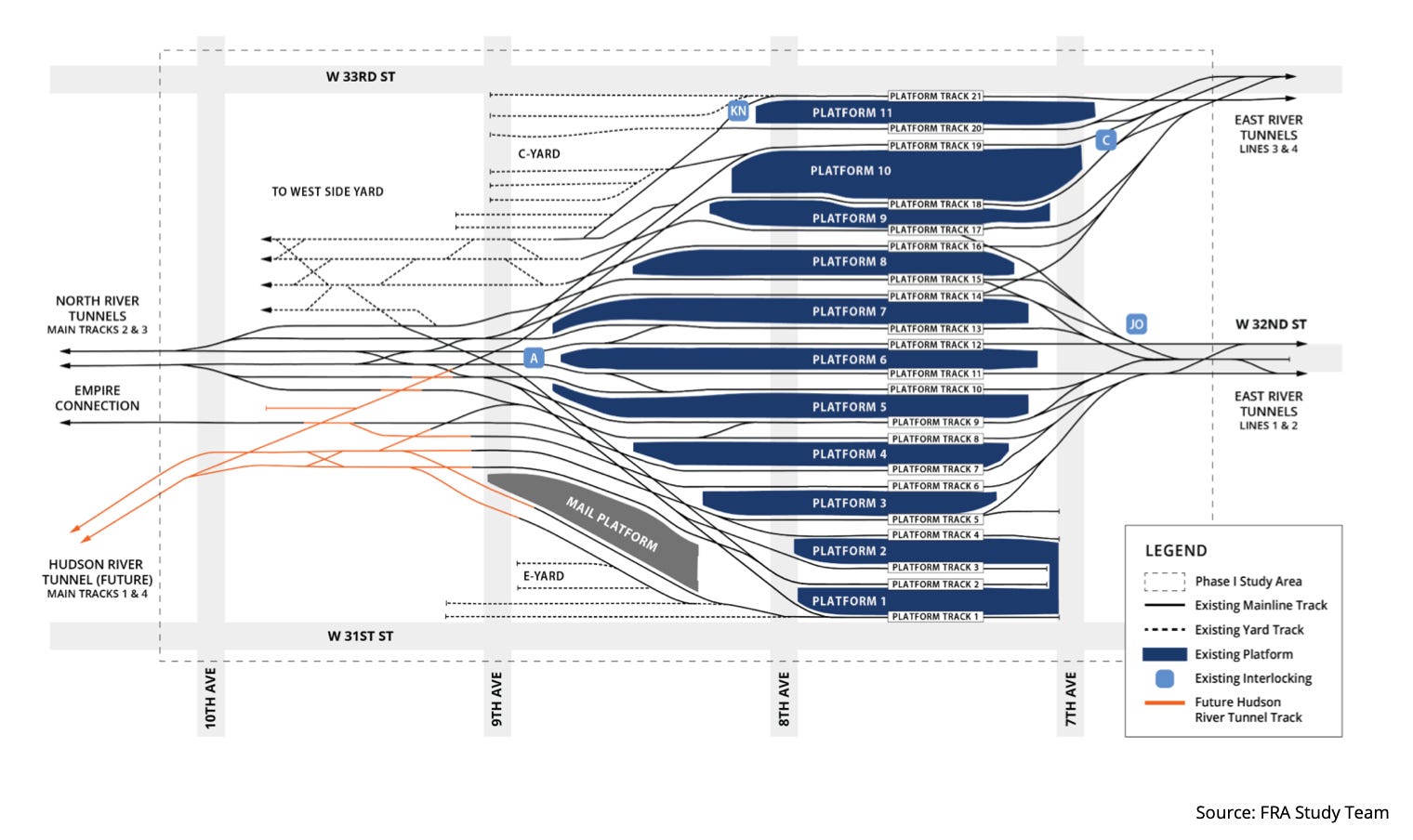
The station is at capacity for service from the west, where only a two-track tunnel crosses the Hudson River. The East River approach, with four tunnels, will be at capacity when new Metro-North service over the Hell Gate Bridge begins in 2030.
The railroads would run more trains at peak times if they could. An opportunity arises with the completion of a new two-track tunnel to New Jersey, expected to be completed by 2035, and the rehabilitation of the existing North (Hudson) River tunnels, to be completed by 2038.
That’s a way off in the future, but Penn Station improvements have long lead times.
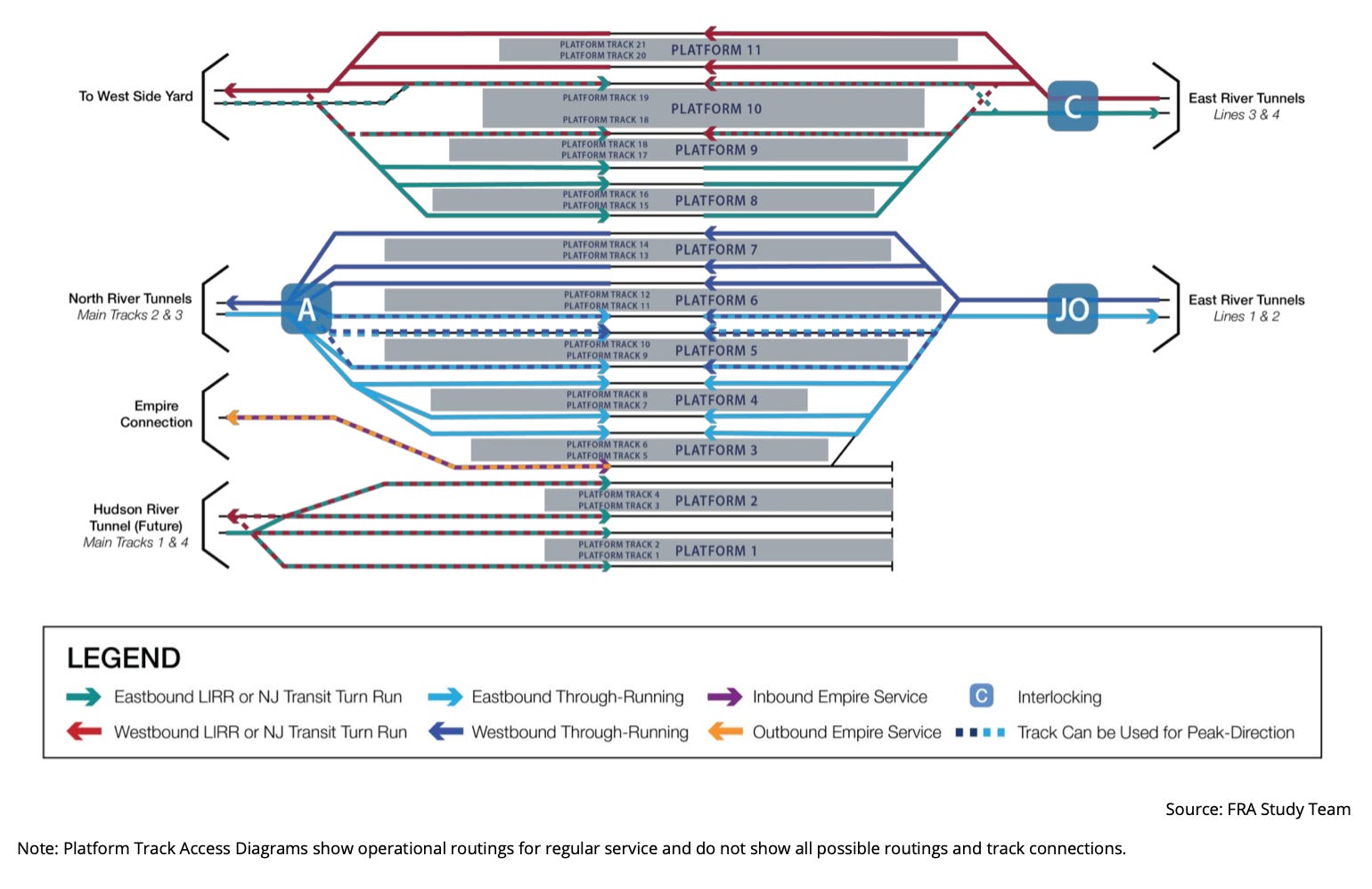
Byford’s team offers two options for the shorter and longer term. The initial Operating Concept 1 (Figure 2 below) would take advantage of the new Hudson River tunnels to simplify traffic patterns within the station. Along with extending the length of the three southernmost platforms, adding more stairs and escalators, and removing pedestrian obstacles on the platforms, that would reduce “dwell time” and allow for more peak-hour service. A longer-term plan would combine two platforms in the center into one, much wider platform.
The new proposals represent a move away from an older Amtrak plan that would have expanded the station to the south to provide capacity for additional service. That plan was first proposed in 2011, as a component of the Gateway program, a series of service improvements between Newark and New York Penn Station.
The Penn South expansion would have constructed new platforms on the city block south of the existing station, bounded by Seventh and Eighth Avenues and West 30th and 31st Streets, known as Block 780. Additionally, it would have included the lots fronting on the east side of Seventh Avenue opposite Block 780, and a portion of the block on the west side of Eighth Avenue (see Figure 3 below).

Penn Station South was never going to happen. It involved the acquisition of substantial residential and commercial real estate at a prohibitive financial and political cost. However, Amtrak’s interest and the misguided support of elected officials placed a cloud over the area. The city has for years maintained obsolete manufacturing zoning that prohibits new housing in an area of high demand.
At a public meeting in Manhattan on July 14, Byford remarked, “ It would’ve been immoral to tear down a vibrant block of New York City before we had properly evaluated how to extract every ounce of additional capacity out of Penn’s existing footprint.” Now that his team has presented a credible plan to do that, one hopes that the development potential of this area can be unlocked.
While a big step forward for practical planning, the Byford team’s proposal has a long way to go. Future steps include getting buy-in from the commuter railroads and the New Jersey and New York governors, and developing cost estimates, an operating plan for expanded train service, and a financing scheme.
The report asserts that the plan offers increased opportunity for “through-running” — commuter service that carries passengers through Penn Station, rather than terminating there as New Jersey Transit and Long Island Rail Road trains do currently.
While theoretically more operationally efficient, through-running presents operational, financial, and labor issues and has long been seenby the railroads and some transit wonks as impractical.
Long-suffering commuters will yet wait a while for relief. However, Byford and his team have performed an important service by focusing on track-level improvements that are both practical and can be phased in as resources become available. Just as important is focusing away from a pie-in-the-sky scheme that has for years paralyzed real estate investment unnecessarily.

The only good thing about Penn Station is that it's only 12 blocks from Rudy's.