

This summer, New York City told the parents of more than 150,000 children that they aren't proficient in English. Most have few options for doing anything about it. Gov. Kathy Hochul can change that.
Gov. Hochul has yet to formally decide whether New York will opt into the new Federal Tax Credit for Scholarships. This is an up to $1,700 dollar-for-dollar tax credit for qualified contributions to scholarship-granting organizations, which families can apply to for scholarships covering tuition as well as tutoring and other education related expenses for children in elementary and secondary schools, including public school students.
Tutoring is exactly what the New York Times writer Nikole Hannah-Jones turned to—according to her much-discussed essay—once she realized just how far behind in school her daughter was. Few of the public school children who fail proficiency tests have that opportunity, and this tax credit could help to start to fix that.
The problem
New York has been testing and identifying children who fall behind in English and math as early as third grade, and it knows that there is a problem—last school year, just 44% of 3rd-graders were proficient in English and 61% in math1. The problem is not a lack of information; it is a lack of accountability at the city’s schools, and a lack of parental ability to do much about it.
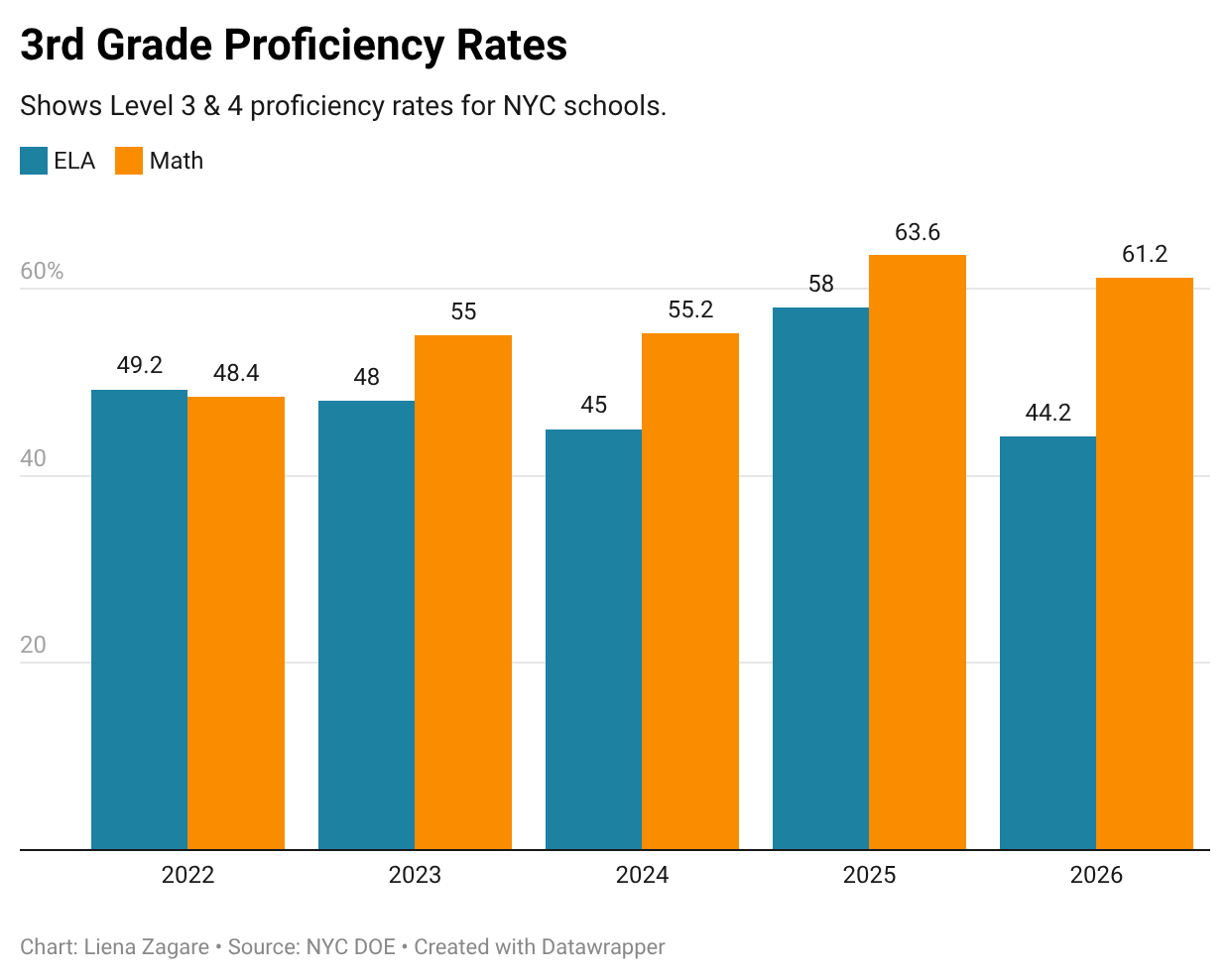
Many parents exercise choice when they can, moving their children into better-performing schools.
Entrance to the city’s screened schools is competitive. The city’s charter school networks have been growing and now educate about 16% of all public school students, many with superior results; however, their expansion is capped by the state, and seats are allocated by lottery. Parochial and private schools are often out of reach financially.
But too many parents have little choice. Even when they know their child is not doing well, or could be more challenged, there are few options open to them– 75% of public school students are classified as low income by the city, and parents themselves may not be in a position to help academically.
What the data shows
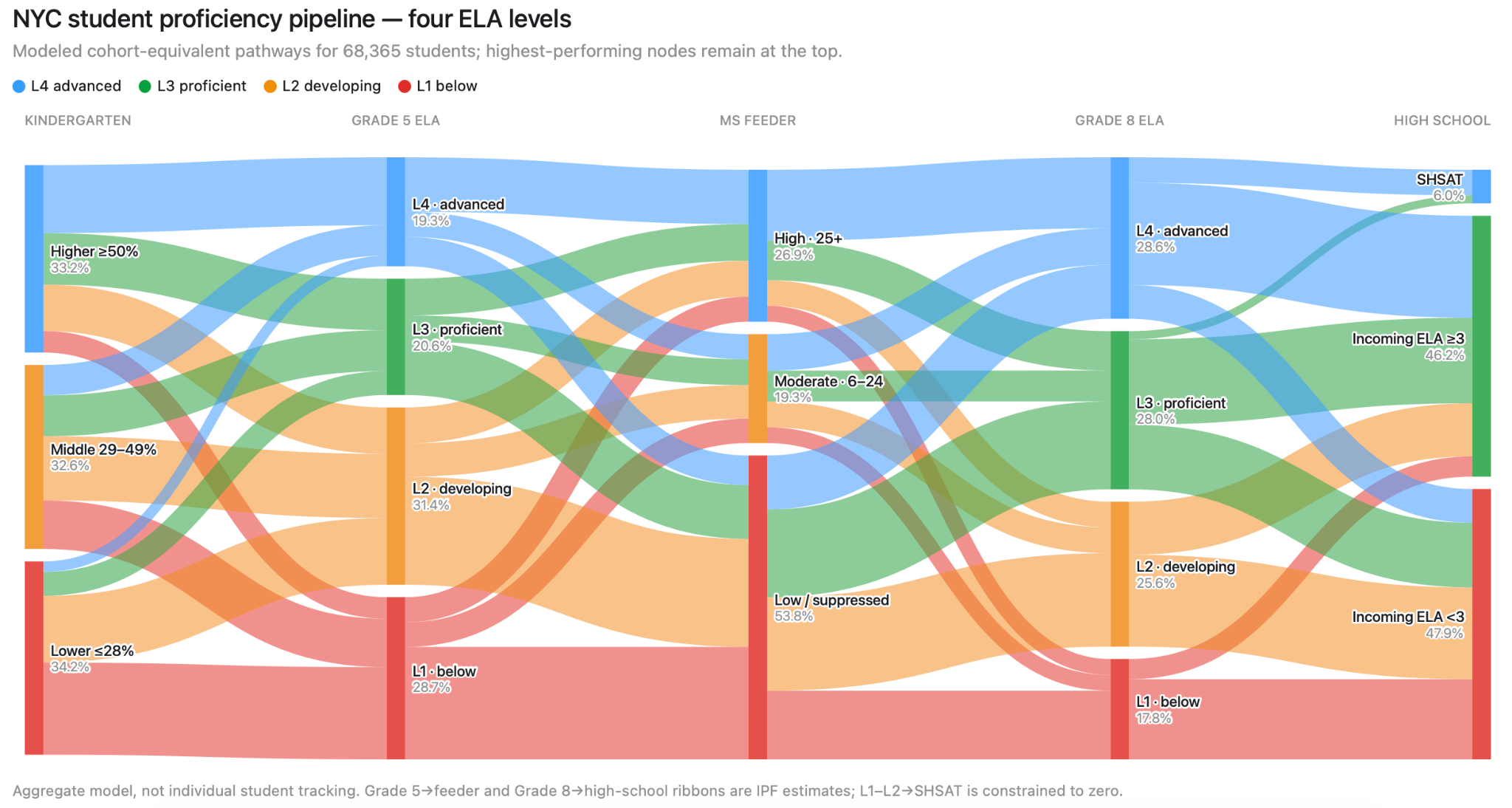
Citywide modeling of a single kindergarten cohort 2016-172 shows that children attend starkly different public schools from day one. At one third of the elementary schools, most children—64%—were proficient in English by the time they graduated 5th grade. At the rest, most were not, and at the bottom third—just 18% of students were.
In NYC, most students apply separately to middle and high schools; the best-performing schools screen students academically or through other aptitude tests. Children who fail proficiency tests in elementary school are set up to struggle thereafter, leaving many of them woefully unprepared for life after high school.
Looking at that 2016-17 kindergarten cohort, the elementary school Ms. Hannah-Jones sent her daughter to, P.S. 307 in Brooklyn, was among the worst performers. It tested 32 5th graders in 2022, and 75% scored in the lowest proficiency band—Level 1—in English. Only 3 students tested proficient. At Urban Assembly Unison School, where her daughter attended middle school, only 37% of its 8th graders, from that same cohort, were proficient in English in 2025, compared with 56% citywide.3
Looking at high schools, 55% of the city's traditional public high schools, which enroll nearly 100,000 students, or about 38% of the total, averaged below 65 on their Regents exams in 2025, by my calculations4. 65 is considered a passing score on an individual Regents exam. Small non-charter non-screened high schools had the worst scores5, and these small schools are concentrated largely in predominantly Black and Hispanic neighborhoods, in Central Brooklyn (Districts 16, 17, 18, 19) and the South Bronx (Districts 8 and 12).
New York’s decision to drop the (already watered-down) Regents diploma requirement starting with the class of 2028 may help graduate more students, but does not fix any of this and will only make it harder to see how the city yet again has failed to educate too many of its children to a very basic proficiency level.
To opt in or not?
The UFT, along with NYSUT, the AFT, the state AFL-CIO and the NAACP’s New York chapter held a press conference earlier this month urging Hochul to opt out of this tax credit, arguing that it is just another voucher scheme and that opting in would take money away from public schools. It is unlikely to: the credit is federal, and no state or city education dollars are involved.
Among those in favor of opting in are school-choice advocates and charter schools, along with the Robin Hood Foundation, United Way of NYC, the New York Immigration Coalition and other anti-poverty organizations.
“We recognize this is a complicated program, and we share the concerns that have been raised about its design,” a coalition of 37 anti-poverty, community and charter school groups wrote in a letter to Gov. Hochul. “But we believe New York can shape its participation in ways that meaningfully benefit public school students.”
Gov. Hochul has indicated she plans to opt in, pending final guidance on rules. She is right to.
Scholarships won't replace public education in a city where private school tuition can be upwards of $70,000, but they should hopefully give some power back to the parents of children the school system is currently failing and who have little recourse.
There are many ways to improve New York’s public schools, as my colleagues have written in numerous research reports and briefs, from consolidating schools, to addressing student discipline and attendance issues, to reforming special education. What it comes down to is this: we need high expectations, real consequences, and accountability all around. We need to be willing and able to make hard decisions as well as reward excellence.
Opting in to receive the tax credit won’t fix public schools, but it may give more parents the same opportunity wealthier families already exercise: the ability to get their child help when there is a problem, rather than wait and keep trusting an institution that has had every opportunity—and tens of billions of dollars a year—to fix this, and has not.
Grade 3 results for New York City public schools, excluding charter schools. NYC Public Schools, Results on the New York State ELA and Mathematics Exams, Grades 3–8, 2018–2026 (Citywide), infohub.nyced.org.
The 2016-17 kindergarten cohort is the most recent for which relevant test results were available due to pandemic disruptions. Middle schools are grouped by the number each sends to schools that require passing SHSAT.
This data is for the cohort of kindergarteners that started school in 2016-17 I had been modeling, not the years Ms. Hannah-Jones’ daughter may have attended them.
Calculated as weighted averages of the Regents scores reported by each school in NYC Public Schools, 2024–25 School Quality Reports: Citywide Results (High School), infohub.nyced.org.
Students can apply to any high school in the city; the geographic distribution in the chart is of schools, not the residences of their students.