

Mayor Zohran Mamdani’s new $67.5 million Pre-K special education expansion is a welcome development in New York City special education policy. For the first time, the city is bringing specialized programs—Nest, Horizon, AIMS, PATH, and ACES— into 26 schools across 14 districts to serve 250 students starting this fall, while adding hundreds of new staff members, including 10 new preschool evaluation teams.
Building in-house evaluation teams rather than continuing to rely on outside agencies is something I recommended in a Manhattan Institute brief earlier this year. This investment is a step in the right direction, but it is a long way from solving the special education crisis facing the city.
The High Cost of Mandated Spending
New York City spent $1.3 billion on due-process claims in fiscal year 2025. These are commonly called “Carter cases,” after the Supreme Court decision affirming that when a school district fails to provide a free appropriate public education, families may seek payment for private school tuition and, increasingly in New York, for privately obtained services.
In 2005, these cases cost the city $47 million. Even with the savings projected in the mayor’s budget, the city expects to spend nearly $1.4 billion next year.
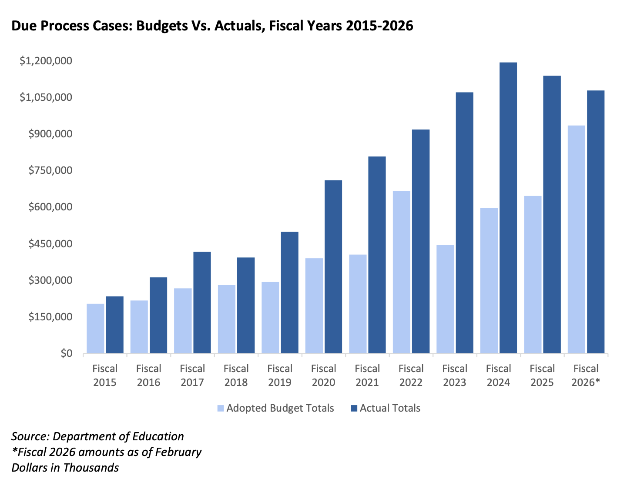
When Mayor Mamdani first revealed a $5.4 billion budget gap, his administration identified due-process spending as one of the major drivers of the shortfall. The average settlement in 2025 was $101,757 per student—roughly three times what the city spends on a general education student.
Explosion of Carter Cases
In 2024, New York State recorded 517 due-process filings per 10,000 students. New York City accounted for 98 percent of those filings. Since 2014, the city’s filing rate has risen from 106 per 10,000 students to 517—an increase of 384 percent.
To understand why so many families end up in due process, we need to look before kindergarten.
As the city rolled out Pre-K for All in 2014 and 3-K for All in 2017, tens of thousands of preschoolers in need of Individual Education Plans (IEPs) were identified. In 2024-2025, of the 94,537 3-K and Pre-K students, 31,945 received special education services—34% of all enrolled.
The city never built the public capacity to serve them.
Instead, preschool special education has operated almost entirely through private providers. Children with disabilities begin their education in small, specialized private classrooms. At age five, they are offered a DOE kindergarten placement that often looks very different, often with larger classrooms and less individualized support.
Between 2013 and 2025, the share of all public-school students identified with disabilities rose from 139 to 242 per 1,000 students—a 74 percent increase—even as overall enrollment fell by roughly 340,000 students. Nearly one in four public school students now has an IEP, and the numbers continue to rise. New special education recommendations increased by 55 percent between 2024 and 2025.
Many families respond to the lack of public capacity to provide special education services by filing due process claims to remain in private settings or continue receiving privately provided services.
Cost Drivers: Geographic Mismatch & Automatic Renewals
The mayor’s financial plan assumes $149 million in reduced Carter spending by serving families who would otherwise seek private placements.
But the geography of this latest expansion suggests otherwise.
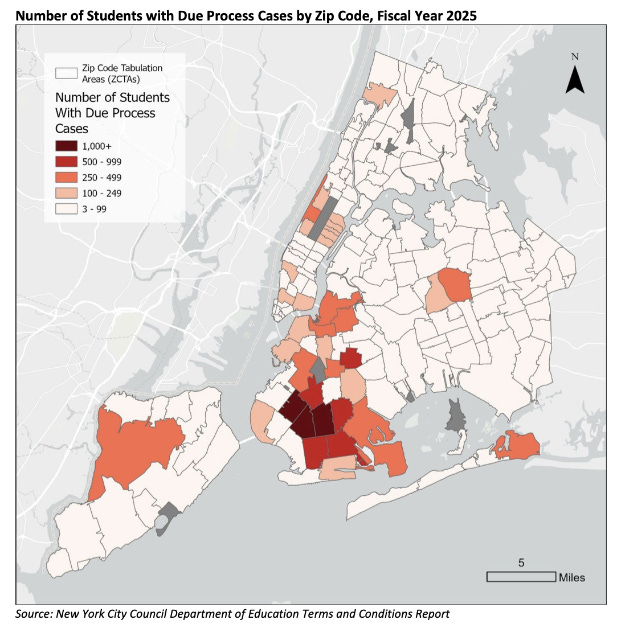
Of the 20,051 due-process cases settled last fiscal year, 65 percent involved white students, who make up just 16 percent of public school enrollment. Eight zip codes, all in central and southern Brooklyn, accounted for 44 percent of all cases.
The expansion adds special education programs at only two schools across those 8 zip codes. The remaining 24 schools are in neighborhoods that have historically generated few to no Carter Cases, meaning the savings the budget assumes are unlikely to materialize.
Under Mayor de Blasio, the city began routinely renewing many of Carter case settlements from year to year without determining whether public schools could now appropriately serve the child.
The growth in Carter cases is unlikely to reduce without addressing the structural issues.
Three Barriers to Fixing NYC Special Education
While expanding preschool special education seats is a positive step, the system relies on models unproven in early childhood, fails to guarantee that children actually receive their legally mandated services, and leaves the underlying drivers of over-classification and rising costs unaddressed.
Programs used are unproven at the preschool level.
The city has highlighted impressive outcomes, including that 97 percent of Nest and Horizon students graduate from high school. But these figures do not come from rigorous evaluations of the programs themselves. They tell us that students admitted to the programs did well, not necessarily that the programs caused those outcomes.
Nor have these models ever operated in Pre-K. What works in K-12 does not automatically work in preschool. The city should commit now to publishing preschool-specific outcome data beginning with the first year of implementation.
Seats are not services.
To its credit, the city has opened more than 800 new preschool special education classes and testified this winter that the seat waitlist had been eliminated. This latest announcement also places programs in neighborhoods where children have long lacked nearby options; fourteen of the twenty-six new schools are in the Bronx.
But classrooms alone do not ensure that children receive the services required by law. Today, only 63 percent of preschoolers with disabilities receive all of the services required by their Individualized Education Programs.
The expansion does not address the underlying drivers of growth in special education or in Carter case spending.
A 74 percent increase in disability identification warrants scrutiny because each new classification entails legally mandated services the city has already demonstrated it cannot consistently provide.
Most states use tiered intervention systems in preschool, providing support within general education classrooms and monitoring children’s progress before referring them for special education evaluation.
New York City’s preschool system, built largely around private providers, has no comparable step. Identification moves almost directly from concern to evaluation and classification. The city needs to make sure it is classifying children accurately.
Federal law also requires annual reviews of student placements. The city largely stopped conducting meaningful reviews of Carter case placements a decade ago and should resume them.
The city deserves credit for investing in public special education capacity, but should ultimately be judged not by how many classrooms it opens or how many staff it hires, but by whether it addresses the structural problems that made it necessary in the first place.
