

Government expenses are expected to grow 4.5% annually over the next few years; city revenues, meanwhile, are projected to grow only 2%, assuming no economic setbacks from a bad year on Wall Street or broader instability. The compounding gap between those two figures means budget shortfalls will only grow.
To balance the books, the City has two options: raise revenue or cut expenses.
Raising revenue means either growing the tax base — desirable but slow — or increasing taxes, which requires Albany’s blessing for income taxes (unlikely) and is deeply unpopular for property taxes.
Increasing the tax base is the most desirable course of action as it grows the economic pie for all involved. Unfortunately, it is also one of the more difficult levers for the City government to control, as it relies on complex economic conditions at the city, state, and federal levels. I proposed some policies the Mamdani administration could pursue in this post, but even if the City follows through on them, it will take years for the effects to translate to City revenues at scale.

That leaves cutting expenses as the most immediate lever available. To that end and to his credit, Mayor Mamdani created Chief Savings Officers (CSOs) at every City agency, tasked with finding savings. Their plans came due on March 20. Here’s what we know so far.
The Mayor’s Strategy: Chief Savings Officers
The CSOs were tasked with identifying 1.5% in savings for 2026 and 2.5% for 2027 and beyond. The total came in at over $1.7 billion — right around 1.47% of the $116B FY26 adopted budget.
What the Mayor’s Office has shared publicly is far less: an “initial list of approved items” across 16 agencies totaling about $250 million over FY26 and FY27. The gap between $1.7B identified and $250M released raises questions worth examining — about what’s in the approved items, and about whether agency-identified savings alone can close a budget gap that keeps widening.
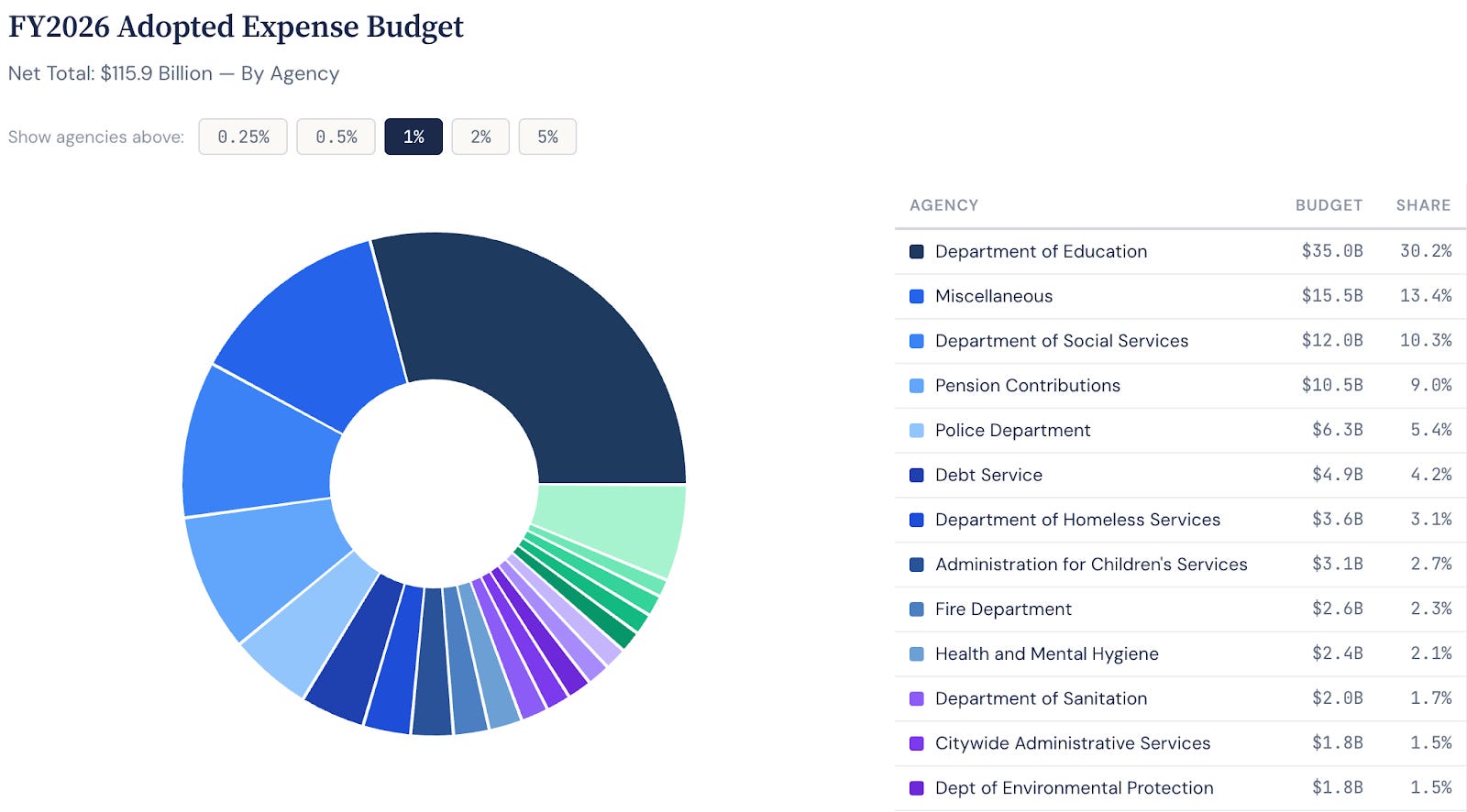
What we know about the CSO reports so far
I’ll use this “initial list of approved items” in my analysis below.
To put the CSO actions in context, I compared them to the relevant agency’s FY25 accepted budget. For each agency, the % of FY25 budget calculation is:
- FY27 savings ÷ FY25 budget (for agencies that have FY27 savings)
- FY26 savings ÷ FY25 budget (for agencies that only have FY26 savings – e.g., DOC, MONS)
The logic here is that FY27 is potentially more of a “steady state” ongoing savings target (of 2.5%), so it’s the more meaningful denominator year to benchmark against. For agencies with no FY27 figure, FY26 is used as the only available data point.
Given all that, here are the released savings by agency, sorted by largest savings for FY27:
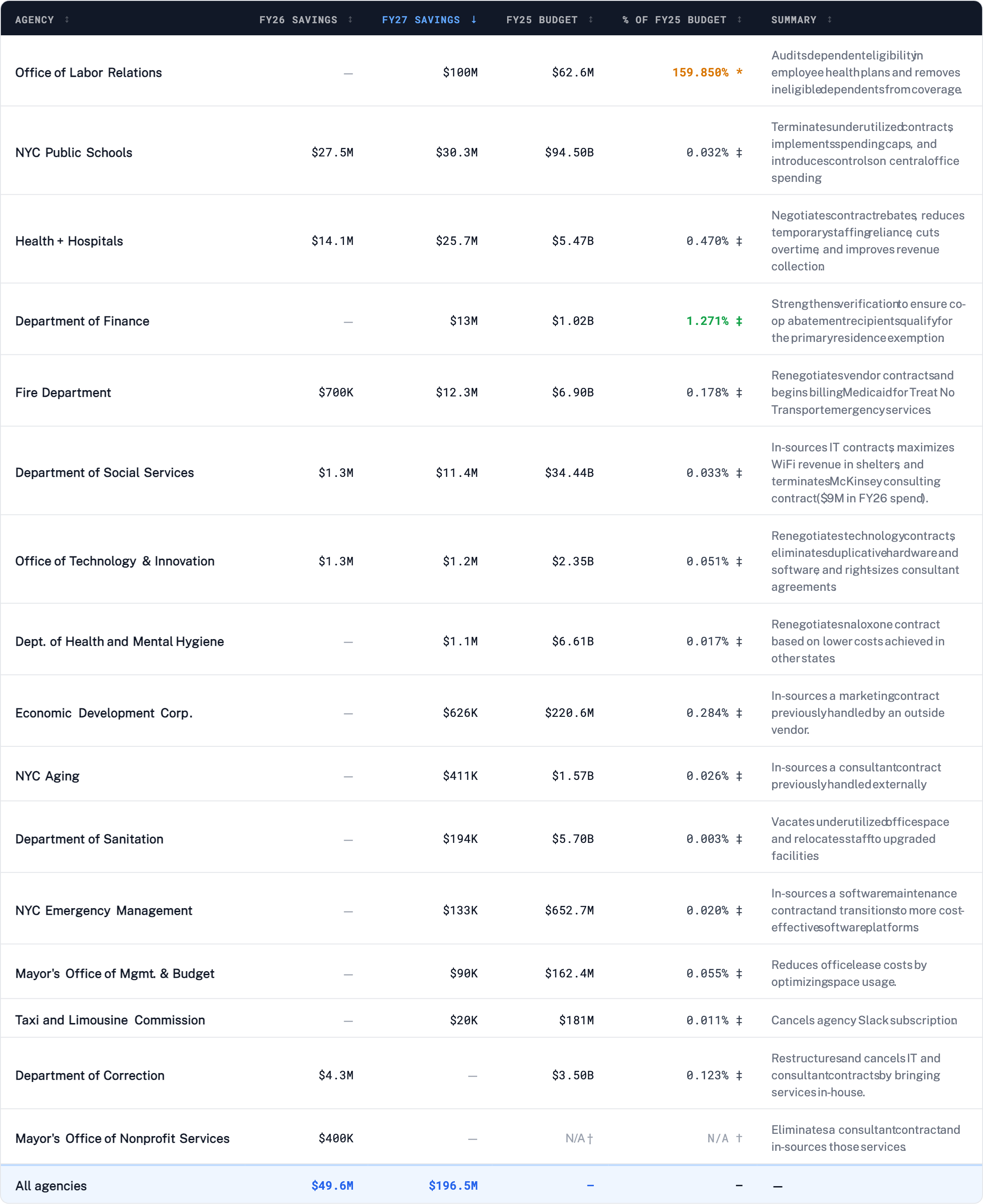
The Office of Labor Relations (OLR) dominates. A single administrative action — a $100M audit removing ineligible dependents from employee health plans — accounts for roughly 51% of total FY27 savings in the Mayor’s announcement. This one item, from a tiny agency, dwarfs everything else on the list.
The Department of Finance (DOF) has the most substantive savings relative to its own size, at 1.27% of its FY25 budget. Its single savings item — strengthening verification for the primary residence co-op abatement — would on its own get DOF nearly to its FY26 savings target.
Most other agencies’ savings are well under 0.1% of their budgets. The savings announced for MONS, NYCEM, TLC, OMB, and DSNY are effectively symbolic. If the released items represent the largest savings for those agencies, they risk falling far short of the 2.5% FY27 target.
What the savings items tell us about priorities
A majority of the announced savings involve contract renegotiations and bringing contracted work in-house, which aligns with a growing literature on excessive procurement costs in government. These are opportunities for NYC to both achieve cost savings and improve service delivery.
Agencies canceling contracts to bring services in-house include the Department of Corrections, the Department of Social Services, the Economic Development Corporation, the Mayor’s Office of Nonprofit Services, NYC Aging, and NYC Emergency Management. The Office of Technology and Innovation, Health + Hospitals, and the Fire Department all mention negotiating contracts. New York City Public Schools will terminate underutilized contracts and implement spending caps, the latter saving over $30 million in FY27 alone. Moving from outside vendors to agency personnel can reduce costs and build institutional capacity over time.
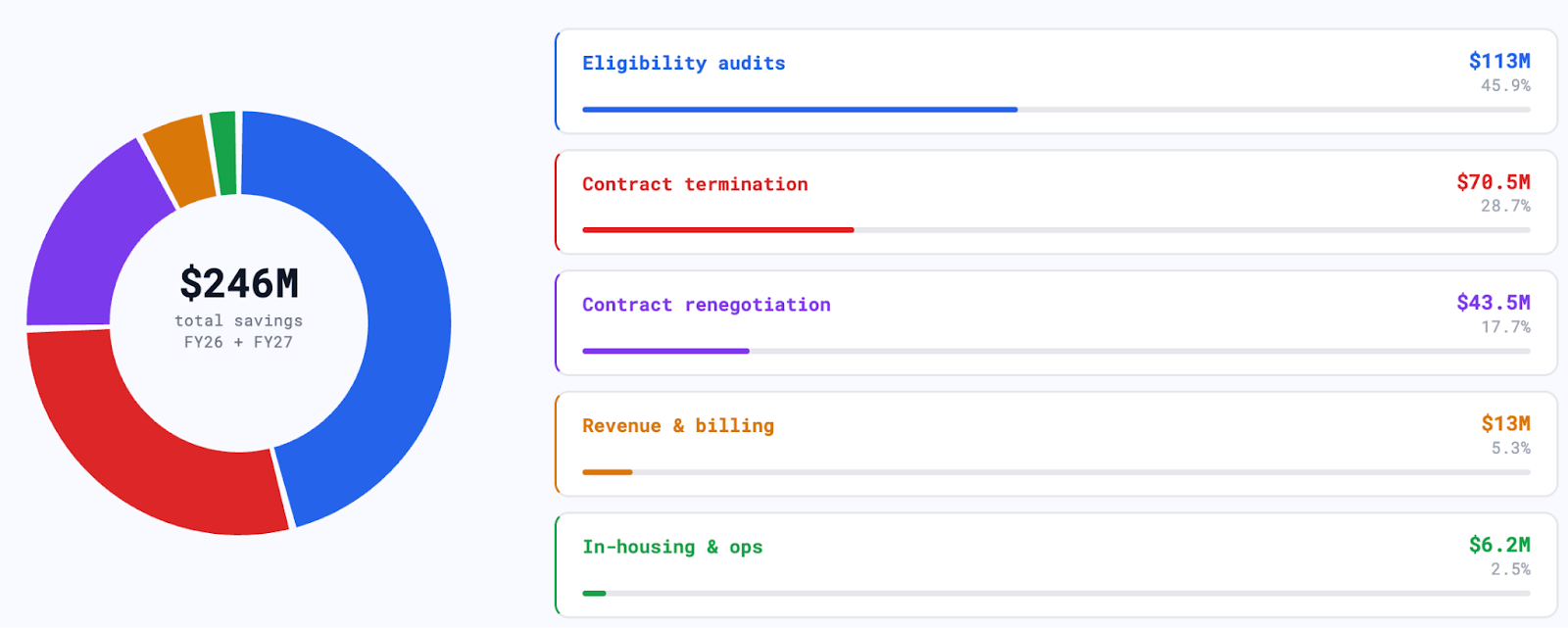
These canceled contracts and moves to in-house services also raise some questions, however. Will the agencies taking on additional in-house work be hiring new employees to manage these new tasks? If so, that may reduce some of the headline numbers from the canceled contracts. It also raises worries about whether these agencies have the ability to hire the needed talent on reasonable timelines, given the myriad difficulties with hiring at the City level. Civil service reform could go a long way toward improving the ability of NYC agencies to bring more services in-house.
The announcement is full of other goodies and common-sense savings measures, from improvements in revenue collection to reductions in office lease costs. There are also some items mentioned that seem to hold deeper stories, such as the Department of Social Services canceling a McKinsey contract worth $9 million in FY26, and the Taxi and Limousine Commission (TLC) canceling its Slack subscription, saving the agency $20,000 in FY27. I’m sure, like me, many are wondering what the TLC will be using for in-office communications now, and why they were singled out for their Slack usage!
How the CSO items compare to other savings options
I previously examined a set of budget options identified by the IBO. Even among options entirely within City control — changing the employee health insurance contribution, eliminating longevity payments, enforcing facade inspection penalties (which Mayor Mamdani is making progress on!) — the independently identified savings are significantly larger than the savings agencies have surfaced publicly.
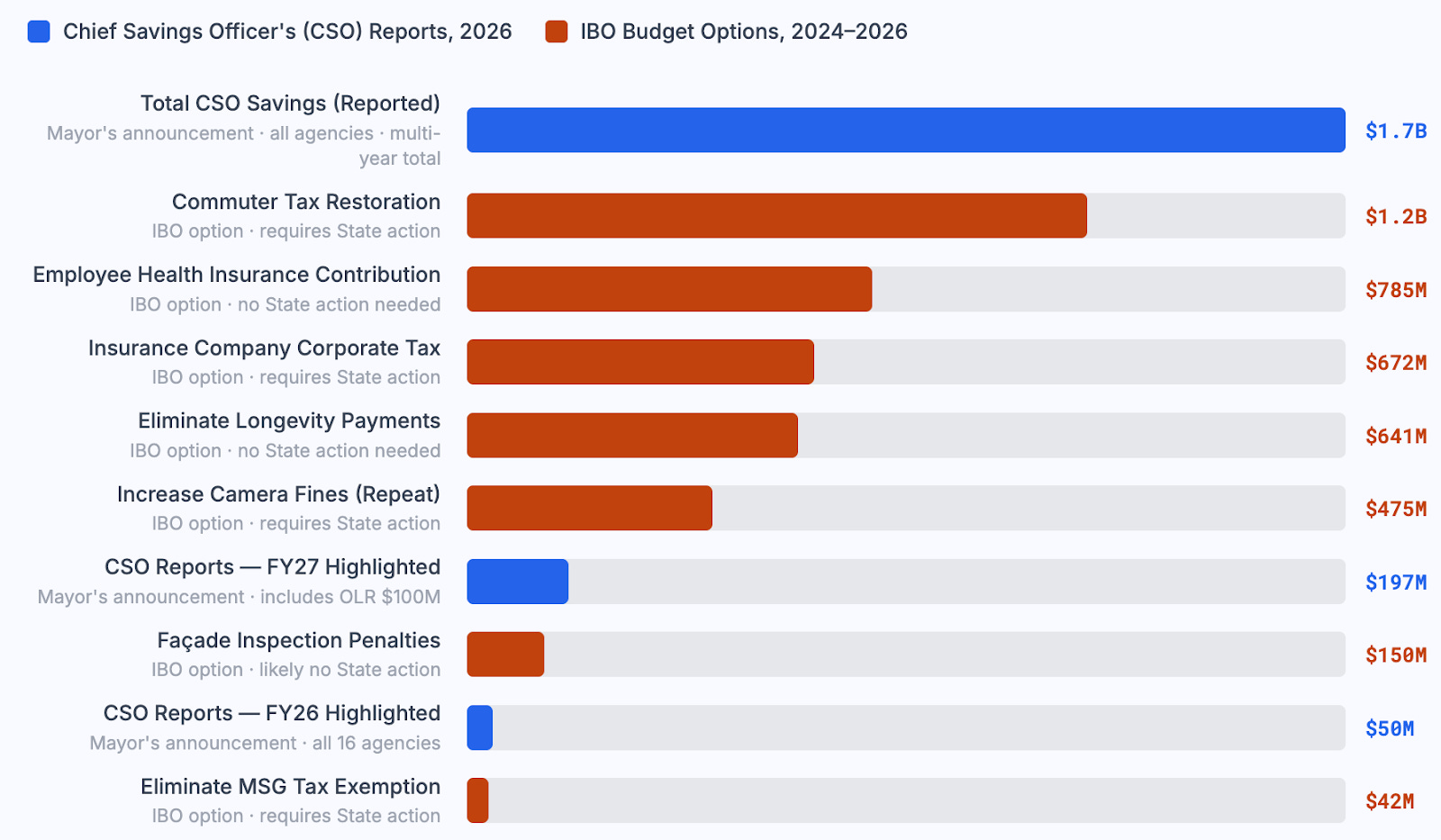
Of course, IBO options involve Citywide policies, and certain actions require State approval; agencies can only recommend actions within their own domains. We also don’t know what was identified but not approved or released — the gap between $1.7B and $250M suggests there’s much more to the story.
Is it enough?
Facing a budget gap growing into the billions in upcoming years and with tax increases remaining uncertain, City agencies and the Mamdani administration may have to get more creative.
Even if CSO recommendations address short-term gaps, it will become increasingly difficult to find easy savings opportunities in subsequent years through contract renegotiations and cancellations. To sustainably balance the budget, a fiscally responsible administration will need to expand the scope or increase the avenues for savings.
And that’s assuming that costs can continue to be cut. Upcoming labor negotiations with the City’s many public sector unions will be a battle. Many of the savings options identified by both CSOs and the IBO involve cuts, restrictions, or caps on benefits for public sector workers. Regardless of how justifiable such reductions are, it seems likely that union leaders will protest them or demand more elsewhere in return for savings, such as cuts to health insurance subsidies or longevity payments.
At the same time, City-funded programs like CityFHEPS and State mandates like classroom sizes are adding billions in new expenses. Recent reporting indicates that the majority of savings would come from delaying the State’s class-size mandate and reducing the City’s rental assistance program.
Both these actions would cut against the commitments Mamdani made to the constituencies he ran on. Delaying the class size law pushes costs forward without resolving them, and while scaling back CityFHEPS is a real efficiency, it means fewer low-income New Yorkers get help paying rent.
To avoid these unhappy decisions, NYC must pursue consistent revenue-generating policies, such as attracting middle- and high-income workers and incentivizing housing production, to expand the base of taxable residents. A lack of good jobs or affordable homes will both prevent new residents from moving here and continue forcing current residents to seek out more affordable cities elsewhere.
Only through these strategies can future administrations be saved from cycling through tough budget choices year after year. The CSO initiative is a good start on closing the budget gap, but more expansive action will be needed for NYC to have sustainable, balanced budgets.ᐧ
