

The late-summer housing news is a new report from NYC Mayor Zohran Mamdani’s administration, setting a very ambitious goal of producing 700,000 new housing units over a decade to remediate the city’s severe housing supply shortage. The report, a draft “Fair Housing Growth Strategy” required by a 2023 local law, also sets out five-year housing goals by community district.
The targets are non-binding, and the report discusses the path to achieving those goals only in general terms, avoiding discussion of specific locations for new housing or the changes in zoning and other regulations necessary to achieve so many new units.
As a point of comparison, in the first six months of 2026, following significant pro-housing zoning changes enacted in the term of Mamdani’s predecessor, Eric Adams, New York City issued building permits for 14,714 new housing units, or just under 30,000 on an annualized basis. That’s a strong pace for the city by recent historical standards, but only a fraction of the annual average NYC would need to hit the target of 700,000 over ten years.
New York City did exceed 70,000 new units permitted in 2022, but that was a consequence of the expiration of the Section 421-a real estate tax exemption program; many years’ construction was brought forward to vest tax benefits.
NYC has long found that the best way to boost housing production is to take benefits away from housing developers. Unfortunately, such boosts are temporary, and housing production subsequently plummets. The prior 421-a expiration, in 2015, also led to a burst in permits, exceeding 60,000 in that year. Going further back in time, the “grace period” in which developments with permits under the pre-1961 zoning could complete construction after the far more restrictive 1961 zoning went into effect also supercharged housing construction.
To get 70,000 new units a year permitted consistently for a decade, or even a large increment over current production, would require that the city maintain a welcoming environment for investment in new housing, rather than periodically offering the last chance to build at a profit for years to come. We are far from that goal.
The Politics of Zoning
The main culprit is zoning. Back in 1961, with the city in decline and the suburbs booming, NYC instituted an entirely new Zoning Resolution. Based on a pessimistic view of the city’s future, the 1961 zoning allowed far less housing growth than the old zoning it replaced.
When the city’s economy recovered from the fiscal crisis of the 1970’s and the population began growing to new record levels, the 1961 zoning proved woefully inadequate. City planners have tried, with some success, to build the political consensus necessary to change the rules to allow more housing growth. Nonetheless, the draft fair housing strategy report indicates that on a community district basis, housing growth is strikingly uneven. As shown in the graphic below, “low growth” areas are found around the periphery of the city, as well as in some affluent parts of Manhattan.
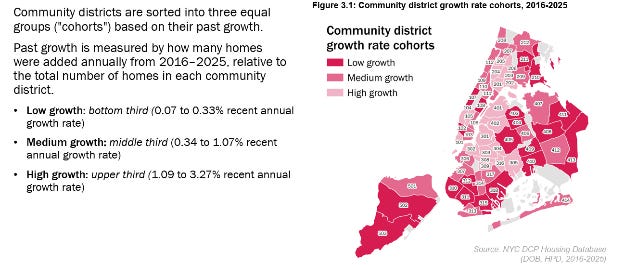
The maps comparing high- and low-growth areas have a lot of overlap with the maps depicting areas that supported Mamdani and those voting for his principal challenger, Andrew Cuomo, in the 2025 mayoral election. Mamdani drew his support mostly from high-growth areas; that growth had produced changes to the demographic composition of the city’s electorate that worked in his favor, in particular the influx of college-educated young adults to growing areas in northern Brooklyn and western Queens.
Mamdani’s lack of political support in many low-growth areas combines with 2025 amendments to the City Charter to give him an opportunity to facilitate large amounts of housing growth.
By October 1, the Department of City Planning will designate the twelve community districts where the “Affordable Housing Fast Track,” a truncated zoning approval process cutting out the City Council, will apply for zoning changes facilitating mixed-income housing.
The designation is based on recent relative levels of affordable housing production, not overall housing production. However, an analysis using preliminary data by NYU’s Furman Center found that the likely qualifying community districts are, except for Manhattan Community District 5 south of Central Park, also low-growth areas using the city’s criteria (see map below).
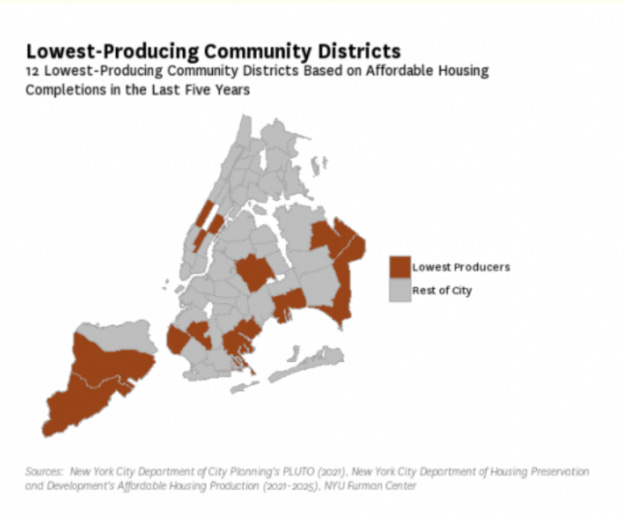
The Affordable Housing Fast Track means that, in the low-density districts, the administration could effectuate, very quickly, zoning changes that could substantially change land use and result in significant increments of new housing. It would be harder in the Manhattan community districts; these areas are already dense, and there are few potential development sites. Building more mixed-income housing would require other changes that are not likely given current politics.
But the Affordable Housing Fast Track is not the only pro-housing-growth charter change.
In other community districts with low-density zoning, the city can apply a similar fast-track process, also cutting out the city council, to allow new housing up to four stories in height. There is also, throughout the city, a Fast Track Zoning Action where the Board of Standards and Appeals (BSA) can grant zoning modifications for 100 percent affordable housing, also without need for the council’s approval.
The combination of a mayor with substantial housing-construction ambitions, his lack of political debts to voters in the areas heretofore protected from growth, and the shift of land use approval power from the city council to the mayor inherent in last year’s charter amendments has made many council members angry and obstreperous. This accounts in large part for the council’s opposition to the mayor’s nomination of John Mangin to head the BSA, a largely technocratic position that is charged with implementing city policies already made.
The council is not without leverage here. I wrote last year, when the charter amendments were proposed:
The mayor’s power under the changed charter is not absolute; he will still need the city council’s support—not only on land-use issues still subject to ULURP but on the budget and other matters under the council’s purview. Many affordable housing developments will continue to require council approval for city-owned land dispositions and tax exemptions.
The Takeaway
What’s needed is clarity from the administration on where and how it intends to utilize the mayor’s new land use powers. It is probably unrealistic to expect council endorsement of these plans, but there needs to be enough of a working understanding with a majority on the council so that city government can continue to function, even with continual bickering. Until that happens, the council will continue to lash out, as with the Mangin nomination – and the tools that can get the city closer to meeting its housing needs will fail to fulfill their potential.
