

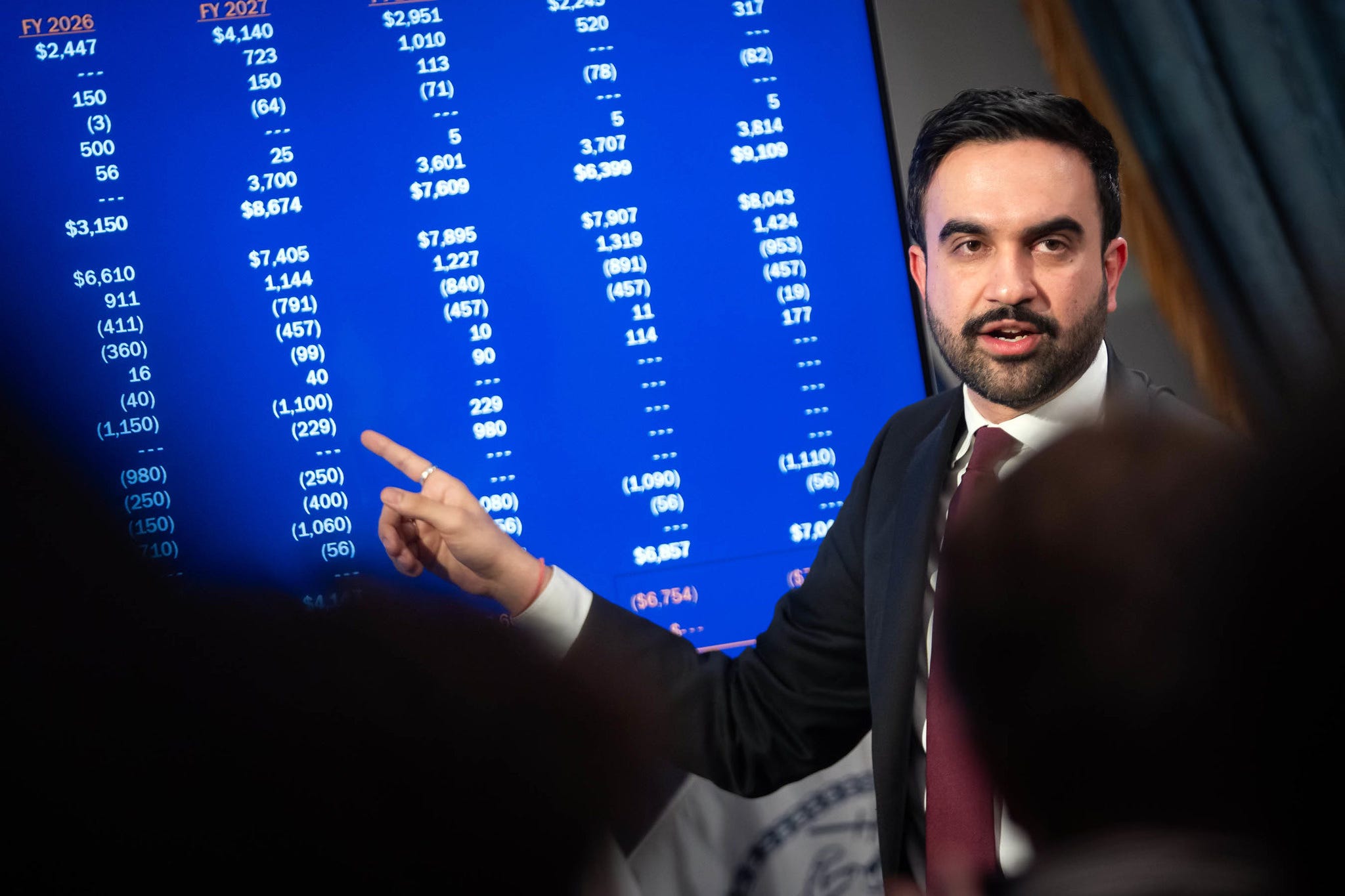
Among the many sins former New York City mayor Eric Adams must answer for is leaving his successor, Zohran Mamdani, a colossal budget deficit of roughly $12 billion this fiscal year and next.
Earlier this week, Mamdani released a revised financial plan where he asserted that closing the deficit would be possible in only two ways. One is for the state legislature to pass, and Governor Kathy Hochul to approve, increases in the tax rates paid by high-income city residents and corporations.
Since Hochul has made clear she will not agree to this, the mayor offered an alternative means to raise $3.7 billion to balance the budget – raising the city’s real property tax rate by about 9.5 percent, which requires only the approval of the city council.
Council speaker Julie Menin and Finance Committee chair Linda Lee promptly poured cold water on Mamdani’s property tax ploy. In an interview, Lee noted that the property tax increase “would have a negative effect on a lot of homeowners” in her district in eastern Queens and others. That makes the proposal politically problematic. But it would also exacerbate the fiscal problems of rent-stabilized housing, even before Mamdani’s proposed freeze on rents.
Because raising property taxes across the board is so widely viewed as, in the words of Queens Borough President Donovan Richards, a “nonstarter,” Mamdani risks annoying voters without gaining meaningful leverage over Hochul and the legislature. Neither would appreciate being strong-armed by the mayor.
The mayor asserted that there is no third way, but of course there is. As noted in Menin’s and Lee’s statement, the city can reduce spending more and raise new revenues.
Previous mayors closed budget gaps with “PEG cuts,” an acronym for “Program to Eliminate the Gap.” Agencies would be assigned targets representing percentage reductions in the expense (operating) and capital (long-term investment) budgets.
Mamdani, wanting to be different, has eschewed this terminology but followed much of the same practice, requiring agencies to designate Chief Savings Officers (CSOs) to identify potential efficiencies. The CSOs were not initially given percentage targets, but at his budget presentation, Mamdani stated that savings would be sought of 1.5% in the current fiscal year (FY 2026) and 2.5% in the next (FY 2027; city fiscal years begin on July 1 of the prior calendar year).
The mayor stated, dubiously, that agencies could not tolerate larger cuts and sustain services. Prior mayors, in crisis mode, have not been so understanding.
For example, amid the Great Recession, Michael Bloomberg proposed in his January 2010 financial plan savings of 2.1% of city-funded expenditures in the then-current FY 2010 and 4.7 percent in FY 2011. I was working for the city’s Planning Department at the time and experienced those cuts as real austerity. There were not enough staff for everything the department wanted to do. However, the city lived within its constrained means, and after a few years, was able to ramp up spending as the economy recovered.
Moreover, Mamdani has alternatives to drastic across-the-board agency cuts.
The Citizens Budget Commission (CBC), for example, recommends targeting cuts to services where demand is shrinking or where costs are skyrocketing. For example, CBC notes that school funding has not declined with school enrollment, and that “40 percent of contracted infant/toddler day care slots were unfilled in fiscal year 2025.” On the other hand, CBC finds the cost per ton of recycling has shot up.
He can also stretch out capital spending, reducing annual debt service. One of the biggest components of the capital program is the construction of replacement jails to enable, in theory, the closure of Rikers Island. That construction is already well behind schedule and could be delayed more.
The mayor can also look for ways to utilize technology to improve employee productivity. Of course, that only works if staffing is actually reduced. For example, NYC has begun to deploy mechanized sanitation trucks handling trash bins, but taking advantage of the potential for one-person operation remains off the table due to labor opposition.
Mamdani can try to bring unduly generous benefits in line with national practice. In another fiscal crunch in 2020, as one example, CBC recommended the city implement cost-sharing for employee and retiree health benefits.
Finally, Mamdani can raise revenue in other ways.
For example, a new report from the Center for an Urban Future supplies “5 Revenue-Raising Ideas for NYC.” The biggest move, of the five, involves more aggressively monetizing the value of the city’s on-street parking spaces. NYC can also dispose of unneeded assets, including land and buildings.
So, there are many possible paths to budget balance. But Mamdani clearly wants his tax increase on the wealthy. If Hochul and the Council leadership stand fast, the alternatives will come into play.
New York City should be able to balance its budget without a tax increase in a year when base tax revenues are rising by four percent, and the state is offering an additional $1.5 billion in aid. If the mayor cannot, one fears how he might handle a recession where revenues actually fall short of expectations.
A version of this op-ed was published by the Daily News.

The city council will never exercise spending restraint.