

Good governance requires transparency, especially from an administration committed to using its powers aggressively.
The administration observes this principle when it suits Mayor Zohran Mamdani’s political needs. For instance, it touted the “unprecedented public transparency” of a new housing tracker. In September, City Hall released a trove of documents relating to air quality in Downtown Manhattan in the wake of 9/11.
“New Yorkers should welcome proactive disclosure,” my colleagues Cameron Macdonald and Santiago Vidal Calvo write. “But transparency is not limited to dashboards that City Hall chooses to publish. It also includes the calendars, communications, and facts informing decisions that the public chooses to examine.”
The Mayor’s Office’s arguably excessive delays (more on that below) in responding to basic record requests under the Freedom of Information Law insulate such decisions from timely public oversight. Which is why the Manhattan Institute is in court to make sure not just we, but the public at large can access public information in a timely manner.
But transparency is not just about documents.
When the mayor’s campaign promises of guaranteed rent freezes for the city’s rent-stabilized apartments shadow the Rent Guidelines Board — which did freeze said rents — there are valid questions about whether such an institution can operate independently or is acting on political mandates, especially since Mamdani appointed the majority of RGB members. (There’s another lawsuit, more below.)
There’s more.
One of the first decisions Mamdani made was to establish the Office of Mass Engagement, directed by the campaign’s former field director, that consolidates city outreach under an explicit organizing mandate. Perception is everything, and the kind of outreach the office engaged in from Rent Freeze hearings and tenant organizing, down to a table for the DSA, his political home, as just another nonprofit transit advocate at a bus resource fair — seems to muddle outreach and politics.
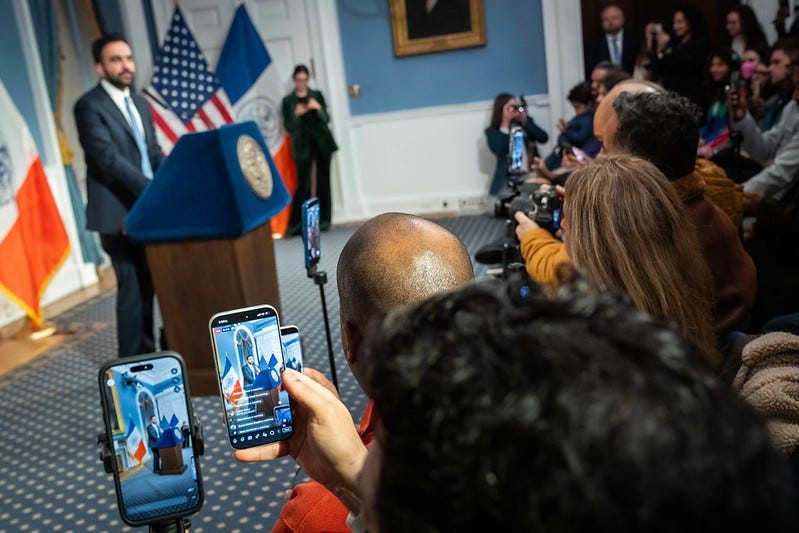
Mamdani’s first press conference was not with traditional media (though the mayor does find time to answer their questions), but creators and influencers, a practice the city has continued, including through Signal group chats that have brought up issues around record preservation.
The city argues the former have bigger reach. They may, but they are also less likely to scrutinize the administration. Since Signal messages were not preserved, we are unlikely to learn what conversations took place. The Signal group was formed out of the Creators4Zohran group that supported the mayor’s election campaign, Columbia Journalism Review reported.
Mayor Mamdani has shown no hesitation in using executive orders to force increased transparency on landlords and businesses. That makes his own office’s resistance to timely disclosure rather ironic.
Transparency Lawsuit
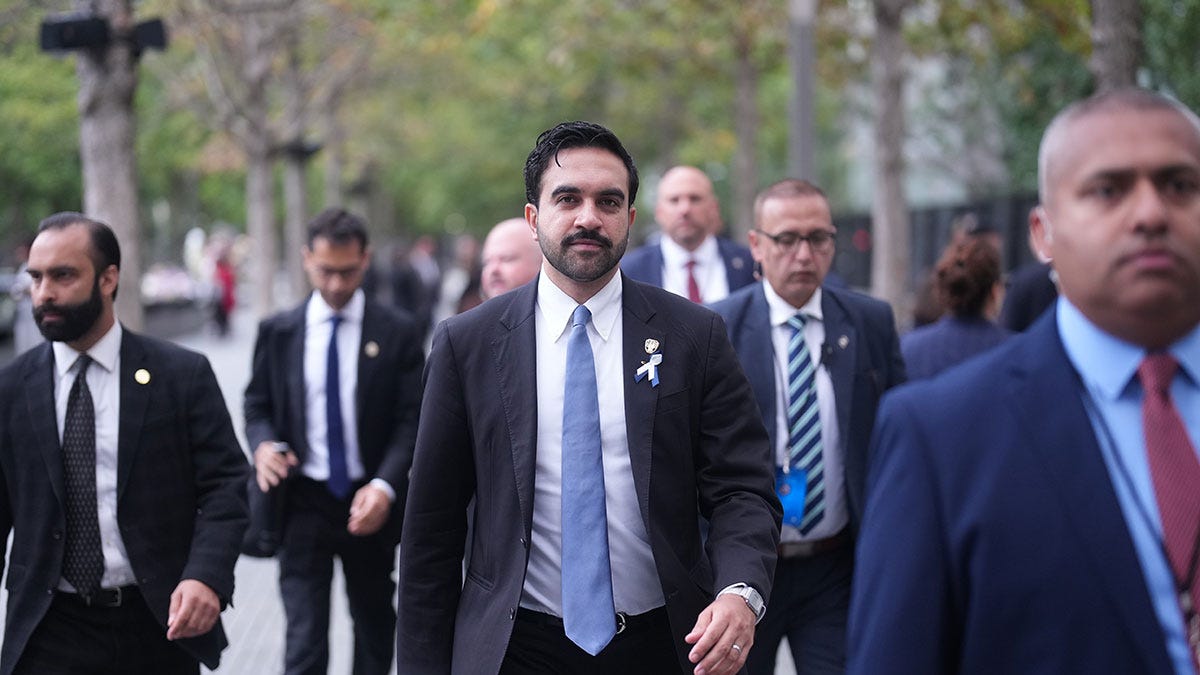
In order to keep the city accountable, the public needs access to information about what the city is doing in a timely manner, and it has the right to request such information under the Freedom of Information Law (FOIL).
MI is suing the city, again, this time over the Mayor’s Office delaying a response to a reasonable FOIL request in a reasonable time.
“Transparency is about timing as much as anything. When a controversy is in the making, records are what drive the reporting, oversight, and legislative debate,” Santiago Vidal Calvo and Cameron Macdonald argue. “To be told in January that a decision on a July request is coming is to have the news after the story has run its course and the officials have moved on. Put off disclosure until the civic moment is over and you have denied it in all but name.”
What triggered this lawsuit was such a six-month delay on MI’s request to see a list of meetings with people outside of the city government by Ana Maria Archila, commissioner of the Mayor’s Office for International Affairs.
Archila, as MI’s Adam Lehodey reported in July, had been planning to meet with Amir-Saeid Iravani, Iran’s ambassador to the United Nations, without Mayor Mamdani’s knowledge. The meeting was canceled once it became known, but prompted the question of who else had she met since taking office without the mayor’s knowledge?
While MI would like the court to order the city to provide information requested by us within 5 days, the case is asking the court more broadly “to enforce a modest rule: before City Hall makes a requester wait six months, it must have a request-specific reason for doing so,” Vidal Calvo and Macdonald write.
The Other Lawsuit: Rent Freeze Promise
The other lawsuit is over this year’s rent freeze which Mamdani explicitly promised during his electoral campaign, and then his appointed Rent Guidelines Board delivered.
The judge decided this week that he wanted to see what written communications the City Hall had with the board to come to a conclusion in the case. The rent freeze is currently set to take effect on October 1.
Why this case matters?
“If the courts don’t nullify the freeze, mayors will obtain de facto control over stabilized rent increases, despite statutory text and structure designed to insulate these decisions from political pressure,” Gandolfo DiFiore and MI’s John Ketcham write. “If successful, our legal challenge would not end rent stabilization or resolve the deeper issues with the HSTPA. It would, however, ensure that owners receive a fair process and prevent mayors from co-opting an independent body for political gain.”
Fixing NYC’s Tech Isn’t an IT Problem — It’s an Operations Problem
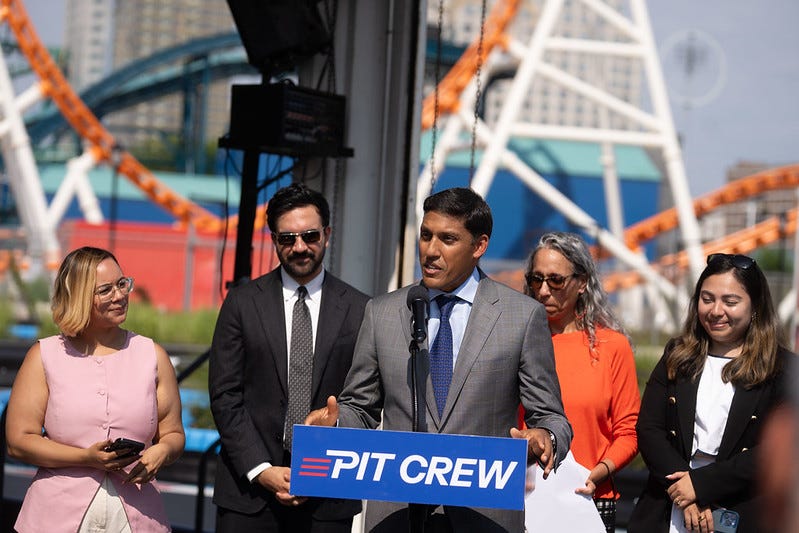
New York City has a long track record of spending millions of dollars on tech initiatives like the MyCity app that fail to deliver on their promise. Most recently, the mayor has deployed Public Interest Technology (PIT) Crews to fulfill his tech promises.
But simply hiring more developers or giving large contracts to vendors won’t ensure meaningful digital service will be delivered on time and on budget, MI’s Brittany Montgomery writes in Vital City.
The solutions to those challenges are operational, and without changing how the city hires, buys and budgets for these investments, even the most ambitious projects will fail to deliver.
The city should move from “waterfall” to “Agile” procurement, which is three times more successful at delivering projects as promised, stop treating tech investments as capital expenses they once primarily were and rethink how it buys technology as a service, she recommends.
And it needs to rethink its diversity requirements.
“The City’s current approach to procurement makes this way of working difficult, if not impossible. Local Law 2019/174 specifies percentage goals of total annual agency expenditure for six classes of minority-owned businesses, adding up to 73.52% of total spend for professional service contracts,” Montgomery writes. “In my experience, procurement officers apply all or most of these percentage goals across all contracts. Requiring blanket target participation rates on a single Scrum team would imply a minimum of six distinct companies supplying staff for a four-person team — a certain (and nonsensical) recipe for failure.”
Issue Brief: How New York City Can Use AI to Improve Quality of Life

While national debate surrounding artificial intelligence often focuses on abstract risks, New York City has a concrete opportunity to use AI to improve daily life for residents.
In a new issue brief, MI’s Josh Appel outlines how Large Language Models (LLMs) can transform municipal governance—building on historic NYC data innovations like CompStat, FireCast, and 311—to synthesize data across city agencies, and how, by leveraging LLMs to analyze multi-agency data in real time, NYC can shift from troubleshooting to addressing emerging issues before they impact residents’ quality of life.
On Keeping Race Out of Student Discipline

New guidance on compliance with Title VI of the Civil Rights Act of 1964 from the U.S. Department of Education’s Office for Civil Rights charges schools with two “fundamental duties”: maintain safe, orderly learning environments and eliminate racial discrimination in disciplinary enforcement.
This is the right approach. By focusing on basic fairness rather than over- or under-disciplining students to align with racial metrics, schools can work on applying behavioral science and addressing the root causes of misbehavior rather than managing public relations metrics, MI’s Jennifer Weber writes in City Journal.
“Schools need to be willing to do more than just count suspensions, assign labels to behavior, and refer students elsewhere for help. Teachers and administrators must be willing to examine their own behavior, too,” she argues. “They must teach expectations, identify missing academic or behavioral skills, respond consistently, and track whether the student improves. The measure of a discipline system should be whether students’ behavior—and their lives—actually get better.”
More on Education
The state moved ahead in the process to eliminate passing Regents as a high school graduation requirement. The results of this test were not meaningful, MI’s Ray Domanico told The Post, but “[t]here has to be a meaningful way to determine if students are meeting expectations. They have to come out of high school prepared.” Officials are yet to share how they plan to ensure that the proposed “portrait of a graduate” paints an accurate picture of a graduate’s skills across the competencies to be judged, like critical thinking.
Councilmembers make new push to improve diversity at NYC specialized high schools (Gothamist)
1 in 3 NYC students were chronically absent from school last year, missing 10% or more of school days. This number hasn’t budged and remains higher than pre-pandemic, Chalkbeat reports. As my colleague Danyela Souza Egorov and I have written, such absences, which start as early as kindergarten, for many students compound over years into significant learning loss.
Gov. Hochul is under pressure from unions and civil rights leaders to “Opt Out” from a federal tax-credit scholarship program, Chalkbeat reports. The governor is firm in her resolve — opting in will benefit all children and takes no money away from public schools. MI’s Ray Domanico agrees, Gov. Hochul is right to stay the course.
Extra! Extra!

Park Avenue redesign moves ahead, city plans leafy walkway and 2-way bike lane (Gothamist)
You’re Joining a Union — Whether You Want to Or Not (City Journal)
How’s Mamdani Doing? Mayor Releases Mixed City Scorecard (The City Reporter)
‘Off a Cliff’: AI Devours Entry-Level Tech Jobs, As Experienced Workers Hold On (The City Reporter)
NYPD expects daily UN General Assembly protests as NYC street closures begin (Gothamist)
More EV charging (with future implications for curb management) and testing bus stop roof gardens coming to Brooklyn, and Tesla starts testing driverless cars in the city.
What The Dickens? DOT’s Final Truck Route Map Is A Tale Of Two Cities (Streetsblog)