


Governor Kathy Hochul presented her FY 2027 Executive Budget in Albany on Jan. 20. Just over a month later, a “little excursion” broke out in the Middle East—touching off what Bloomberg News called “the biggest oil supply shock in history.” Energy prices jumped, supply chains wobbled, stock prices slid, and inflation, which had been cooling, began heating up again. Economists quickly responded by raising their inflation forecasts, trimming expectations for growth and jobs, and putting the odds of a recession this year at roughly one in three.
The conflict arrived at what might have seemed like a fortuitous moment for New York policymakers. It broke out just as the state’s annual budget process was entering its most crucial phase—leaving time, at least in theory, for the governor and Legislature to absorb the implications before finalizing a spending plan.
So far, however, the reaction in Albany might best be summed up as … War? What war? Negotiations have reportedly centered less on fiscal conditions than on a grab bag of non-budget priorities, even as the financial plan already calls for spending growth far outpacing inflation and is almost certain to grow further before adoption.
To be sure, the state is entering this period with an unusually large cash cushion. Years of pandemic aid, windfall tax revenues from a booming stock market, and billions in investment earnings have left Albany with reserves on a scale rarely seen in its history.
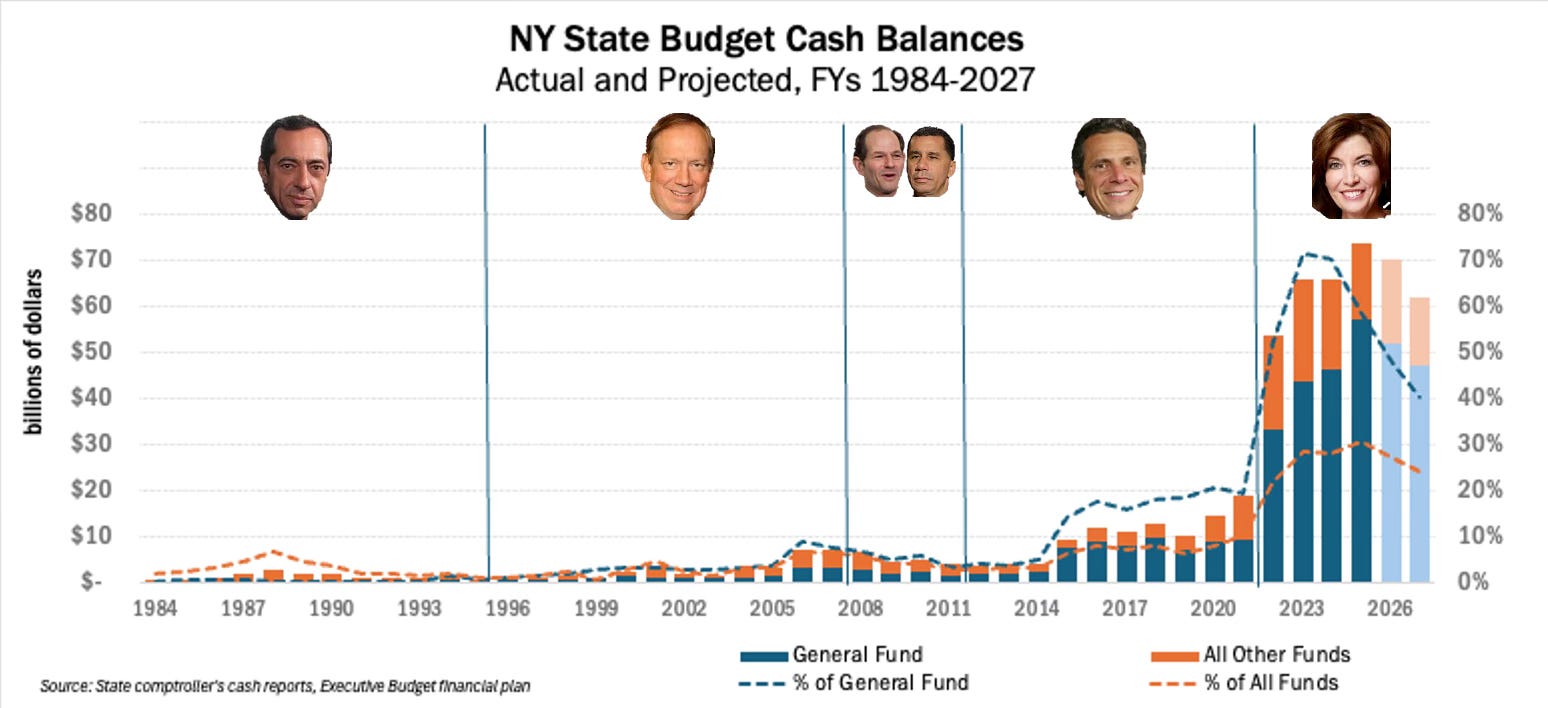
But much of that money is already spoken for—tied up in tax credit obligations, prepayments, and accounting maneuvers that make the balance look larger and more flexible than it really is. Meanwhile, underlying spending trends continue to point toward large out-year gaps even under stable economic conditions.
Which leaves the state appearing flush in the moment while remaining structurally unbalanced and highly exposed to a downturn—especially one driven by volatile global forces beyond its control. In a typical recession, tax receipts could fall by tens of billions of dollars over a few years, quickly eroding even a large reserve.
The war no one in Albany seems eager to talk about may determine how long the money lasts.
