

The New York Times profiled the Manhattan Institute this week, describing us as “a think tank with a roster of New York City obsessives” and as the “intellectual hub of the resistance” to far-left governance and bad ideas.
It’s all true. We are very much obsessed with making the city better. That includes questioning Mayor Mamdani’s policy agenda, spotting issues and trends, and suggesting alternative (better!) solutions to the problems NYC faces. We are skeptical, but give credit when it’s due.
As MI president Reihan Salam told the Times:
“I vehemently believe that we are defenders of the beautiful mosaic,” he told the Times’s Eliza Shapiro and Nicholas Fandos of our vision for the city. “But it means that you need to not be an idiot.”
To the many new subscribers who read the Times story — welcome!
This week’s focus is on welfare and housing, a bit on education, and groceries.
Our latest poll looks at how Americans think about welfare thirty years after the landmark 1996 reforms; Stephen Eide reviews a new paper from Notre Dame on the impact of the right to counsel for tenants on evictions and rents, and looks in depth at the recent migrant crisis and the role of the city’s generosity in shaping it.
On the education front, Jennifer Weber presents a framework on how to think about AI in the classroom. And Jennifer and Danyela Souza Egorov write in Searchlight (Citizens Union’s new publication) about the need for education reform.
That, and more, below.
Price Controls and Rationing at Mamdani’s Groceries?

This week, Mamdani announced that the city will set prices, monthly, at 30% below those at comparable groceries for the subsidized basket of goods sold at its five yet-to-be-opened groceries. The basket will include all fruit, vegetables, meat and fish, as well as some dairy and dry goods sold at the stores.
This raises the question of arbitrage — why would someone not buy out the store and sell the goods nearby at a profit?
“[W]e are looking to make sure that we target New Yorkers, whether it be [through] a sort of a library card-esque [system], and also, we manage who’s buying and that it’s focused on everyday New Yorkers,” the interim EDC head Jeanny Pak says. “So, we are mindful of that, and we’re going to make sure that we have all the things in place to ensure that that does not happen.”
It won’t come as a surprise that MI fellows don’t think public grocery stores are a good idea. As Nicole Gelinas wrote in the Times, the problem with public grocery stores is reality.
Data Dashboard
We are adding a Data tab in the navigation bar to allow for easier tracking of key measures of the city’s health — and potential early warning signs.
The number of individuals in the city’s Department of Homeless Services shelters is one such data point.
More than 82,000 residents slept in the city’s shelters on July 28; almost 28,000 of them — a third — were children. In fact, families with children account for 63% of all homeless individuals, a number that shot up during the migrant crisis. While it has been slowly decreasing, homelessness among single men and women is on the rise, keeping the total number high.
“New Yorkers should not make their peace with tens of thousands sleeping every night in shelter and a couple thousand more sleeping on the streets and in the subways,” MI’s Stephen Eide tells The Bigger Apple. “And history suggests that they will not. It’s only a matter of time before homelessness reemerges as a front-burner source of public controversy. This shelter tracking tool can serve as an early warning system.”
Related:

New York City’s Migrant Crisis. “Immigration scholars have long debated whether, and to what extent, generous public benefits induce migration. The migrant crisis in New York City presents a case study of this “welfare magnet” hypothesis, demonstrating that certain benefit programs, in some situations, can indeed affect migration. The crisis also offers a case study in how state and local benefit programs can influence the movement of low-income people more broadly,” Stephen writes in his new brief.
Free Eviction Defense Lawyers Don’t Prevent Homelessness. While being represented in housing court can delay evictions, Notre Dame economist Robert Collinson and his co-authors find that the right to counsel also raises rents.
Funding Housing Isn’t Cheaper Than Shelter, because shelter is temporary, and housing is permanent. When CityFHEPS, the city-funded housing support program, was introduced as a cheaper alternative to funding shelter stays, families were spending an average of 446 days in DHS shelters. Once people secure permanent housing, however, they stay. NYCHA residents remain in their apartments for an average of 27 years, while NYC Section 8 recipients stay for 15. CityFHEPS may formally be a five-year program, but with a 90% extension rate for "good cause," it is hardly temporary.
Latest Polling: American Attitudes on Welfare, Crime, and the Political Environment
Our latest national survey is out, and Bill Clinton was right about welfare, MI’s Jesse Arm and Sean Speer write. Thirty years after the landmark 1996 welfare reforms, Americans across demographic and political lines overwhelmingly favor requiring welfare recipients to seek work (74%), prioritizing targeted aid for those in true need (67%), and providing dedicated benefits rather than unrestricted cash payments (80%).
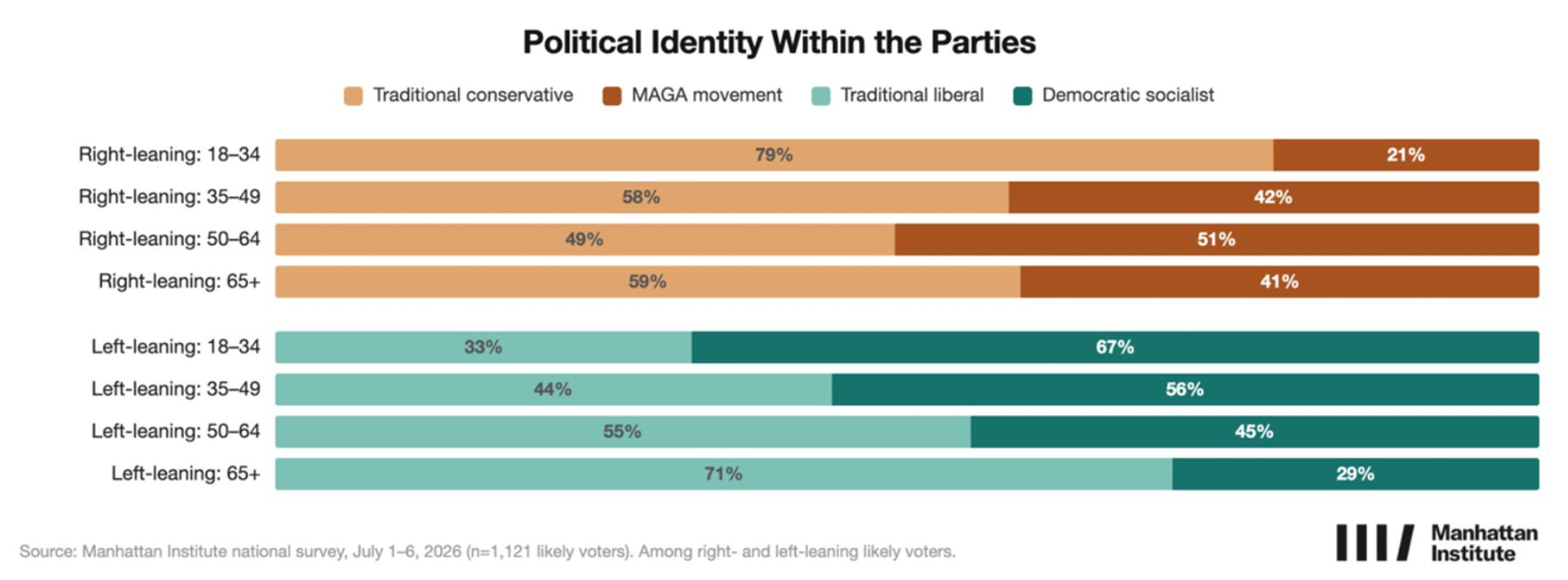
Voters also strongly oppose radical proposals to abolish police, prisons, or borders while maintaining support for the death penalty for severe crimes. However, notable generational divides surface throughout the survey: younger voters express significantly more openness to universal basic income, unrestricted cash aid, and socialist identities than older Americans.
One Size Does Not Fit All: A Developmentally Appropriate Framework for AI in K–12 Education

For the past hundred years, schools have brought in new technologies like radio, television, and computers before really understanding how they affect children. By the time the impact became clear, these tools were already part of students' everyday routines. But this time it’s different, MI’s Jennifer Weber tells the Bigger Apple.
“Instead of just changing how students get information, generative AI can actually do the thinking and learning for them, taking over the tasks meant to help students build their own skills,” she writes. “Right now, most fourth-graders in New York are not reading or doing math at grade level, and those most likely to rely on AI instead of thinking for themselves are often the least prepared to handle it.”
In a new brief, Jennifer looks at AI in education through the lens of cognitive development, suggesting a framework for when and how AI should be used in classrooms, based on students’ developmental needs.
Talk to Tenants Trouble

By using its resources to help organize tenants through the Talk to Tenants initiative, the city is picking sides when its proper role should be a neutral arbiter, MI’s Nicole Gelinas writes. That aside, there is also a more practical reason not to.
As Nicole notes, tenant organizing in the 1970s and ‘80s was a genuine grassroots effort in deteriorating buildings, where residents themselves handled repairs, collected rent, and maintained safety:
“But if you can’t do the basic work of organizing yourselves, you likely won’t be able to do this much harder work. Few if any buildings are in this dire state today, and encouraging tenants to force fragile buildings into greater disrepair when they are unprepared to do the sweat-work themselves is irresponsible.”
Extra! Extra!

This was not a great week for our mayor.
Mamdani’s Netanyahu gambit served no one, Ross Barkan writes in Crain’s, and he’ll be tested by protesters during the United Nations General Assembly in September. “Can the new mayor ensure there isn’t any chaos or violence? Will protesters feel aggrieved if the police exercise a heavy hand? We will find out soon enough.” (Mamdani’s address.)
Outrage over Mamdani’s messy Pied-à-Terre list or Mamdani’s pied-a-terrible mess, as POLITICO calls it, and blowback over the lack of Jewish lawyers on a panel that advises him on picking judges, given the large number of Jewish lawyers in the city, were bigger than the city probably envisioned.
Meanwhile, rent freeze goes to court, MI’s John Ketcham writes in City Journal, and the teachers’ union threatens “all out war” with the mayor over council-approved paraprofessional payments he’s yet to sign off on, the Times reports.
But it was not all bad. The mayor’s “Open for Business” offers common sense changes to the city’s regulatory code to help small businesses comply with the city’s rules, a welcome move, though there’s much more to be done.
So, Can Socialists Govern? Crain’s looks at Mamdani’s opportunities, and it seems he may have more durable support from the DSA than one may have expected.
But I’ll leave you with Allison Schrager’s thoughts in Americans Are Richer Than Ever. Why Are They So Angry? According to her,
“Much of the dissatisfaction has non-economic roots, and politicians are feeling pressured to respond with policies that purport to take control over the economy and provide a sense of safety — price controls, immigration restrictions, tariffs and so on. Americans should be wary. If these are the solutions, soon they will not only be unhappy, but poorer too.”
Mamdani’s grocery stores? You can’t fix stupid.