

One of the greatest accomplishments of Eric Adams’s mayoralty was City of Yes for Housing Opportunity—the most significant rewrite of New York City’s zoning code since 1961, and a reform for which history will likely treat him better than the past. In a city starved for housing, its ambition was straightforward: to unlock a little more housing in every neighborhood, including in places already built.
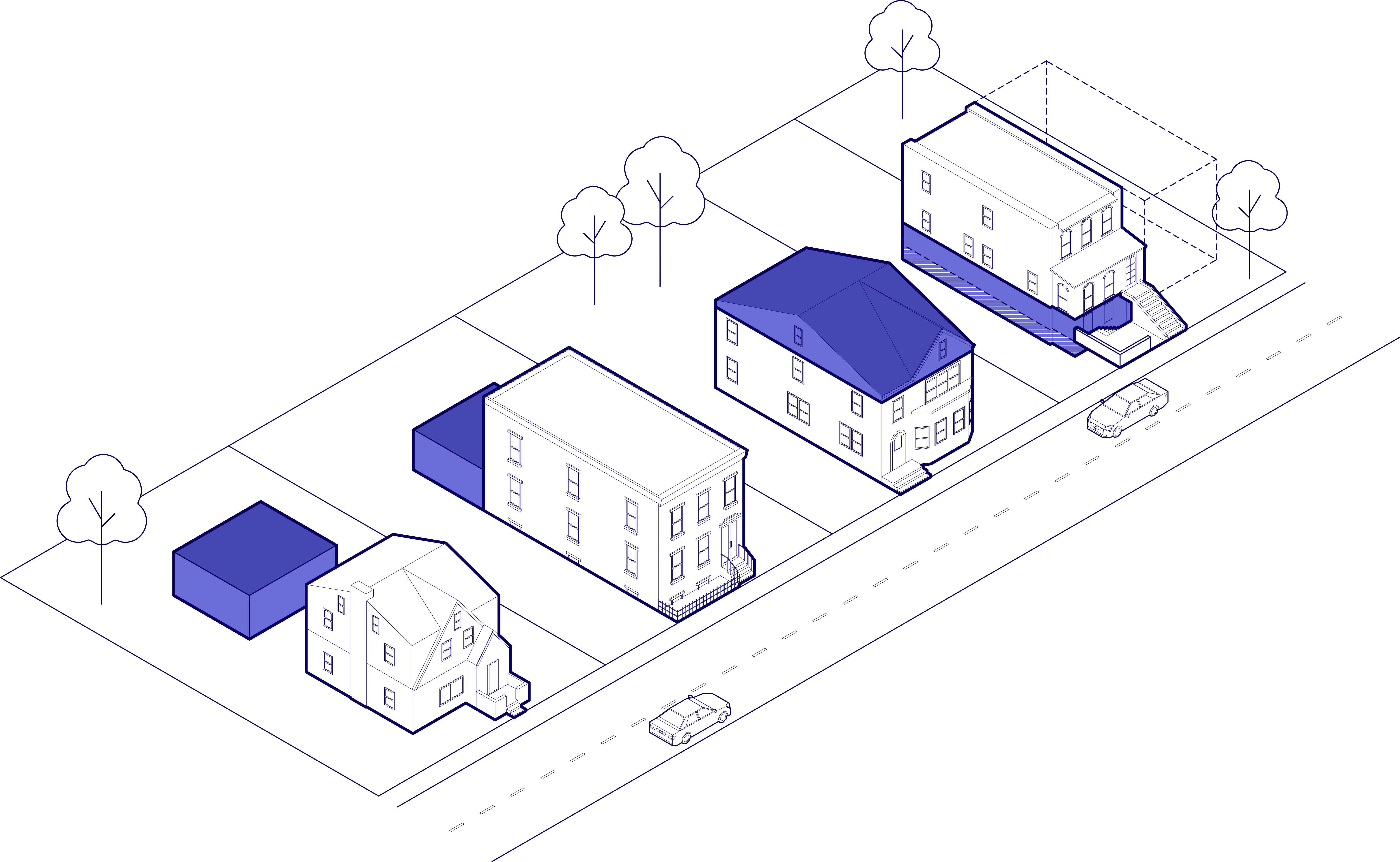
One of its provisions amended the zoning ordinance to allow accessory (or ancillary) dwelling units (ADUs)—small dwellings carved out of basements, attics, or home extensions, or built as standalone structures in backyards. These under-800 square foot units represent the closest thing New York has to “instant housing.” Basements across the outer boroughs already exist, so bringing as many of them as possible into the legal market should have been a top priority.
Instead, state law has turned basement ADUs into a dead end.
New York’s Multiple Dwelling Law (MDL) applies to homes with three or more units and imposes a series of costly requirements, including fire sprinkler systems throughout the building and its units. When owners of a two-family home wish to add an additional unit, such as by legalizing a ground-floor “walk-in” apartment, they must install sprinklers throughout the entire home.
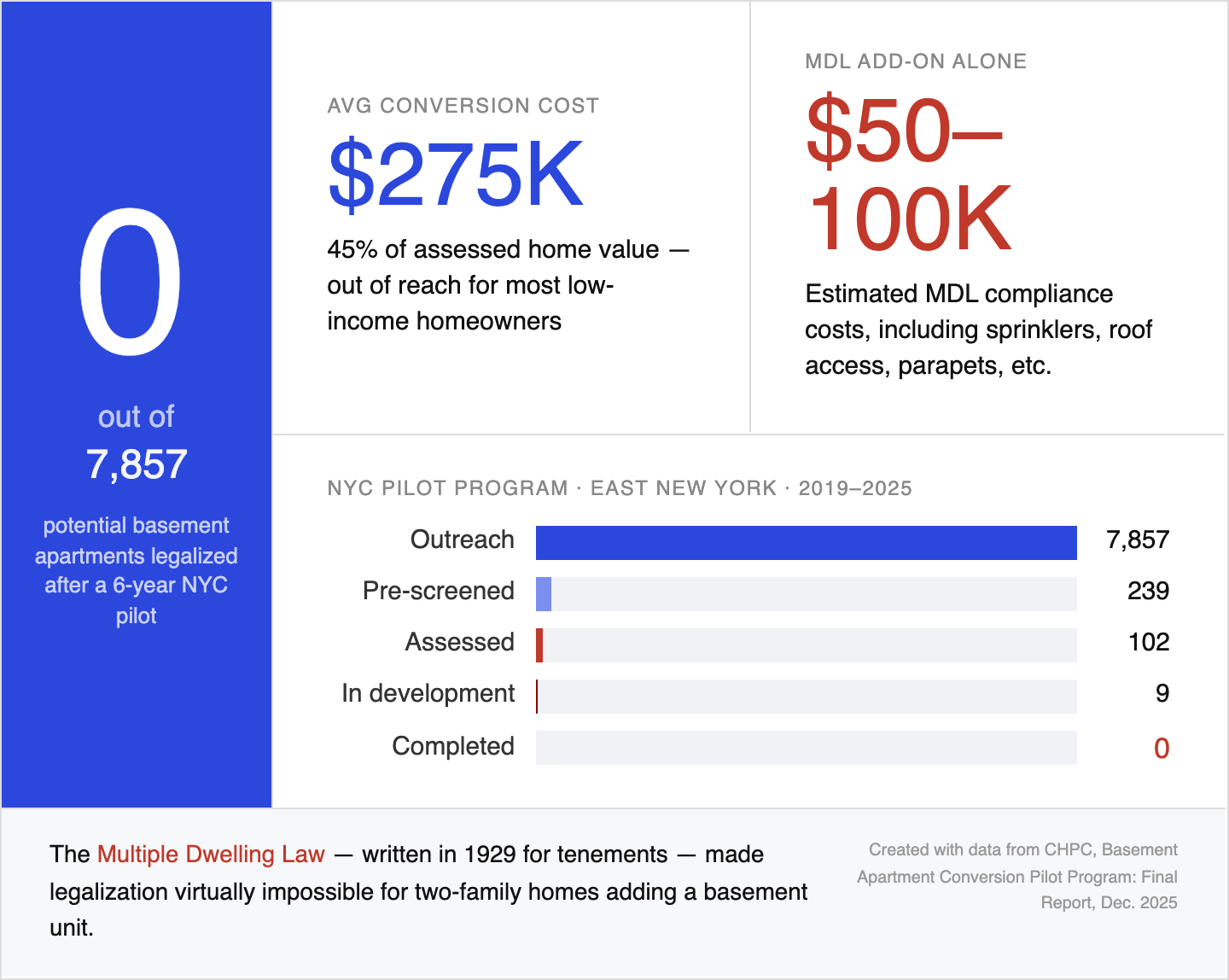
New York City homeowners who wish to add a basement ADU likewise trigger the MDL, requiring sprinklers and the law’s other requirements throughout the entire home, something that can easily cost north of $50,000. MI senior fellow Eric Kober warned about this in 2024, yet the legislature opted not to conform the antiquated MDL with newly legalized ADUs.
Add in other costs and the inconvenience of legalizing ADUs—which can involve as many as five different agencies—and the result is that despite the zoning change, few owners will bother adding basement ADUs.
Tens of thousands of basements already form part of New York’s housing ecosystem. They exist because they meet New Yorkers’ needs, particularly as a form of lower-quality, lower-rent housing. Former mayor Bill de Blasio once lived in a basement apartment.
In a city with a severe housing crunch, the policy goal should be to regularize as many safe apartments as possible as quickly as possible, not impose a compliance regime so onerous that it encourages them to remain underground. At a minimum, the state legislature should exempt two-family homes that wish to add an ADU from the most costly requirements of the MDL, such as sprinkler system installations.
Such a proposal would, of course, meet resistance from those who stand to benefit from perpetuating the status quo. The Plumbers and Steamfitters Unions and industry groups like the New York Fire Sprinkler Contractor’s Association share an interest in preserving government mandates that generate work.
Sprinkler systems may have a place in large buildings, but for small homes, their cost must be compared to the incremental safety benefit relative to an adequately charged and maintained fire extinguisher.
Despite invocations of overblown safety fears, policymakers should recognize that the alternative is to keep thousands of naturally affordable apartments off the market, which could go a long way toward alleviating the city’s housing crisis in the short run.
And a city that truly embraced innovation would use technology to ensure compliance and speed. Since 1995, New York City has allowed registered architects and professional engineers to self-certify that plans comply with building codes, subject to random audit. Professional certification reflects a recognition that ensuring compliance doesn’t require city officials to sign off on every job.
ADUs should follow the same logic. The city could establish clear safety standards, such as two means of egress, proper ventilation, smoke and carbon monoxide detectors, and allow owners to demonstrate compliance through documentation. Photos, videos, and digital floor plans could be submitted periodically through a centralized portal, say, every 3 to 5 years. On the city’s end, AI tools could flag likely violations for human review and, where necessary, in-person inspection. Some self-certification applications could be subject to random audits, with violators subject to penalties and the loss of self-certification privileges.
Such a system could lower compliance costs and help bring thousands of affordable units online while preserving safety.
City of Yes was supposed to mark a turning point, a recognition that New York needs to build its way out of a housing shortage. Yet at least some of its promise has already fallen prey to the New York impulse for the government to offer relief, then make it difficult to obtain through costly regulations and time-consuming approvals.
As New York’s rents continue their relentless climb to record highs, city and state leaders have themselves to blame for keeping even the simplest, most obvious housing stuck in the basement.
John Ketcham is the director of Cities and a senior fellow at the Manhattan Institute.
I did this conversion (2->3 to “regularize” an owner-occupied first-floor apartment) I wouldn’t do it again even if they waived the multiple dwelling rule. As a non-professional, touching the CofO on a small property in NYC is a potentially life-ruining mistake regardless of the headline construction costs. In my case the “self-certifying” architect screwed me over just as badly as an unbelievably incompetent DOB.
Have we heard from Mayor Affordability on this?