

New York City faces a multi-billion dollar budget deficit thanks, in part, to a recent ramp-up in social spending. The economy’s not in recession. But the local welfare state has, of late, registered impressive growth.
Local policymakers reason that, since low and moderate-income New Yorkers are up against it, and federal programs aren’t expanding, this city must take the initiative.
However, a functional welfare state cannot be built on compassion alone; it must rest on more solid principles, and New York is building an expensive welfare state without the tools that make it possible at the national level.
Cities Have Limits
New Yorkers are more willing than most Americans to tax themselves to fund a generous welfare state. Why not celebrate that as federalism in action?
Because, according to a long tradition of urban politics and economic scholarship, the national government is far better positioned to run redistributive programs than cities.
No city can keep raising taxes on middle and upper-income households forever. People can move. Since international outmigration is more difficult than domestic outmigration, many scholars argue that the federal government, not cities and states, should lead in helping the poor.
The issue’s not just wealth flight. Local welfare programs hinder upward mobility by hindering horizontal mobility. Sometimes, people need to move elsewhere to move up. That is the premise of “moving to opportunity” programs, long promoted by center-left policymakers, that make low-income households’ access to housing benefits contingent on their moving to safer communities with stronger schools and job prospects.
New York, by contrast, links benefits to local residency. The New York model discourages horizontal mobility among moderate-income households, while encouraging it among upper-income households. A good socioeconomic system would do neither.
Lack of Vision for Middle Class Upward Mobility
In New York, the only vision of upward mobility into the middle class that policymakers these days seem to offer centers on government jobs.
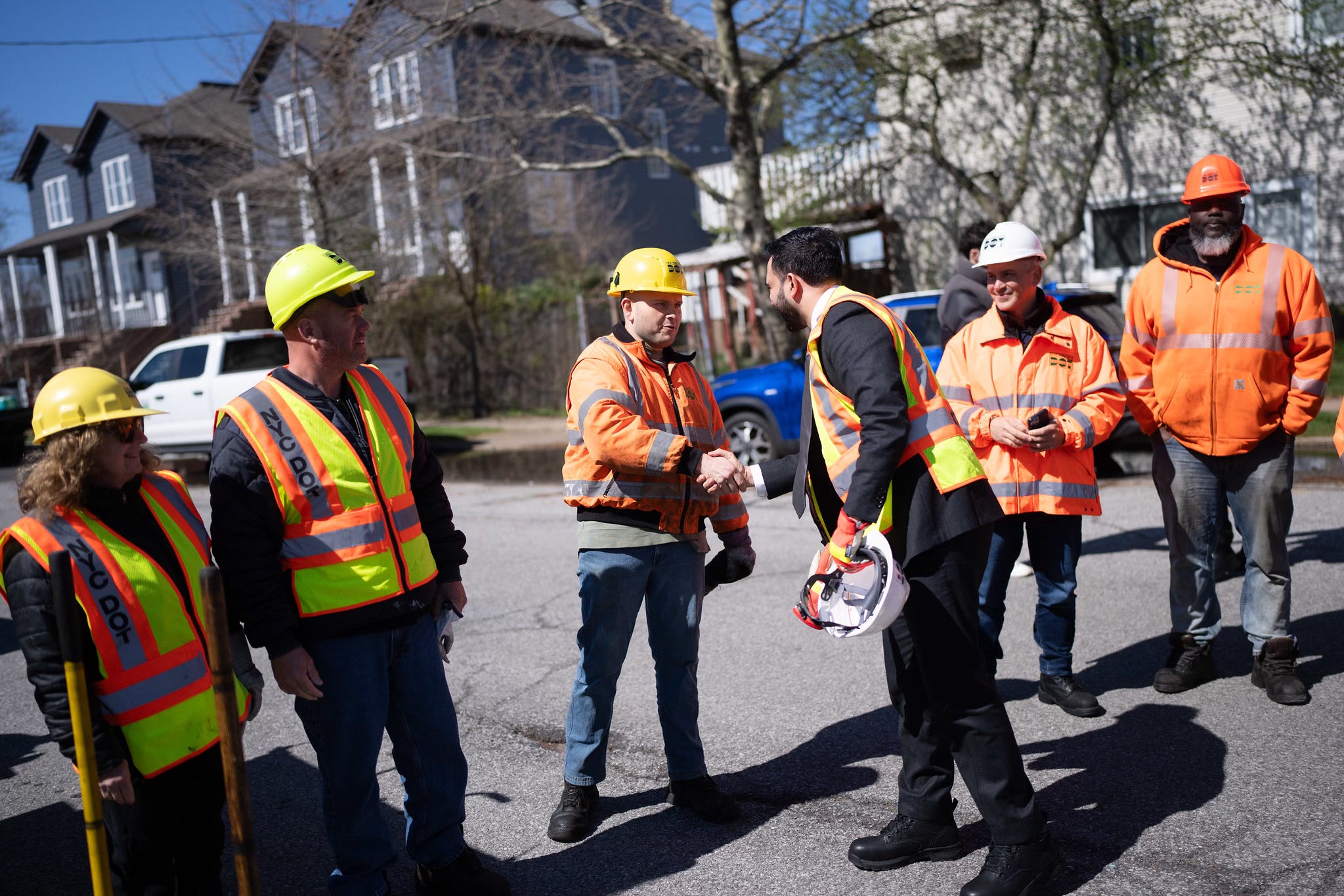
One moves up the socio-economic ladder by getting a job with the school department, transit, state government, or perhaps an NGO. Healthcare jobs, often subsidized by public benefit programs, should also be considered a form of public employment. The result is a model where advancing out of poverty consists of shifting from one form of government dependence to another.
New York cannot afford this strategy for at least three reasons.
First, while all varieties of economically unexceptional communities rely on government jobs (Indian reservations, the Rust Belt, Appalachia), New York cannot afford to be unexceptional. Economic exceptionalism is necessitated by New Yorkers’ unique sense of pride in their city and the city’s exceptional fiscal commitments.
Second, it treats government employment as an economic growth policy. But the only principled reason to grow most varieties of government jobs is as a response to social breakdown. Under what conditions should status quo levels of investment in cops, correctional officers, teachers, homeless shelter staff, etc. be considered inadequate? Probably bad conditions. A government-job centered economic strategy is invested in social breakdown, just as a healthcare-centered strategy is invested in old age and sickness.
Third, when public agencies function as job programs, service quality inevitably suffers. It is absolutely idle to debate “outcomes” or “performance measurement” in a company town whose core business is government.
The government should be the employer of last resort, not first, and government employment should not be the primary path upward.
Wealth, Not Just Income

A stronger vision of upward mobility should focus on wealth formation, not just income. For low-income households, saving is often secondary to immediate needs. But for the working and middle classes, it is central, as wealth provides stability income alone cannot.
Here, New York is at a disadvantage. Not everything is more expensive in New York. Transportation is a deal, and CUNY ranks as one of the most affordable public university systems in the nation.
But housing costs are high, and because New York is a city of renters, proportionately fewer households than elsewhere experience the “wealth effect” from high and rising home equity.
In America, the less rich you are, the more of your wealth is concentrated in home equity. In New York, wage stagnation stings more than elsewhere because of working and middle-class households’ diminished access to home equity. Perception matters in economic policymaking just as much as it does in public safety.
If middle-class households in New York can’t rely on home equity for wealth formation, supporting other opportunities, such as small business ownership, becomes more important. Those have not been priorities of city policymakers, of late. When households cannot build wealth on their own, they end up relying more on the government, and over time, that reliance leads to further entitlements, such as unsustainable public pension expansions.
When Everyone Feels Poor

Affordability anxiety also frustrates a core principle of the American welfare state – targeting. America’s welfare state is smaller than Europe’s but better targeted to the poor, as has been illustrated in analyses by Chris Pope and others, which has helped keep safety net costs sustainable.
With federal programs, targeting was a legacy of the War on Poverty. In the 1960s, social activists such as Michael Harrington believed that the New Deal had not focused enough on the truly poor. Thus, the addition of Medicaid and expanded income support spending to the New Deal’s unemployment insurance and old age pension initiatives.
New York City has, of late, been moving in the opposite direction, launching programs that begin by narrowly targeting the neediest, then broadening eligibility. That’s what happened with the major benefit expansions over the past two decades: Pre-K, Fair Fares, and CityFHEPS.
Targeting requires an eligibility standard. But when everyone feels poor, or at least economically anxious, the ranks of those who believe they deserve government assistance expand inexorably. The line between poor and near-poor has always been blurry. The affordability crisis has made it blurrier, and political pressure is pushing programs outward.
New York has to balance its budget, and when a program like CityFHEPS grows wildly, something has to give. If eligibility cannot be tightened, policymakers will have to resort to self-imposed spending caps, such as proposed by the Citizens Budget Commission. But such caps are often temporary, and when fiscal pressure eases, expansion resumes, and the cycle repeats.
Conclusion
New York will never embrace a minimalist “night watchman” model of municipal government. The local welfare state has deep roots stretching back generations. Even during the neoliberal era of Giuliani and Bloomberg, New York went above and beyond.
But New York City is doing what only a national government can reasonably sustain. It is loosening targeting and expanding benefits without a clear plan to fund them, and its vision to lift its residents up is to offer them government jobs. In the long run, a system built this way will come under pressure from the city’s budget, its tax base, and the people it is meant to serve.
To build a sustainable welfare state, compassion alone is not enough.

I would not even give them the points on "compassion." Compassion is what you do with your own money, not money you confiscated from someone else.
As for the budget, real per capita NYC municipal revenue has increased 104% since NYC's fiscal crisis in 1975 - a crisis brought on entirely by spending rising faster than revenue was rising (yes, revenue was still rising, in real per capita terms, just at a slower pace than it had been).
That means that we do not have a revenue problem. At all. Not in any way, shape or form. The beast is not starving - the beast went back to the buffet table for seconds.
So why do we have a budget deficit?
Real per capita SPENDING has increased 111% since the fiscal crisis.
That is (obviously) just not sustainable. It is not responsible - in fact, it is reckless to take in a windfall and just raise base spending - - when you get a windfall, you save it, you return it, or you make a one-time investment. But they just increased baseline, annual spending, and so now that the pace of revenue growth has slowed, they falsely claim that revenue is the problem.
Some discussion of the historical Irish-American rise through public employment such as police and fire? The Post Office also has played a role in, e.g., Filipino middle class.