

I watched the results of Tuesday’s primary elections from the country I grew up in, Latvia, where NATO aircraft occasionally fly over my mother’s house. And while democratic socialism is traditionally seen in terms of left-wing domestic policy, I found myself thinking of conversations the New York Editorial Board, of which I’m a member, had with two socialists who beat other Democrats in their primaries — and how destabilizing some of their views on international security could be to this tense part of the world.
Darializa Avila Chevalier, who won over five-term Congressman Adriano Espaillat (NY-13), described the notion of nations having borders to us as a “militarized project” that is “deeply dehumanizing to so many people.” Out here, borders are a fragile guarantee against a bloody Russian invasion. When we asked her to apply her views to Russia and Ukraine, she expressed sympathy for the lives lost but said her real hostility is to “global systems where you have imperialist powers engaging in constant violence in a war machine.”
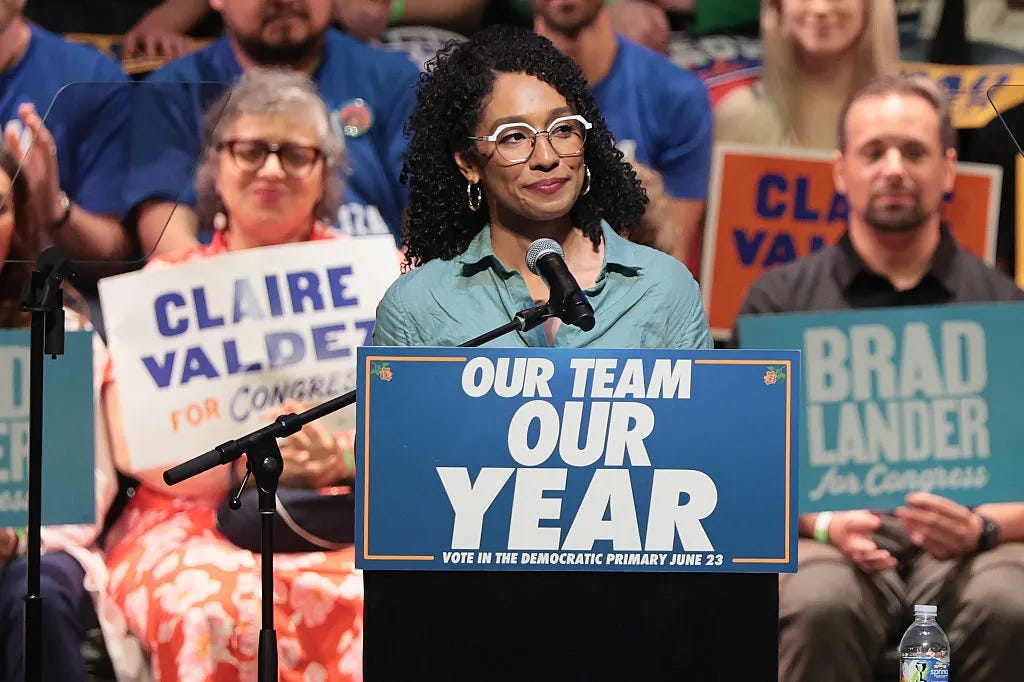
Democratic socialists won big Tuesday, likely increasing their New York state and assembly numbers to at least 15, and adding two new members to Congress – Chevalier and Claire Valdez, who succeeded Congresswoman Nydia Velázquez (NY-07). Both were supported by New York’s Mayor Zohran Mamdani, and both replaced solidly progressive Democrats.
The NYC DSA’s focus has vocally been on bread-and-butter populist issues, and many voters who backed these candidates were likely responding primarily to that message rather than to the full range of foreign-policy implications associated with the broader movement. The popular mayor campaigned for these candidates and his positions carried weight among voters.
But the broader stances of the National Democratic Socialists of America are far-reaching, and their platform essentially advocates for the dismantling of the post-World War II international order. Their foreign policy mandates include greatly reducing U.S. military budget, closing overseas military bases, bringing troops home, and ending all economic sanctions as part of their “Workers Deserve More” campaign, which my colleague Stu Smith reported on last week. NYC DSA’s own Anti-War Working Group is “dedicated to countering US imperialism and resisting US regime-change operations and interventions in foreign wars and conflicts.”
To someone who grew up in Latvia under Soviet occupation, concepts like “deterrence” and “sanctions” are not abstract terms. When you look at the current geopolitical landscape, Europe is experiencing the most serious security crisis since 1945. The only credible deterrent preventing a revanchist Russian state from expanding its borders into the Baltic region is the commitment of American military power and Article 5 of the NATO treaty. As democratic socialist candidates and their allies gain influence, the result may be an expanded isolationist bloc in the federal government.
The growing visibility of democratic socialist ideas in American politics therefore raises important questions about the future direction of U.S. foreign policy. A reduced emphasis on military engagement in favor of diplomacy and decreased military spending in favor of increased domestic spending, combined with skepticism of international borders and alliances, would make a fundamental shift in how the United States projects influence abroad.
While the rhetoric differs wildly, the goals of the populist Right’s “America First” isolationism and the populist Left’s “Anti-Imperialism” would produce the same result: unilateral contraction of American global hegemony. It’s all too clear out here what would replace that: expansionist authoritarians.
The United States is not on the verge of adopting democratic socialism. But in an era of narrow congressional margins, even relatively small blocs of legislators can exert outsize influence on foreign policy debates. As these ideas gain traction, their implications, especially for regions where security remains precarious, deserve careful scrutiny.
Excellent analysis. The narrative that the DSA speaks for “the people” ignores the many Democrats who reject ideological litmus tests. Local officials should be judged on how they govern New York, not on how loudly they signal their views on international conflicts. Many voters are looking for practical leadership, not ideological movements.