

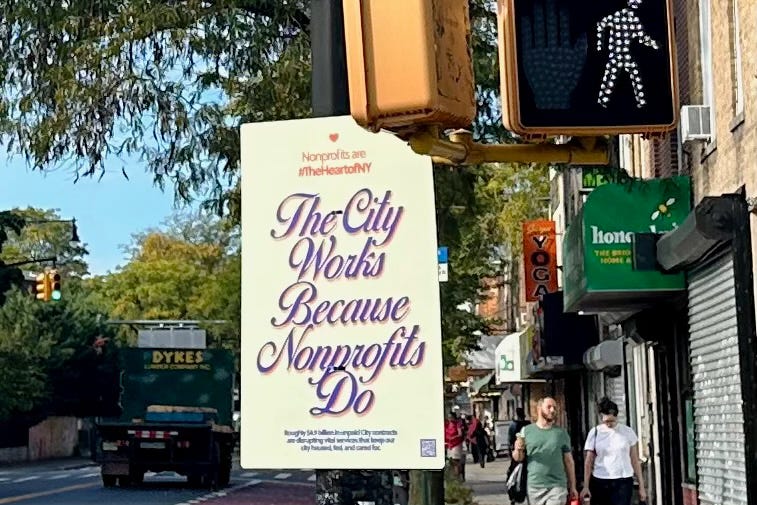
Will The Politics of Affordability Undo The Nonprofit Human Service Provision?
This Labor Day, local politicians will once again extol their support for working New Yorkers, standing shoulder to shoulder with the city’s unions. Staunchly pro-labor Mayor Zohran Mamdani will be there and may point to his support for the Delivery Protection Act, which would prohibit operators of last-mile facilities from contracting out their core warehouse and delivery work.
The bill is principally aimed at Amazon’s Delivery Service Partner model and would require companies operating these facilities to employ workers directly.
Mamdani argues that a company should not control working conditions while outsourcing responsibility for workers.
But the Mayor is also management now. And before he targets private sector contracting practices, he might want to look inward: New York City itself relies on a vast contracted workforce to deliver essential public services, and does a notoriously bad job paying and managing those contracts.
More than 80,000 employees of nonprofit organizations provide human services under New York City contracts, staffing shelters and senior centers, representing indigent defendants, and operating foster-care and after-school programs, among others.
There are good reasons to contract out work: it allows the city to potentially offer better service more efficiently, and these nonprofits tend to possess the knowledge, agility, and specialization that the city may not. But those advantages depend on the providers being able to operate independently and compete with one another.
That is, often, not how it works.
The New York City style of outsourced government means that city agencies are the main purchaser, with enormous leverage over price and contract terms. Yet it also cannot credibly allow many providers to fail and let services stop. So, the city preserves incumbents and outdated contract terms rather than risk disruption, especially when it comes to serving “vulnerable populations.”
Human services account for 87% of the city’s negotiated contract extensions since 2010. Over time, some providers become too big, too specialized, or simply too embedded to replace, and repeated extensions in turn weaken both competition and the pressure to innovate.
Incumbency can be mutually convenient—the city likes familiar providers, providers like guaranteed contracts.
But providers and workers alike bear the costs of this system.
Bureaucratic rules result in slow contract processing and notoriously late payments, effectively limiting competition to those nonprofits who can fund operations while waiting for the city to pay and know how to navigate the bidding process.
A 2025 review of payment delays for the city’s human services by the comptroller found roughly 4,000 unpaid nonprofit invoices worth $861 million. At seven of the eight agencies examined, providers waited more than 200 days on average from the official start of a contract to receive their first payment.
To help meet their contract obligations, providers often borrow to make payroll, leave positions vacant, and ask existing employees to do more.
Meanwhile, the city micromanages away the flexibility that was a reason to outsource work in the first place. Micromanaged budgets make it difficult for providers to respond to changing market conditions: moving money into payroll may require city approval that can further delay payments. Stagnant wages have led to high turnover and high vacancies.
It is hardly surprising that workers have turned to unions.
Nonprofit human-services employees earn an estimated 25 to 30 percent less than city workers in comparable jobs. This summer, employees of Bronx Defenders, a legal aid organization, staged an 11-day strike over compensation. Such negotiations are effectively three-sided: workers bargain with the nonprofit, but City Hall largely controls the money available for a settlement.
In response to this precarity, the City Council has introduced legislation (Int. 0452) that would establish a “required wage” for contracted human services providers tied to comparable city employment. #justpay, a coalition of nonprofit human services providers and workers, unions and advocates, has made passing this bill a priority.
What’s really happening here is that the city’s own contracting failures are pushing the system toward public-sector wage structure.
In a better-managed system, competitive compensation would not necessarily mean matching municipal salaries, benefits, and collective-bargaining increases—many of which are inflated by the political power of public-sector unions. By one estimate, salary parity would cost the city between $965 million and $1.35 billion annually. Replicating the full municipal compensation would risk turning nominally independent providers into a shadow civil service.
The reasons to outsource this work were and remain good ones.
Nonprofits often possess expertise and community relationships that government agencies lack; outsourcing should give them operational flexibility, and competition may produce better services at lower cost.
But if New York wants outsourcing to deliver on its promise, it needs to start by reforming its contracting practices so providers are able to operate as independent contractors: pay them on time, give them operational discretion, and rates that allow them to compete for labor. The city also needs to ensure there is enough competition so that incumbency does not become an entitlement, and capable challengers have a genuine chance to enter.
And, as MI’s Josh Appel argues, it should judge providers by service quality, not their ability to finance the city’s late payments or master its paperwork.
Mamdani’s NGO Model Army
The contracting system has also affected the city’s political landscape.
The administrative choice to shift provision of New York’s social-services from unionized city employees to a large, lower-paid nonprofit workforce has had political consequences no one fully appreciated until last year, when Zohran Mamdani won a campaign powered by tens of thousands of young, ideologically motivated volunteers.
Read Stephen Eide’s brilliant piece on Mamdani’s NGO Model Army to understand how we got here.
Related: What Role Should Nonprofits Play in Cities? (Vital City)
More from MI:
New Brief: The Mediocre State of New York State Schools

New York “spends more per pupil than any other state, pays among the highest teacher salaries, maintains some of the most rigorous teacher certification requirements, and identifies a larger share of students with disabilities than nearly every other state,” MI’s Jennifer Weber, Carolyn D. Gorman, and Ray Domanico write in a new report. Yet student outcomes remain mediocre.
They point to a governance system, led by the Board of Regents and the State Education Department, “that makes no-one truly responsible for results” as the root cause of this failure and recommend that the state measure what works and use evidence to guide policy and classroom decisions.
Rethinking NGO Procurement Through Performance-Based Models
This winter policy analyst Josh Appel looked at New York City’s nonprofit procurement process and found that the current reimbursement-based model provides few incentives for cost control or performance.
Transitioning to a performance-based model “will reduce administrative burden on the front end while incentivizing improved outcomes and lower spending,” he writes, acknowledging that “the challenge will be finding the best metric to measure “performance” across the categories of nonprofit work. But certainly, even while operating the cost-based model, we should be able to measure success to some extent even if it is not a prominent factor in procurement today.”
Extra! Extra!
Mamdani’s mixed signals on use of Signal. (The City Reporter)
Inside Mamdani’s Private Army of Public Influencers. (The New York Times)
Should NYC Have Open Primaries? Hellgate is curious why “Mayor Mamdani now opposes an election reform that would allow 1.1 million independent voters—people currently shut out of a major part of the democratic process—to vote in City primary elections.” MI’s John Ketcham thinks we should have open primaries.
Recent Trends in Personal Income & Wage Inequality — a report released this week by the city comptroller finds that New York today is more unequal than it was before the pandemic, however, “most of the increase in income concentration, in recent years, appears to have been driven by business and investment income, reflecting wealth inequality, and also by bonus incentive pay. Base wages and salaries do not appear to be the culprit—as looking at them alone suggests, paradoxically, that workers in lower-wage occupation have generally seen faster income growth than workers in higher-wage fields.”
Rules surrounding the new street vending licenses are murky (The City Reporter).
The city announced a one-year moratorium on AI for students in 2-K through eighth grade. To understand why that is a step in the right direction, read MI’s Jennifer Weber’s brief.