

From street-corner cameras to high-flying drones and license plate readers, the eye of government is getting harder to escape in New York. In today’s round-up, we weigh the evidence on whether ALPRs actually deter crime, look at the NYPD’s latest public housing lawsuit, and break down key updates on city labor battles, fiscal policy, and Wall Street earnings.
Are ALPRs Worth It?
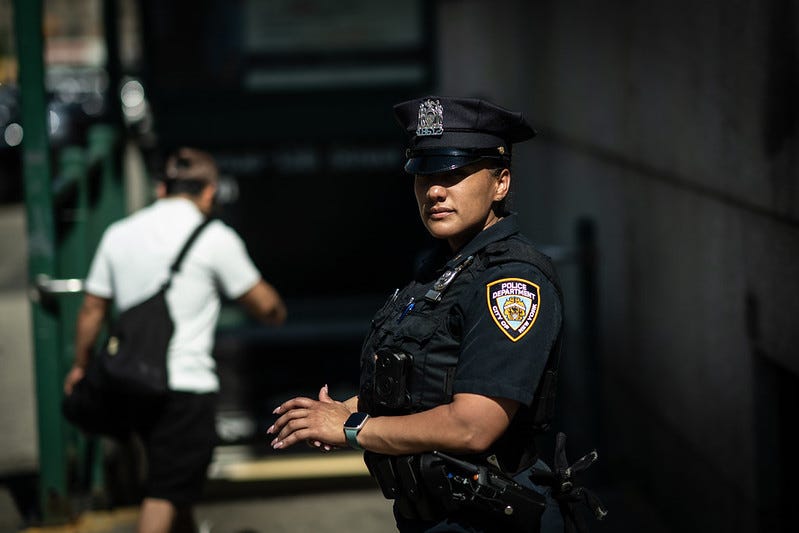
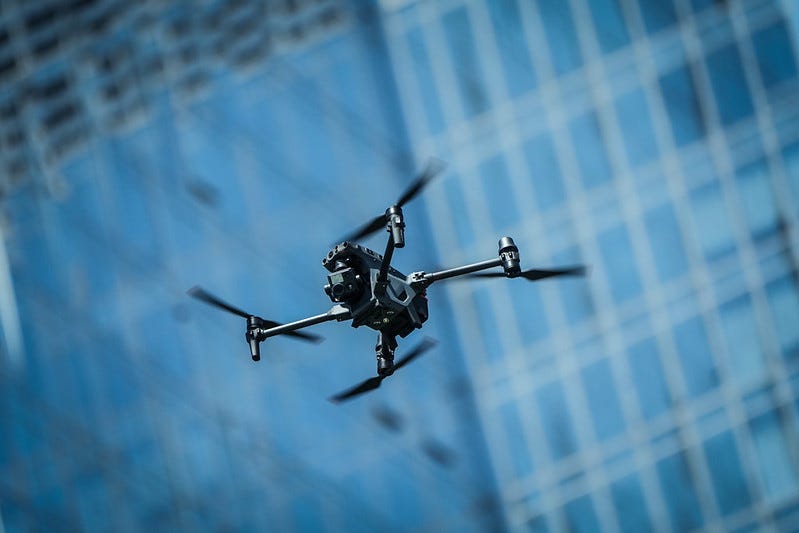
CCTV cameras capture you passing by, the NYPD watches over many street corners and from the sky, dispatching drones to evaluate 911 calls and monitor large gatherings, as well as using license plate readers to find vehicles of interest, all fed into its Domain Awareness System.
On August 26, U.S. Senator Josh Hawley (R-Mo.), Chairman of the Judiciary Subcommittee on Crime and Counterterrorism, launched an investigation into Flock Safety’s AI-powered network of thousands of cameras across the country.
Writing in defense of automatic license-plate readers (ALPR), some of which are produced by Flock, and AI surveillance in The Atlantic, MI’s Charles Fain Lehman notes that cameras in general are known to reduce crime. Do ALPRs work? There is little research, but one recent report found they resulted in an 11% drop in vehicle theft.
There has been legitimate pushback against such cameras from both the right and the left over systematic surveillance by the government and the potential for abuse of such powers. But we should not dismiss ALPRs reflexively, Lehman argues.
He points to research that cameras in Medellin, Colombia, reduced crime by about 19%. Subway stations in Stockholm, Sweden, saw a 25% reduction in crime after cameras were installed, and similarly, crime fell 20% in areas with cameras in Montevideo, Uruguay.
“Cameras help police catch criminals,” he writes. “That reduces crime through two channels: incapacitating offenders who are caught and convicted, and increasing the certainty of apprehension, which theoretically should deter criminals from offending in the first place.” Appropriately regulated, such cameras have the potential to “make the criminal-justice system both fairer and less punitive.”
Cato Institute’s Mike Fox pushes back on Lehman’s piece, quoting Benjamin Franklin: “Those who would give up essential liberty to purchase a little temporary safety deserve neither liberty nor safety.”
“Flock is merely one piece of a vastly expanding surveillance state,” he writes. “The company’s potential downfall should not be blamed on legislation targeting ALPRs specifically but through the firm enforcement of the Fourth Amendment itself.”
Related:
Two of the city’s public housing (NYCHA) tenant associations are suing the city over privacy concerns from NYPDs direct, real-time access to nearly 20,000 public housing cameras, NY Focus reports. The footage goes straight to the NYPD’s Domain Awareness System to support the NYPD’s “predictive policing” approach.
Crime Data & Reality
Murders and shootings are down mid-year, and while the rest of the seven major crimes are also down, overall major crimes remain 25% higher than in 2019. Felony assaults have increased for 6 straight years and are now 48% higher than in 2019.
“Criminologists have for years generally viewed homicides as one of the most reliable markers of general crime trends because they tend to have the highest reporting rates. They also constitute a category that is relatively difficult to manipulate,” MI’s Rafael Mangual writes. “But in New York’s case, homicides have diverged from many of the other crime categories tracked by the city, which over the last several years have not declined at nearly the same rate, if at all.”
Despite progress, the city was not yet at pre-pandemic crime levels at the end of 2025.
Related:
Where Do Voters Turn When Crime Goes Up? Apparently, Nowhere in Particular, MI’s Robert VerBruggen writes.
Unions and Fear of Being “LaSalled”
Mamdani is right to take on the City Council over paraprofessional pay, MI’s Ken Girardin explains. Such payment should be part of collective bargaining under the 1967 Taylor Law, and a ruling against the mayor would embolden public-sector unions to make similar deals with lawmakers outside of contract negotiations.
“The fight between the city council and Mamdani will be compelling because of the extent to which the unions have gone in attacking the independence of the state’s judicial system,” Girardin writes, referring to the union-led campaign three years ago to derail Hochul’s nominee Hector LaSalle. “The UFT seems to be betting that judges, at least at the trial level, will fear getting ‘LaSalled’ if they question the legality of what the union and its proxies are attempting.”
More from MI

Nicole Gelinas on NYC Austerity. What do we mean when we talk about austerity in New York? In a must-read piece in City Journal, Gelinas dives into the city’s history and looks at what Mamdani’s narrative is likely to mean in practice. “Though politically useful, Mamdani’s attacks on austerity may only hasten its return,” she notes. “Regardless, then, of how New York’s mayor or other political leaders talk about austerity, the real question is how long governments can keep avoiding it. After decades of rising debt and expanding budgets—and financial markets willing to absorb both—fiscal restraint has been the exception rather than the rule. The uncertainty is not whether austerity will return—but when.”
John Ketcham on Urban Density. “Whether greater density yields shared prosperity or urban dysfunction depends on whether public and private institutions can channel the concentration of humanity into productivity rather than cacophony,” Ketcham writes in City Journal. “The denser the city, the more capable its government must be to address its disadvantages.”
Christian Browne on Mamdani vs. Amazon. “The city council has no general power to ban employment contracts or to dictate the labor arrangements between last-mile operators and their workers,” Christian Browne writes. “The New York State Labor Law governs employment matters throughout the state.”
Extra! Extra!

Comptroller’s monthly economic snapshot of the city’s health notes that Wall Street firm profits reached $24.8 billion, boosting corporate tax payments that surpassed New York City’s full-year Financial Plan profit projection in just six months.
Mamdani has assembled his Business Advisory Council, to be announced imminently, the New York Times writes.
The number of millionaires in New York is virtually unchanged, according to the latest income tax data from the IRS, MI’s E.J. McMahon writes.
Economic gain from the 2026 FIFA World Cup for the region: $3.5 billion, a report from Gov. Hochul says.
Grocers sue the city over Mamdani’s city-owned supermarket plan, claiming such stores would be unfair competition, NY Post reports.
REBNY second quarter real estate report shows that condo construction is down.
Mamdani’s pied-à-terre tax rollout has been a mess, but it has cost Mamdani nothing in terms of support from his political base, MI’s Daniel Rosen writes.
Students want to be in the city, and universities are hiring, the City Reporter reports.
