

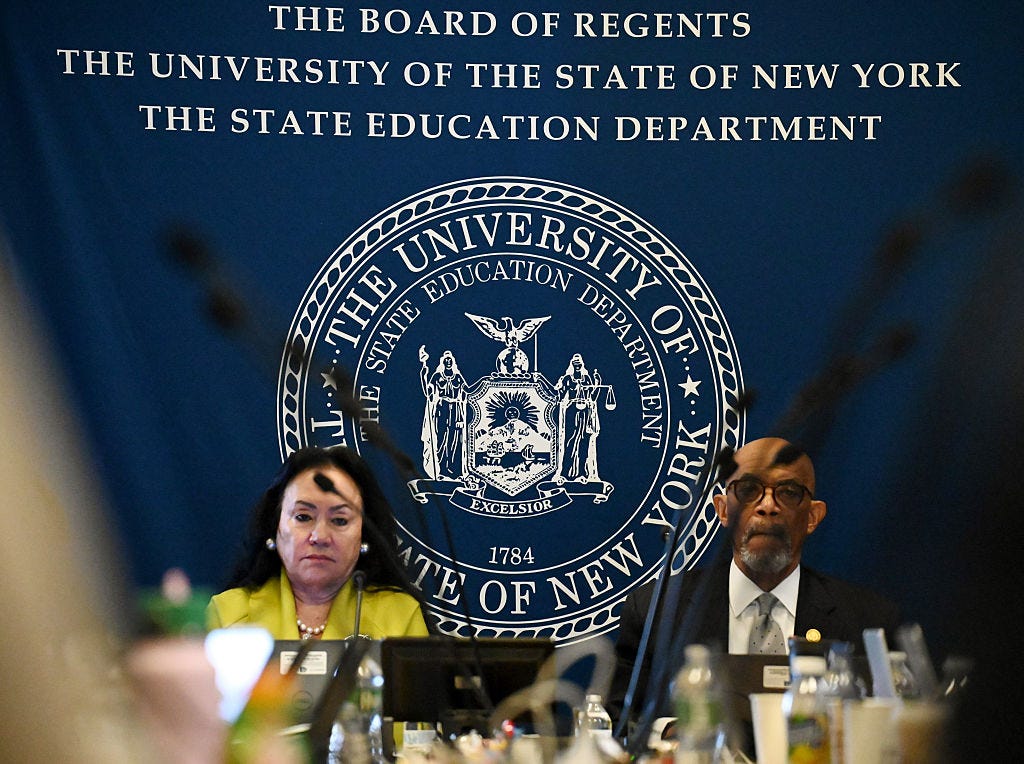
State Senator John Liu wants to give the Board of Regents, which answers to no voters, a new responsibility: the power to decide each year whether New Yorkers opt into the federal tax credit for education scholarships.
Liu introduced this bill earlier this month, weeks after Governor Kathy Hochul became the second Democratic governor to opt into the program. His proposal would take the decision away from Hochul and hand it to the Board of Regents, which oversees the state’s Department of Education, beginning in 2028. The board would also have a say in which scholarship organizations qualify.
The problem with the Board of Regents is that the legislature chooses them. That makes it nearly impossible for voters to hold anyone accountable for education outcomes within the state.
The scholarship program, created by last year’s One Big Beautiful Bill Act, allows taxpayers to redirect up to $1,700 per person (or $3,400 per married couple) to scholarship organizations starting January 2027. The money can be used to pay for private school tuition, but also for tutoring, enrichment programs, transportation, and instructional materials for students in public schools.
Liu calls the credit “a federal voucher program.” He argues that the Regents’ expertise makes them the right body to decide whether New York should continue to opt in.
Liu and his co-sponsors, including State Senator Liz Krueger, think that scholarships could draw students, and eventually funding, away from public schools. The federal government pays for the tax credit in full; New York only has to decide whether its residents can take advantage of it.
And falling enrollment has not taken funding away from the public schools. Between 1993–94 and 2023–24, enrollment in New York’s public schools fell from 2.67 million to 2.42 million, while their total revenue nearly quadrupled, from $23.5 billion to $90.1 billion. Even after inflation, spending per student nearly doubled.
The federal credit is also not limited to private school students. Some families have already chosen religious schools. Families wanting their child in a Catholic school or Yeshiva can use scholarships to help pay tuition. Those children most likely would never have ended up in public schools to begin with, and the scholarships help them pay tuition while giving them the choice of school that makes sense for them. Other families want to keep their children in public schools but need help paying for tutoring, enrichment, or special-education services. And that is where the tax credit can help.
Liu wants that decision taken from the governor and given to the 17 Regents, who are chosen by the legislature, set education policy, and appoint the state education commissioner. In a Manhattan Institute report this September, my colleagues, Ray Domanico, Carolyn Gorman, and I found that New York spends about $34,300 per student, more than double the national average. Yet fewer than one in three fourth- and eighth-graders read proficiently on the National Assessment of Educational Progress (NAEP).
Liu sees the board’s independence as a strength. His own press release even credits the board with setting policy for more than 200 years. But that really just means that taxpayers have nobody to hold accountable for education outcomes within the state. The handling of graduation requirements is the most recent and clearest example of what Liu would be trusting by giving the Board of Regents control of the federal tax credit. [Link my story to]
In July 2025, the Regents adopted a new “Portrait of a Graduate,” part of an overhaul of New York’s high school graduation requirements. Students who graduate in January 2028 or later will no longer have to pass a prescribed set of Regents exams to earn a diploma. The state is also developing a broader system for demonstrating academic competencies.
The Board of Regents has argued that students should have more ways to demonstrate what they know. But changing graduation requirements is one thing. Establishing reliable measures of what students have learned is another.
At the board’s recent meeting, Education Commissioner Betty Rosa called for a significant increase in state funding to pay for the new requirements. “When we have an initiative like this, we can’t be starved,” she said. Yet, she did not say how much it would cost.
School officials are already asking for grading rubrics and examples of acceptable student portfolios. Rosa suggested that some schools might need experts to help teachers evaluate student projects, and that every school might even need a coach.
Regent Weinman Shorenstein warned that evaluating portfolios is a lengthy and expensive process. Regents exams, by contrast, give every school a common basis for measuring student performance.
The legislature did not vote for this overhaul. The Board of Regents and the Education Department developed it. Lawmakers will instead be asked to carry it out.
Hochul herself has questioned this division of authority. Just after her reelection, she called for greater control over state education policy, pointing specifically to the decision to eliminate Regents exams as a graduation requirement. She even argued that because the state pays for education, she should have the final say. There is a problem when one body sets policy, and another finds the money: nobody is then accountable or bears full responsibility for the results.
If Liu’s bill passes, the same board whose commissioner says its overhaul “can’t be starved,” would gain a veto over federal money that can pay for after-school tutoring, enrichment, and additional services in public schools. And if the Board of Regents declined to opt in, families could lose that help after just one year.
Albany should start by rejecting Liu’s bill. Then it should change state law to let the governor appoint a majority of the Regents, so that one elected official answers for what the board does. Lawmakers would still control the money. And the voters would finally know whom to blame when their children are not learning.
Hochul has said she wants that job. “The buck should stop with me,” she said earlier this month. The legislature should take her at her word.
