


A common question from education professionals outside New York is how the city can manage to spend over $42,000 per student while roughly half of its students fail to meet basic reading and math benchmarks. The answer is that the city is wasting a massive amount of money because it prioritizes politics over the needs of students and families.
Let’s look at the latest data.
The number of students in the city’s public schools is falling. The Department of Education’s projections indicate a 4.2% decline in enrollment for the coming school year (excluding pre-K students in off-site facilities), down from 766,730 to 734,551 in SY 2026-27.
The School Construction Authority is also projecting a steady decline.
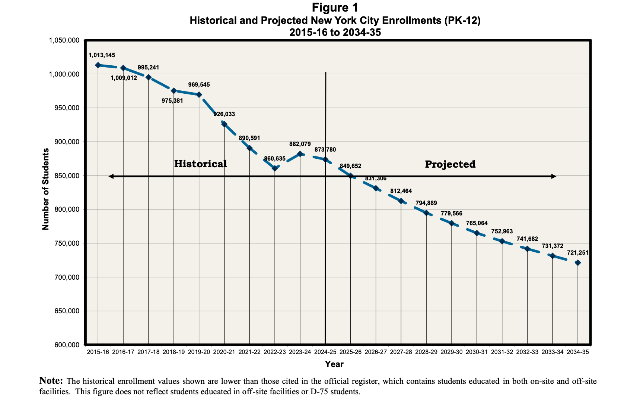
Despite this, the total education budget under Mayor Mamdani continues to rise, with a proposed 7.4% increase, and by increasing total funding while educating significantly fewer children, the per-student cost keeps rising ever more.
Class Size Law
A major reason for these soaring expenses is the UFT’s outsized impact on city and state politics, perfectly illustrated by the ongoing battle over the Class Size Law.
Passed by the state in 2022—with the support of Mayor Mamdani, then an assembly member—the law mandated strict caps on classroom sizes in the city’s traditional public schools to improve the quality of education.
But from the beginning, the law was built on a series of practical impossibilities.
First, the city lacks physical space in school buildings to create thousands of new classrooms. Second, due to a labor shortage, there are not enough qualified teachers to staff these new classrooms. Lastly, the price tag is billions for new construction and teacher salaries that the city can ill afford. All of this was methodically recorded in the Class Size Working Group Minority Report.
This terrible law should never have been passed and must be repealed, as some are also asking. Academic consensus indicates that the individual classroom teacher is the primary driver of student success, not class size.
The political motive behind the law is transparent: after the city’s public schools lost more than 100,000 students between 2019 and 2022, it was clear the they no longer needed so many teachers. Albany hurried to pass the law to keep the UFT insulated with an artificially preserved headcount of dues-paying members.
Fiscal Implications
This year, facing a massive budget gap and mounting costs to comply with the law, Mayor Mamdani and Albany negotiated a two-year extension, delaying the full implementation of the Class Size Law until the 2029–2030 school year.
However, to secure union approval for the delay, the city struck a side deal with the UFT to directly compensate teachers working in non-compliant classrooms. Under this arrangement, the union won additional compensation of up to $8,500 for teachers working in rooms that exceed the mandated caps. It is estimated that 2,463 teachers will receive this bonus. The city is now budgeting to penalize itself—paying extra union salary costs because it structurally cannot meet the law’s demands.
Enrollment and Compliance
The district has achieved compliance in roughly 64% of classrooms, but meeting the remaining threshold poses a serious dilemma.
Most non-compliant schools are highly sought-after, popular institutions with full classrooms and limited physical space. To comply, these popular schools will be forced to reduce enrollment and turn families away. As Schools Chancellor Kamar Samuels recently noted, “when families don’t get their first option, they usually don’t come to the public school system.” By capping enrollment at its best schools, the city risks accelerating its own enrollment decline.
Instead of adjusting school budgets to changing demographics, Chancellor Samuels announced that schools that lost students this year will see their budgets remain completely intact for next year. This is an extension of the “hold harmless” policy instituted during COVID-19, which has already cost the city $1.6 billion. Decoupling funding from actual student enrollment removes accountability, giving principals no reason to care whether families and students are re-enrolling in their schools.
The outsized and growing power of the teachers’ union in NY runs counter to what is happening across the country. A new report from the Fordham Institute shows that union power is declining in most states, driven by the expansion of school choice and the Supreme Court’s ruling in Janus v. AFSCME, which barred the mandatory collection of union dues from nonmember teachers.
But while other major cities right-size their schools to match demographic shifts, and other states empower families to make choices about how to educate their children, New York continues to spend billions to protect its institutions and appease the unions. The $42,000 per-pupil figure reflects funding empty classrooms and paying penalties for a law that can never be fully implemented.

As a teacher, I generally agree that class size really doesn't matter, though I am in the minority among teachers with regard to this. Generally speaking, a class of 34 mostly well behaved and attentive students is a lot easier to teach than a class of 15 students where three or four of them engage in disruption and/or misbehavior. Related to that, how little support most teachers have when trying to discipline such disruptive students can throw the whole class out of whack.
My school is quite small and is in a campus. I'm sure I don't need to explain what that is. Most of my rosters cap out at 22; of those, I have about 70% attendance on a good day. There are obviously lots of factors, but we definitely have the space to accommodate more students. This seems largely an issue more about increasing attendance overall than anything else.
Iq is genetic and “education” does nothing to change it. Basic three Rs training could get done for $10k a year easy. The rest is all just union and contractor grift for the benefit of the providers not the kids.
If NY just gave everyone $42k cash per kid we could solve the fertility crisis overnight.