

Autonomous vehicles are a revolutionary new technology that is already available in American cities like Los Angeles, San Francisco, and Austin, and even skeptics concede it’s a matter of “when, not if” these cars arrive in full force in New York City.
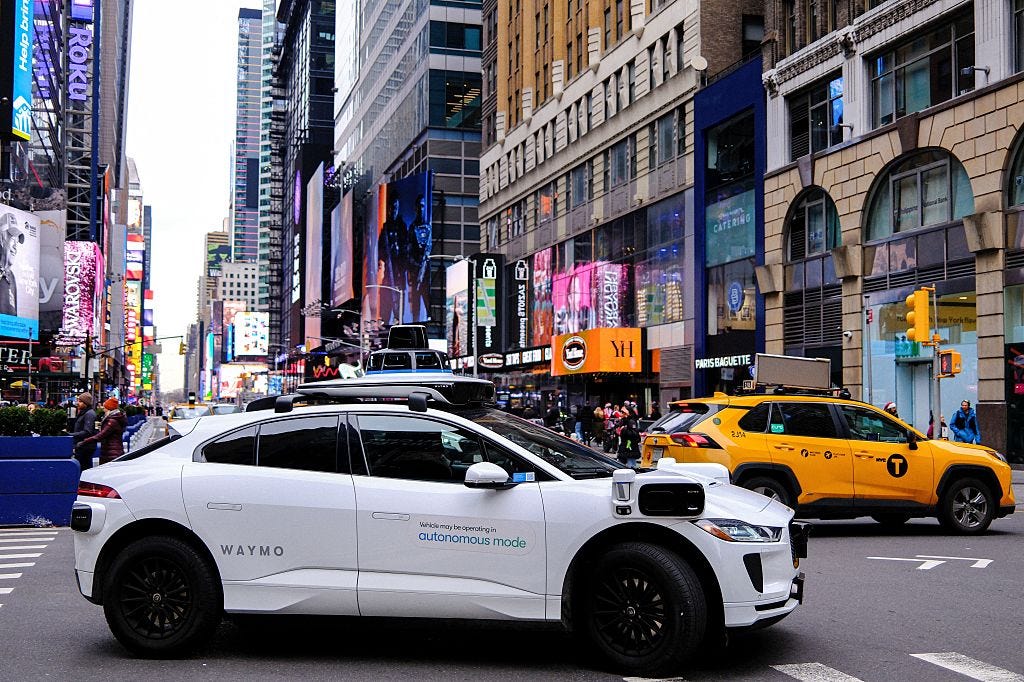
But New York’s political class, planners, policy wonks, and journalists are resistant to change, cautious after the upheaval caused by the ride-hailing expansion of the 2010s, and skeptical of trends that don’t start here.
Mayor Zohran Mamdani has a positive vision for transportation — he has revived stalled bike and bus lane projects. But here, technology threatens a constituency that delivered his margin of victory: he went on a hunger strike with taxi workers in 2021, and has not left that political moment.
There are four main objections to self-driving taxis: that they’ll throw for-hire vehicle workers out of work; that they’re dangerous; that AVs will increase congestion; and that they’ll hand New York’s streets over to corporations.
On The Bigger Apple Podcast, I recently spoke to my co-host Nicole Gelinas, “Gridlock Sam” Schwartz, and Kelly McGuinness, who runs the Sam Schwartz Transportation Research Program at Hunter College, about autonomous vehicles and New York. None of them is reflexively anti-AV; all argue that the technology should be regulated before deployment rather than after, and that it has the potential to be good, especially if integrated with transit. They raised a range of serious concerns and suggested, reasonably, that New York can afford to watch and learn from the experiences of other cities.
But by claiming that no city is quite like New York, we tend to dismiss these experiences. Many major cities in America have permitted autonomous vehicles, and their citizens choose to ride them, not least because they perceive them as safer. New Yorkers should not be denied that choice indefinitely, and unless we test, we will never know.
These objections deserve to be taken on their own terms.
Thousands of drivers will lose their jobs
There are roughly 180,000 licensed for-hire vehicle drivers in the city, for whom driving has long served as a primary path to economic opportunity — a substantial political force, and a significant share of the city's labor market. The fear of impact on this workforce is real, and pretending otherwise would not be a serious response.
If one accepts the inevitability of technological change, the solution points toward proactive management of the transition rather than prohibition. Change will not happen overnight. New licenses can be issued over months and years, and new kinds of work will likely emerge, including around maintenance, safety, and oversight. Worker retraining funds could be created from AV license fees. As New York’s planners like to remind us, there’s a recent precedent — the Uber and Lyft-driven upheaval of the late 2010s.
But there’s also precedent for what happens when the response is to refuse the technology indefinitely — and that’s the failure to modernize New York’s subway system, driven in part by rigid labor and operational practices.
As TWU International President John Samuelsen put it: “The 1960s version of Abundance bros was saying it’s inevitable that there will be fully automated operation of the NYC subway,” the City & State reports. “Forward flash 60 freaking years, and there’s still a two-person train crew. That’s because of the union.”
The right time to engage with new systems is before they are at scale, not after.
AV Safety Record is Questionable
This is the objection most dependent on still-limited empirical evidence and unresolved questions about what counts as “safe enough.”
Findings published in peer-reviewed journals suggest that Waymo vehicles are involved in substantially fewer serious injury crashes than human drivers in similar operating conditions.
But autonomous vehicle deployment remains geographically limited, is yet to be tested in dense urban environments like New York, and AVs have not yet accumulated enough real-world miles to definitively establish long-term comparative safety, something Waymo is complementing with billions of simulated miles.
Public tolerance for machine error is likely to remain lower than tolerance for ordinary human negligence.
Another objection is that New York is very different from other cities.
New Yorkers don’t behave the way other Americans behave. We don’t stand on the corner and wait for the walk signal. We cross where we want. We stand in the first lane. We jaywalk. Yet the city’s casualty rate per mile driven is the lowest of any major American city, arguably in part because of that chaos. Autonomous vehicles, which are programmed to obey rules, cannot model the unwritten ones New Yorkers actually follow.
The city has, for decades, built its streets in ways that prioritize cars. Jaywalking is a rational response to infrastructure that punishes compliance.
Traffic deaths peaked at 701 in 1990. Last year, there were 205, widely attributed to the success of Vision Zero – speed cameras, red light cameras, leading pedestrian intervals, shorter crossing distances created by bike and bus lanes, and lower speed limits.
But changes that calm the streets and make rules easier to follow also make the streets more welcoming to vehicles programmed to obey rules.
The argument that it just won’t work in New York, even if it works in San Francisco or London — well, we will never know until we try it, especially if our environment, as is claimed, is so unique.
Other concerns center on blackouts (which, by the way, also affect the subway), system failure, remote operators, terrorism, data privacy and security issues, as well as liability — more will inevitably arise as the technology gets deployed.
Autonomous systems do introduce more centralized risk, but they also introduce new forms of control. A human driver can make unpredictable decisions; a networked fleet can be monitored, constrained, and shut down.
This is not a choice between risk and no risk but between different risk structures, and the responsible way to evaluate them is with data the city does not currently collect.
Congestion Will Get Worse
Critics are right that adding a new mode of vehicle travel adds new vehicles to the road, but it does not follow that it should result in more congestion if aggressive road management is implemented. Absent pricing and road management, AV fleets could worsen congestion, much as ride-hailing did in the 2010s.
New York’s streets are scarce public goods that must be priced and managed. The demand for fast, flexible, door-to-door service is real – people pay for it even during surge pricing. Time is valuable in New York City. The average American worker spends just under an hour commuting each day, and New Yorkers have some of the longest workweeks and worst commutes.
And yes, sometimes that demand will pull from public transit, especially when the alternative provides a superior service. The person who needs to make a work call may prefer a car. The elderly or disabled rider is more likely to be on the bus. The young professional decides whether the weather and her clothes are better suited to a bicycle or the subway. A multitude of considerations go into which mode of transportation one chooses at any given time, and a good system provides and prices such alternatives to maximize efficiency.
Transit remains the backbone of the system as it is the only mode capable of moving millions of people efficiently. But it is not a complete solution, and the city’s goal isn’t simply to get as many people on the subways as possible — it’s to help its citizens lead their best lives. The current transit system is designed to move people into Manhattan, ignoring much of the inter- and intra-borough needs. This is one reason why car ownership remains high in the outer boroughs, and why more efficient, AV-integrated fleets might provide better service to the people who have no other way to get around when or where the demand is low.
The real threat to transit is not competition; it is unpriced or poorly priced competition. Congestion pricing is the natural policy response, and explicitly linking AVs to new revenue for public services could make those charges more politically palatable.
Corporations will rule the streets
Like Uber and Lyft in their day, AV publicists like to talk up ways their companies can make positive social change for people in hard-to-reach places or with disabilities. The public appears receptive: polling commissioned by the Chamber of Progress in 2025 found 71% of New Yorkers believe AVs will particularly benefit elderly and disabled residents, and a majority support expanding AV testing and availability in the city.
Still, officials’ concern here is that companies will prioritize high-demand areas, often in Manhattan, in ways that may not align with the city’s broader goals around equity. This is not a new problem and is precisely what regulation is for. The city already has tools to address it — pricing, caps, service requirements, and data-sharing rules, among them.
The constraint is whether the city has the willingness and capacity to use them.
The incentives of the various stakeholders, and their relative powers, do not line up with the public good of moving as many people as possible safely and efficiently. Companies are driven by profits, labor by job protections, and politicians by their reelection prospects.
The choice in front of the city
New York law currently requires drivers to keep “at least one hand on the wheel” — meaning companies like Waymo cannot even begin driverless testing here, let alone commercial service. (Waymo’s NYC and state testing permits expired at the end of March, and are yet to be renewed.)
Waymo is now operating commercial service in 11 metro areas, including Dallas, Houston, San Antonio, Miami, and Orlando — all in Republican-dominated Texas and Florida, chosen for their favorable regulatory climates. If all goes according to plan, Waymo will be operating in more than 20 cities by the end of 2026.
New Yorkers travel. They come back having experienced a service they can’t get here. Meanwhile, a bill that may lead to federal preemption of some local regulation is already moving through the House. The question is not whether New York faces this, but how soon, and on whose terms.
One thing is obvious, though: Mayor Mamdani, Governor Hochul, and other city and state leaders should insist on extensive pilots and begin building the regulatory framework now, while the city still has the opportunity to shape the technology on its own terms.
Good article, but too gentle!
NYC's luddite politicians and union hacks oppose most every innovation.
They tried to kill off Uber and Lyft, but they cause LESS pollution and congestion than taxis because they don't cruise, looking for fares.
Self-driving taxis will be even better because the machines are safer than human drivers. Not approving them would be condoning mass murder.
Generally on target, though you threw me with this reference: The person who needs to make work calls will not be on the subway.