

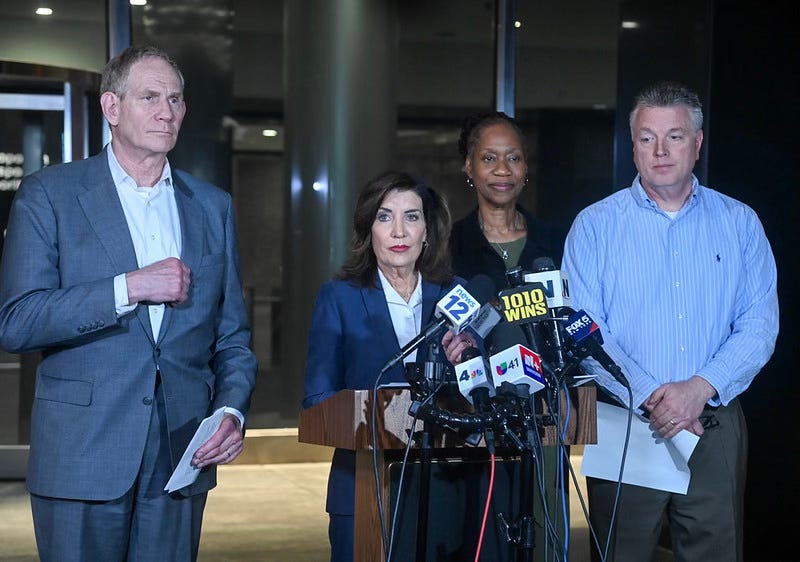
After more than three days, the Long Island Rail Road strike is over. Governor Kathy Hochul announced Monday night that the MTA and five LIRR unions had reached a “fair” deal that won’t result in higher taxes or fares—at least in the short run. Service has resumed, but the strike will affect MTA’s ability to fund future labor agreements.
LIRR workers enjoy the highest pay of any commuter-rail system in the country, thanks in part to overtime, which accounts for 22 percent of the railroad’s payroll. As MI’s Ken Girardin has pointed out, in 2025, over 328 LIRR employees earned more than $100,000 in overtime alone, while 168 made more in total pay than Hochul’s $250,000 salary, and 25 hauled in over $300,000.
Antiquated work rules have become sacred cows for union bosses, in part because workers have come to expect the opportunities for extra pay. One of the most egregious “penalty pay” provisions grants train engineers an extra day’s pay if they operate both a diesel and an electric train during the same shift. Another gives a full day’s pay for moving a passenger train to a yard after service. Those provisions stack, so an engineer could theoretically be paid for three eight-hour days after working a single shift.
Unsurprisingly, LIRR fares are also much higher than the subway and bus’s flat $3. LIRR’s monthly fares top out at nearly $500, while the subway system has a $35 weekly cap, or about $140 monthly. Hochul warned that accepting the railroad unions’ demands would cause fares to spike 8 percent.
Before the strike, management and labor had agreed on a cumulative 9.5 percent raise, effective retroactively, for 2023 through 2025. Unions demanded 5 percentfor 2026, while LIRR offered 3 percent and a $3,000 lump sum payment, in exchange for productivity concessions. More recently, LIRR offered a lump sumpayment of 4.5% for 2026, which union bosses rejected as a “one-time gimmick.”
The final deal, whose details still require MTA’s confirmation, provides a 2026 raise of 4.5 percent, in exchange for workers forgoing pay on up to 16 hours of Computer Based Training (CBT). There were no other changes to work rules or overtime provisions.
After holding out against union demands for months, Hochul provided reason for hope that she could reform some of the LIRR’s structural cost drivers. Because she doesn’t face a primary challenger, she had a freer hand to force concessions on the unions in exchange for a deal. While she could have held out for more, she also had good reason to stop a strike from hampering the downstate economy, particularly ahead of the Memorial Day holiday.
In short, Hochul continued the status quo, while securing modest savings compared to union demands. The biggest missed opportunity, therefore, is forgone productivity. The work rules that have made LIRR operations outdated and inefficient will remain in place, save for the CBT giveback.
Nonetheless, it’s good that Hochul stood up to the union bosses, and not all hope for reform is lost. The new contract will expire in August 2027, giving her another chance to renegotiate work rules in her likely next term. But as now, doing so will involve confronting militant unions that won’t give an inch unless she shows real mettle.
Despite a less-than-ideal situation this time, the governor sent the important message that she will not capitulate to unreasonable labor demands. That should strengthen her hand in future bargaining rounds with the Transport Workers Union Local 100 and the approximately 40,000 subway and bus workers it represents.
As Girardin and I wrote in the New York Post, the LIRR fight was never just about the LIRR. Because LIRR is governed under federal law, its unions are legally authorized to strike, giving them leverage that most MTA workers do not have. TWU Local 100, which represents subway and bus workers, cannot legally strike under New York’s Taylor Law. An illegal walkout could subject the union to potentially crippling penalties and even jail time for the leaders who authorize it.
So the TWU had every reason to support a richer LIRR deal that could “set the pattern” for its own negotiations. That’s why Hochul’s holding the line mattered so much, not only for the LIRR contract, but to prevent an unsustainable precedent from rippling across the entire transit system.
The LIRR strike imposed real economic costs and inconveniences, but the public didn’t exactly rally to the side of railway employees seeking additional concessions from riders and taxpayers. Plenty of left-of-center transit advocates saw through the unions’ absurd requests.
By contrast, many New York Republicans, including Nassau County Executive and gubernatorial candidate Bruce Blakeman, irresponsibly swallowed the union line wholesale. They found themselves on the same side of the picket line as Democratic Socialists such as Assemblymember Claire Valdez. She marched alongside striking railroad workers, many of whom live on Long Island and likely support the MAGA movement. Blakeman, for his part, parroted union leaders’ gripes that there was “no money” for Long Island because of funding that had been going to illegal migrants.
LIRR’s already generous pay, along with management’s agreeing to most of the unions’ demands, make these claims unfounded. In any event, the migrant crisis, whatever its costs and mismanagement, has no reasonable relationship to the LIRR strike. Most of that spending was borne by the city, not the MTA, and couldn’tbe substituted to pay for railroad labor contracts. Besides, LIRR wages require recurring revenues, and the migrant crisis’s recurring budgetary pressure has diminished.
The governor deserves credit for refusing to give the unions everything they wanted, and for getting the trains running again ahead of a major holiday weekend. The price of peace was letting the old rules roll on.
Blakeman is baloney.