

Student protests in France began at Saint-Exupéry, a high school in Créteil, southeast of Paris, where students blocked access to the school over teacher shortages, overcrowded classrooms, and deteriorating buildings. Within days, the protests had spread. By October 1, more than 1,000 high schools had been affected, and 222 were blockaded. Some protests also turned violent.
Two weeks later, unions and other groups joined a much larger national protest. By then, it was no longer just about schools; it also became about budgets and the cost of living. Between 550,000 and 800,000 people took to the streets on October 17th across France. Masked groups also broke into and robbed stores, attacked police and public buildings, and set fire to Limoges city hall.
So, how does a teenager protest become a citywide riot?
For decades, explanations for teenage urban riots have focused on poverty, segregation, discrimination, failed institutions, and policing. That explains how conditions accumulate and why some neighborhoods are more vulnerable.
From a behavioral perspective, we can look at this differently.
A teenager does something, whether it’s showing up late, skipping math, or disrupting a class. The student learns quickly what will happen, if anything at all. The student either does it again or doesn’t. Each school day offers hundreds of opportunities. These events create what we in behavior analysis call a learning history. Most of it gets written in school.
With that in mind, we need to consider the early responses to the riots.
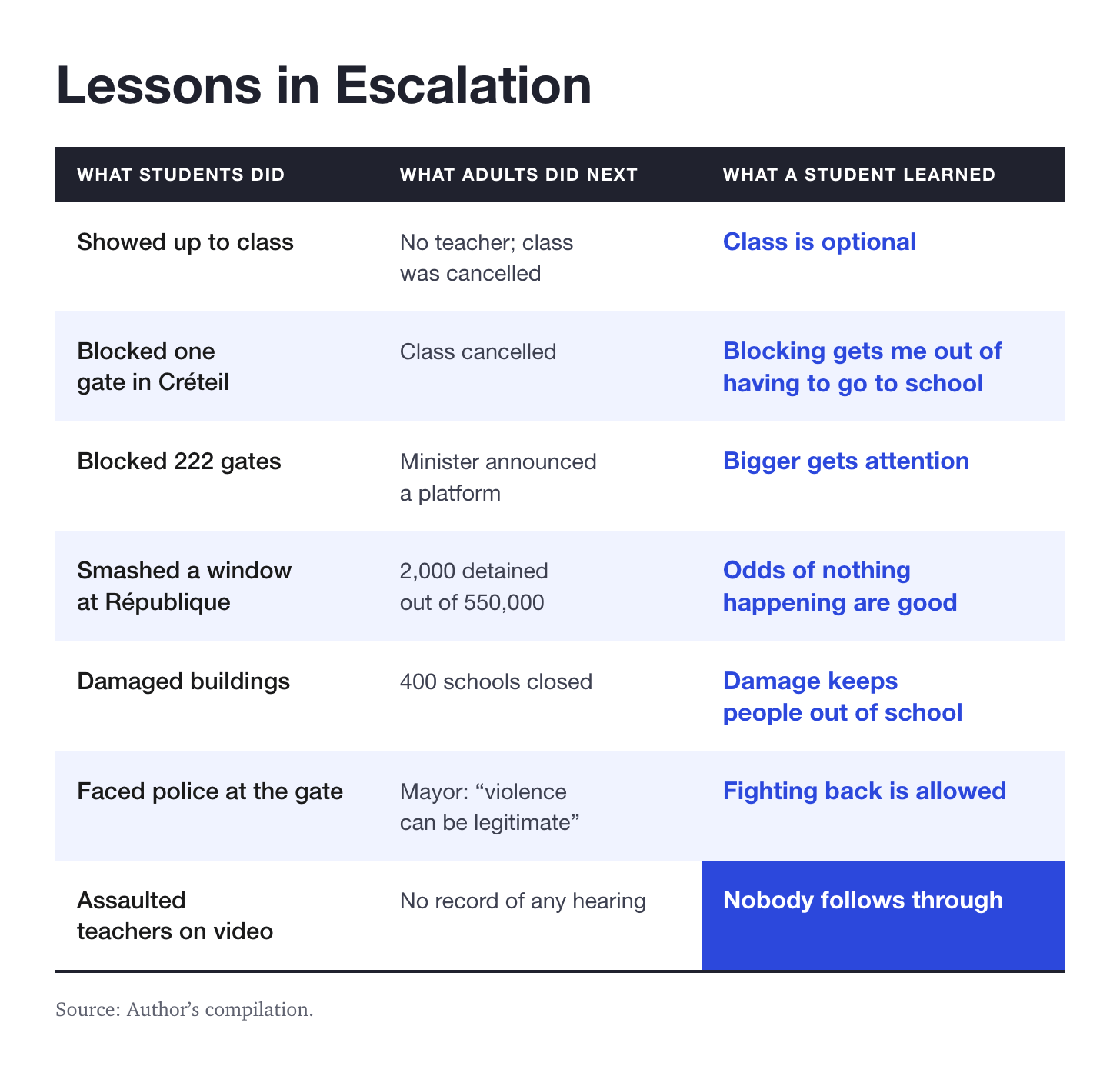
Government’s first response was to close the schools.
Closing the schools gave the disruptive behavior exactly what it was producing: no class.
At Saint-Exupéry, students began blocking the school in late September. On September 30, a Wednesday, the education minister announced a national “consultation platform” to collect students’ demands.
By Friday, roughly 400 schools had closed as blockades and damage made normal instruction impossible. The minister met with student unions, parents’ federations, and teachers’ unions at the ministry.
The following week, the minister pledged that the government would not cut any teaching posts in 2027 and said it would amend the budget to address some of the student demands.
Schools’ response was handcuffed by their discipline rules.
France’s national code includes warnings, reprimands, responsibility measures, temporary classroom and school exclusions, and permanent expulsion. A hearing is even required when a teacher is verbally threatened and mandatory when one is assaulted.
Yet, more than a thousand schools were disrupted in ten days, and teachers were assaulted on video, and there is no public record of disciplinary hearings on anything like that scale.
On October 16, in the middle of the crisis, a teachers’ union in western France filed a formal alert that local education authorities distrusted staff trained in restorative justice and even blamed the practices themselves for the rioting.
Since 2014, France’s national guidance has explicitly encouraged what it calls a restorative justice approach: up to twenty hours of “responsibility measures,” suspended sanctions, and alternatives to exclusion intended to reintegrate the student and repair relationships. The same guidance also says schools must sanction serious, repeated misconduct.
American cities have spent the past decade testing the same idea of restorative justice. The problem with restorative justice in schools is that districts use it as a replacement for consequences rather than a supplement.
A two-year randomized evaluation by RAND in Pittsburgh found that restorative practices reduced suspensions in elementary grades and improved teachers’ ratings of school climate, but did not reduce middle-school suspensions, and academic outcomes worsened for students in grades six through eight. A federally funded evaluation of restorative circles in Brooklyn high schools, by the Center for Court Innovation, found no evidence of any effect on student behavior, suspensions, or school climate.
In a Manhattan Institute brief last year, I found that New York City spent nearly $97 million on restorative justice over a decade while classroom disruption and police interventions in schools all got worse.
Societal enabling
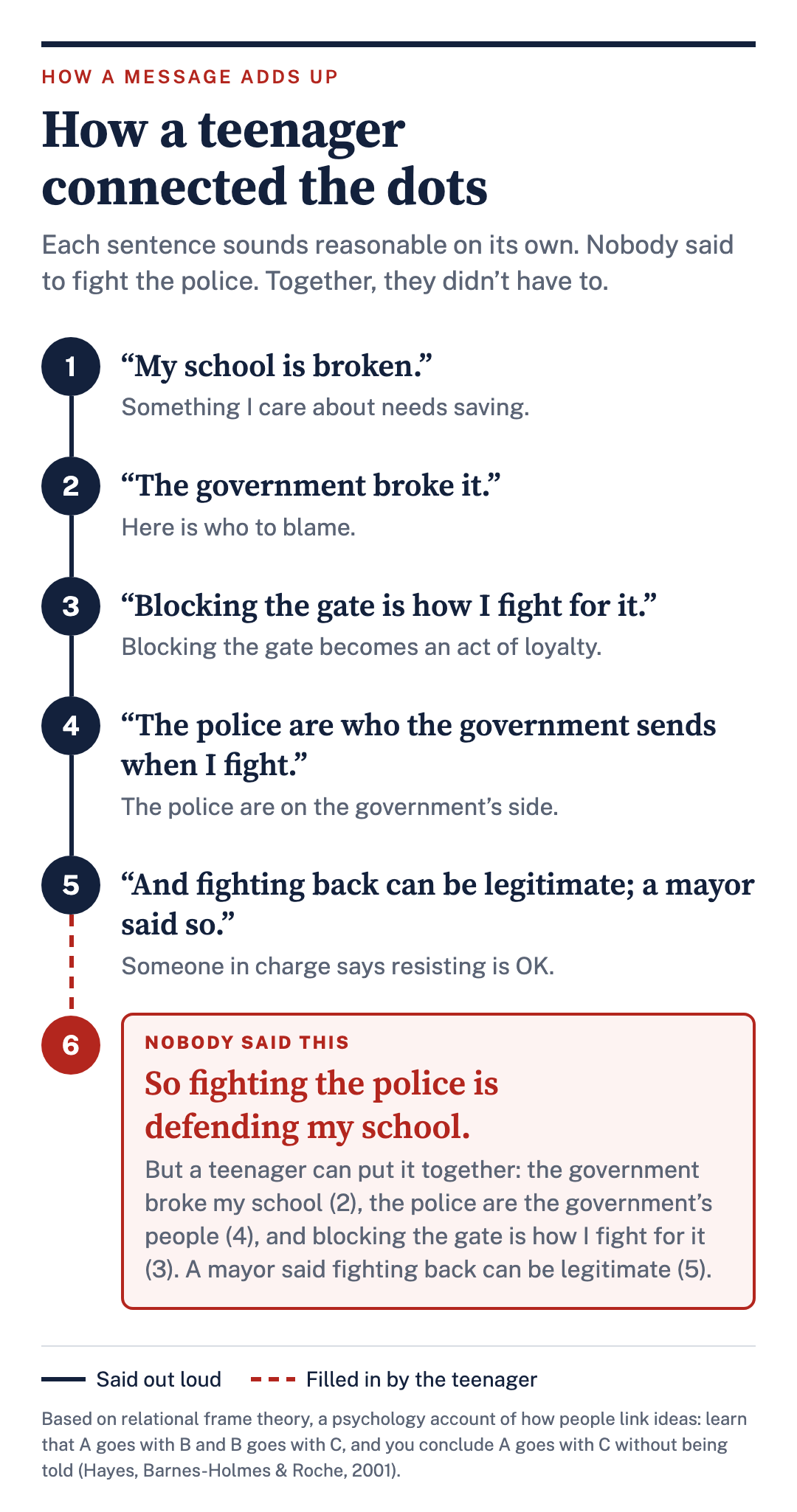
The coordinator of France’s hard-left party said on national radio that the student mobilization deserved everyone’s salute and should spread. The mayor of Saint-Denis, standing outside a blockaded high school, said on television that violence can at a certain point be legitimate. Teachers’ unions called strikes in support. None of these adults told a student to riot directly. The students connected what they heard and jumped to the conclusion that riots would produce change.
What they heard was: My school is broken. The government broke it. Blocking the gate is how I fight for it. The police are who the government sends when I fight. And fighting back can be legitimate; a mayor said so.
Peer contagion
Researchers have known for decades that unstructured time with peers is linked to delinquency. A longitudinal study of urban youth in Chicago found that unstructured socializing with peers is a powerful predictor of violent behavior. Psychologists call what happens when teenagers get together without adults “peer contagion.” Kids may laugh, notice the kid who did it, and then do it themselves.
A blockade creates almost perfect conditions. It takes students out of classrooms, puts them together with nothing structured to do, and gives them an audience.
The first student blocks a gate, and students cannot enter school. Another school does the same, and that gets the government’s attention. A teenager takes a bigger risk, and his friends laugh, film it, or join him. The school then closes. More students are outside. Videos circulate to thousands of other teenagers. Politicians tell them the cause is just. The crowd grows, while the chance that any one student will face consequences decreases.
That is how a school protest can become something else entirely.
Lessons for New York
And that lesson isn’t just for Paris. New York City has many of the same conditions. One in three public school students was chronically absent last year, and in high schools the rate has remained above 40 percent.
Those students already spend school hours outside the one place where adults are supposed to structure their day and set the rules for what happens when they break them. The city’s discipline code has told principals to make every effort to resolve misbehavior through restorative practices before imposing more serious consequences.
What reliably interrupts that cycle is an adult who models accountability and follows through with setting expectations and providing consequences.
That is why schools are critical to teenage riots in cities. Children and teenagers will learn what works somewhere. For most of the day, that somewhere is supposed to be a building full of adults whose job is to teach them. When those adults don’t, teenagers will teach one another instead.
By the time a teenager joins a crowd in the street, he has already spent years learning what happens when he breaks a rule, challenges an adult, or follows his friends.
During the protests in France, students watched schools close, the government respond to blockades, politicians praise their cause, and other teenagers take even bigger risks.
By the time a riot starts, it is too late. Schools have years to do it before then. It starts with setting clear expectations.
Then, respond when students cross the line. Finally, follow through with consequences.
