

Americans have long debated who is responsible for children’s civic development. Philosophically, the debate is organized into two camps: one favors the family’s authority, the other a strong state role. Politically, the fight has centered on public schools, where beliefs about parental authority and legitimate state interests manifest in fights over curricula, district governance, and school choice.
We’ve completely overlooked a third sphere between home and school: the neighborhood. The built environment where children physically encounter neighbors, strangers, institutions, and informal rules without parents or government deliberately instructing them.
Writing in The Political Science Reviewer, political theorist Elly Long suggests that partisans of the question “who forms children?” may find common ground by instead asking “where.” What built environment is most likely to produce capable participants in democratic life? Her answer is walkable, mixed-use neighborhoods.
The Problem With “Car Hell”
In contrast to mixed-use neighborhoods, single-use zoning separates residential areas from public and commercial zones. The result is sprawl. Single-family zoning has dominated all other forms of residential land use regulation in the U.S. since the 1920s.
Children are the biggest losers of sprawl, according to James Howard Kunstler, because they’re unable to move between the private and public spheres by themselves. They don’t drive cars, and streets without sidewalks usually aren’t safe for walking or bicycling. American Enterprise Institute’s Tim Carney named this condition in his book, Family Unfriendly: “Car Hell.”
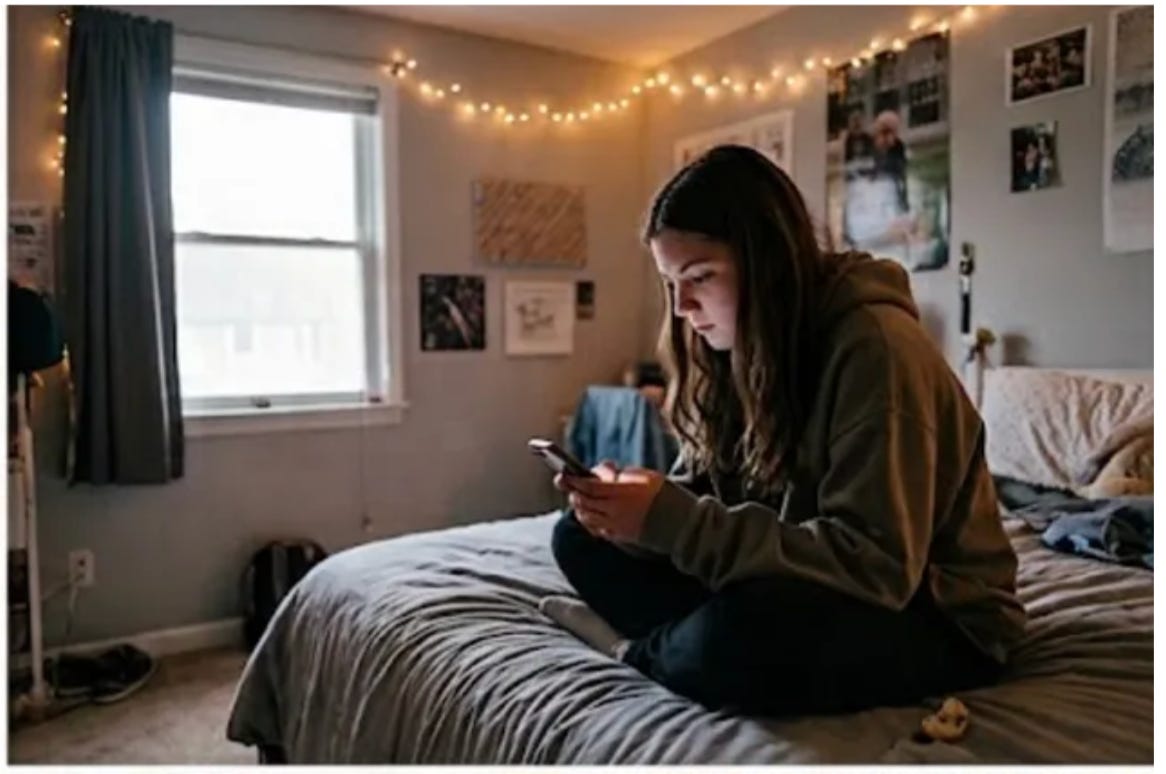
A child confined at home by sprawl accesses outside influence through their phone screen. That brings two things directly into the living room that neither side of the debate on civic formation wants: anti-democratic ideas and the tyranny of public opinion. In a walkable city, a child learns on the sidewalk that not all strangers are threats, that a neighborhood contains people like and unlike his parents, and that he can navigate a busy world without an adult driving him through it.
Both sides of the debate have reason to find this fresh framing attractive. Those who favor public institutions for civic formation argue that children need exposure to people and ideas beyond their families to learn how to live with differences and develop ideas independent of their parents. Those who favor the family, on the other hand, argue that parents are responsible for giving children the moral framework they need to make sense of the world, while also protecting them from having the values of the state or the majority imposed on them.
Walkable, mixed-use neighborhoods offer what both sides want: they create more interactions between kids and the community through physical proximity, while not dismissing parental authority.
New York’s Unique Asset
Long is describing New York. Only 15 percent of the city’s land is single-use zoned. Its sidewalks and subways are places where future productive citizens learn to practice autonomy for adult life.
So why are families leaving?
According to an April Manhattan Institute report by Connor O’Brien and Liena Zagare, New York City’s under-five population fell 18 percent in just over three years—18.9 percent in Manhattan, 17.8 percent in Brooklyn, and 17 percent in Queens. Falling birthrates and out-migration explain the decline, which has been steepest in the densest places.
Walkable New York is Scarce and Expensive
Families need family-sized housing they can afford. Roughly 70 percent of New York households rent, but just 19 percent of the city’s rental apartments have three or more bedrooms (compared to 40 percent renters nationally and 30 percent three-bedroom apartments or larger).
The average asking rent for a three-bedroom market-rate apartment in Manhattan, the most walkable borough of the city, this July exceeded $12,000 a month. A two-bedroom is now more than $8,000. The citywide vacancy rate is 1.49%, a number not seen in generations, making finding an affordable apartment for the average family almost impossible.
The solution is abundance. With the City of Yes, the city has taken steps in the right direction, but it needs to facilitate the development of much more market-rate housing than the current zoning and building code make feasible.
Order, Transit, and Criminalizing Childhood
Physical space alone is not enough. As Jane Jacobs argued, public trust is accumulated through “eyes on the street”—many small sidewalk contacts are only possible when those contacts are unthreatening.
Because a child’s independent range in New York, like in the suburbs, is limited by the available transportation options, safety of streets and transit determine a practical limit by influencing how far and in what ways parents will actually let kids go. Enforcement of rules, better street lighting, and regular police patrols promote civic formation in addition to quality of life. Homelessness and random violence physically hinder it the same way sprawl does by sticking kids and parents in “Uber Hell”.
The capacity for children’s independence does not mean it will be made use of automatically. A 2025 survey of parents by the Institute for Family Studies finds a general culture of low autonomy. Most American kids are not allowed to travel beyond their own street by the age of 14, according to their parents, but independence can have meaningful positive impacts on children’s anxiety.
Even though there is no age limit on when a parent can leave a child alone in New York, there is no affirmative protection allowing ordinary, age-appropriate independent activity, like walking home from school. Without legal protection, parents allowing their children to be unsupervised can face a child protection investigation and, depending on the circumstances, criminal charges, with the court deciding after the fact whether a parent’s judgment was reasonable.
New York State should pass a Reasonable Childhood Independence law (joining eleven other states) to clarify that leaving a child unsupervised is not by itself neglect.
The Bottom Line
If we want to raise capable participants in democratic life, part of the policy question should be how to increase more children’s access to walkable, safe, mixed-use neighborhoods. One answer is by building more of them.

I hadn’t ever considered affordable housing and open space as a “rights of the child” issue. That is a very profound lens thru which to see the challenge.