

Have you added The Bigger Apple Podcast to your favorite podcast player yet? Nicole and I just wrapped our episode on Mamdani’s first 100 days, and I think you’ll enjoy it.
Mayor Zohran Mamdani is holding a rally this weekend to celebrate his first 100 days in office. Every outlet in the city is scrutinizing his performance, but few questions are asked about the longer-term implications of his short-term decisions.
Mamdani promised to make the city more affordable by bringing us universal childcare, freezing rents, offering government groceries, and fast and free buses. He also promised not to govern as an austerity mayor, but one focused on “ambition.” As he put it in his inaugural speech:
“The movement we began over a year ago did not end with our victory on Election Night. It will not end this afternoon. It lives on with every battle we will fight, together; every blizzard and flood we withstand, together; every moment of fiscal challenge we overcome with ambition, not austerity, together; every way we pursue change in working peoples’ interests, rather than at their expense, together.”
Thereby, he set the standard against which his mayoralty should be measured, whether it’s 100 days or 4 years.
The polls
A mayor can only be as ambitious as he is popular. Mamdani started from a position of strength, and is working hard to maintain his approval — he controls the biggest megaphone in the city, able to reach more residents than virtually all other media combined, and he has been using it.
Two polls that came out this week, Marist found 48% of New Yorkers approve, 30% disapprove, and 23% still unsure of how well Mamdani is doing. Emerson similarly found 43% approve, 27% disapprove, and 30% neutral. Both are net positive, but both trail his predecessor, Eric Adams, at the same point — 61% — and are closer to Bill de Blasio’s 49%.
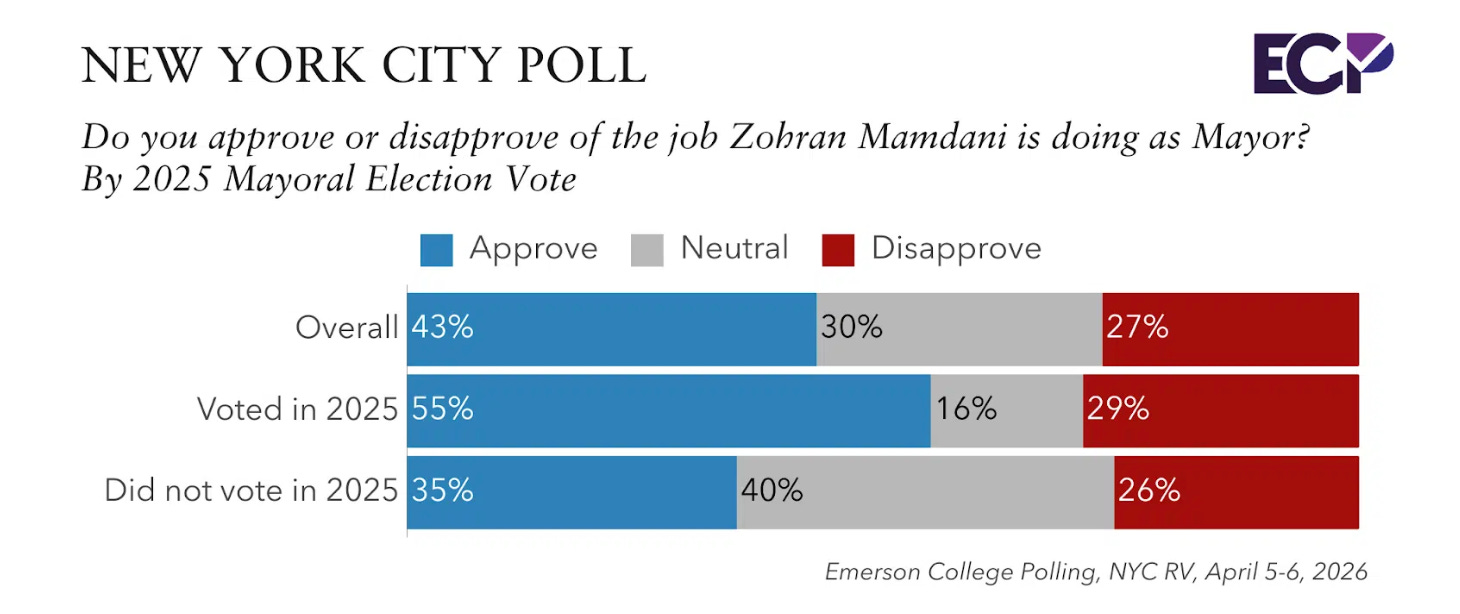
Marist found 74% of residents think he’s working hard. A majority aren’t so convinced he’s delivering results. The Emerson poll reports 59% of registered voters say the city is on the wrong track.
People like him, they think he’s working hard, but they are not sure he’s doing well or that the city is going where they want it to go. Personal approval can survive policy disappointment for a while, but if the wrong-track number stays high while the big promises stay unfulfilled, he loses the political capital he needs to move Albany and the Council, and absorb the stumbles that come with any first term.
What he has actually done
There is only so much one can accomplish in 100 days, good or bad.
His clearest wins are the most basic: garbage is being picked up. The city cleared the snow and filled 100,000 potholes. Crime, perhaps suppressed by the cold, has been historically low. Police Commissioner Jessica Tisch has held a steady line despite tension over gang databases and the new Community Safety Department, which mostly just consolidated existing programs under one roof.
This is not nothing, but it is also not transformational. So what about the big promises?
Childcare
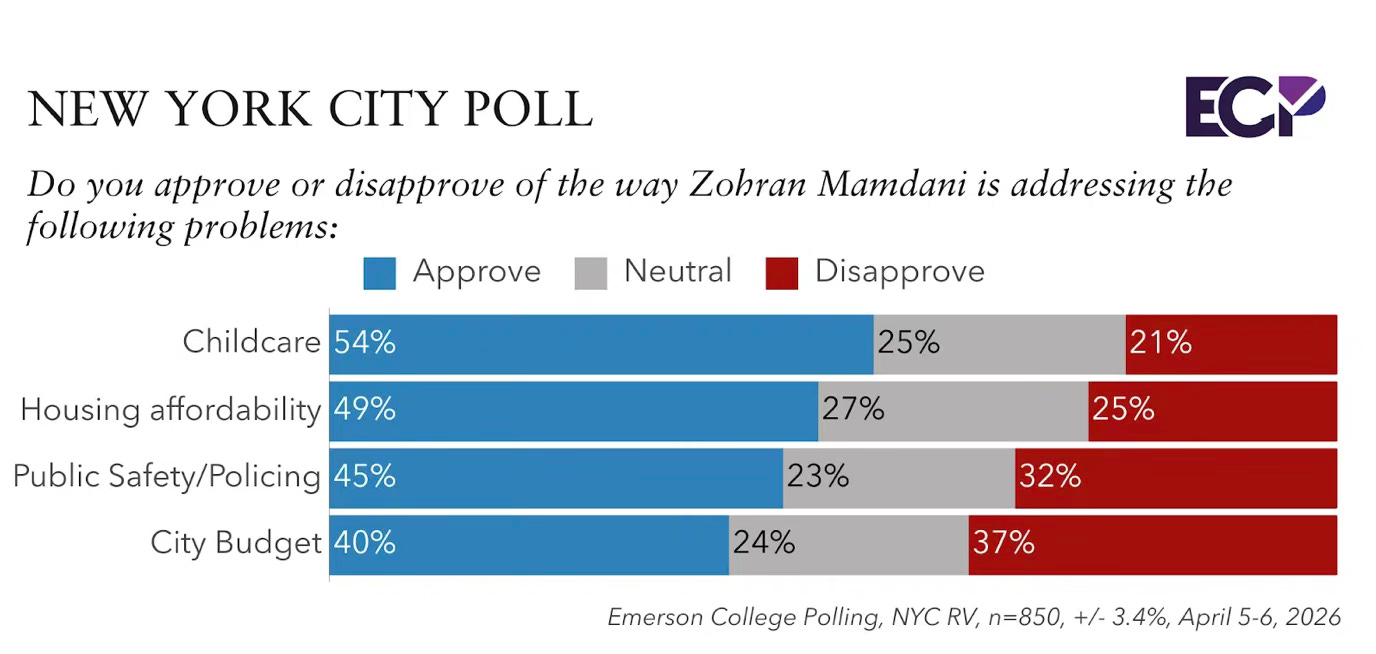
On childcare, the story is real progress wrapped in inflated PR. He got Governor Hochul to fully fund his small and expensive 2-K childcare pilot. Governor Hochul committed $73 million in state funding for 2,000 seats this fall, expanding to 12,000 (and $450 million) next year. Beyond that, funding is unclear. As the 3-K rollout showed, that is never a good sign.
Enrollment in 3-K and UPK has been underwhelming for years, with seats sitting vacant across existing facilities. The city is now making an aggressive push to enroll more kids, framed as expansion, which is one way to describe trying not to contract. New enrollment numbers have not been released, and, given how eagerly this mayor promotes every win, the silence is telling.
There is also the cost. The 2-K pilot runs about $36,500 per child per year — roughly $13,000 more than what parents pay in the private market.
Housing
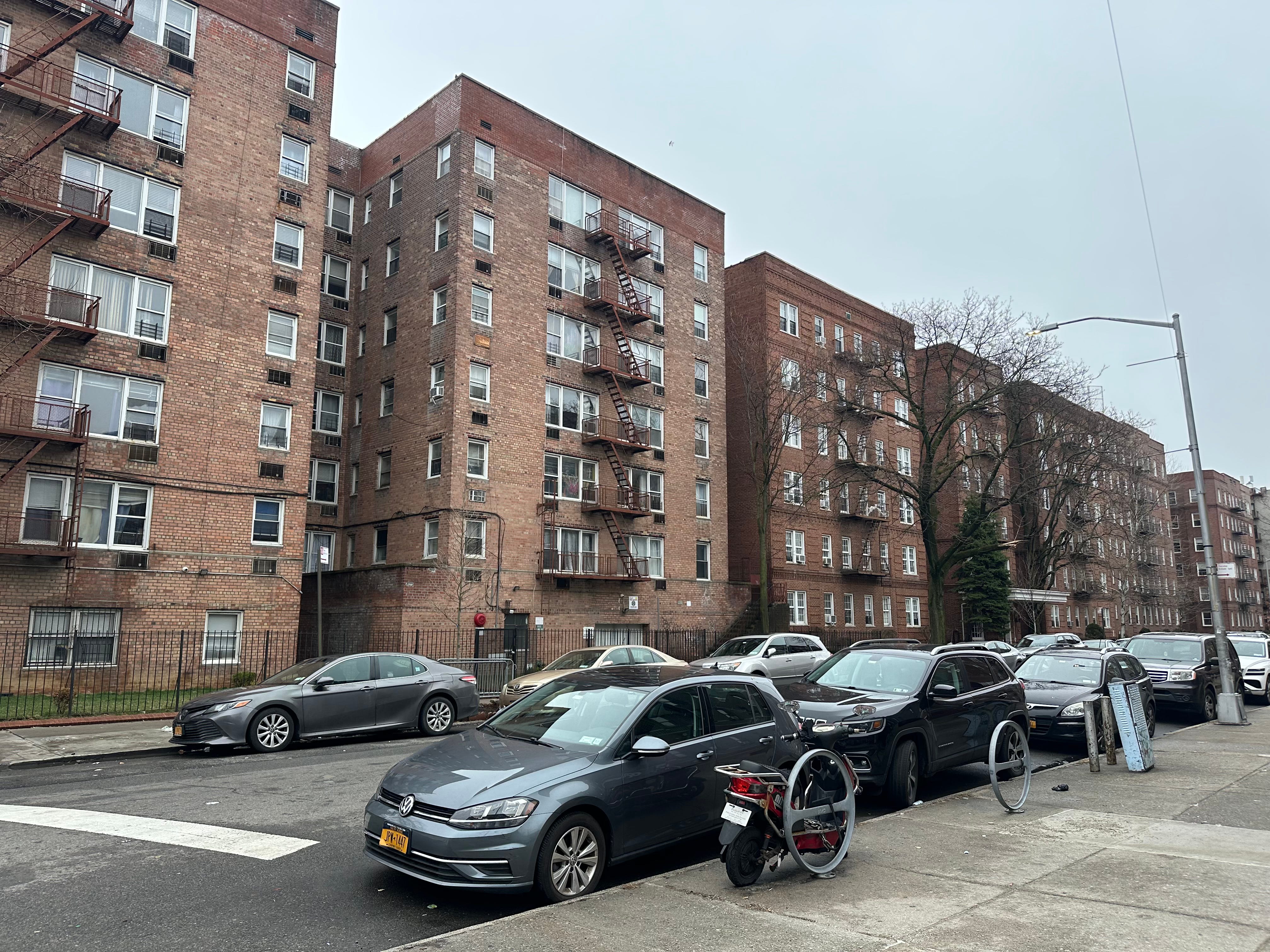
On housing, the Mayor’s posture has been aggressively on the side of tenants. One of the first appointments Mamdani made was to the Mayor’s Office of Tenant Protections. He also appointed six of the nine members of the Rent Guidelines Board, and expressed trust “they will consider all the factors facing the city's rent-stabilized tenants and come to an appropriate decision.” He would like to see the decision be to freeze rents on rent-stabilized apartments so he can fulfill yet another campaign promise, one that would have a real pocketbook impact on roughly half the city’s renters who live in such apartments.
The Rental Ripoff Hearings were held, loudly advertised, and were not really hearings, but as I’ve written before, yet another well-produced PR opportunity.
A rent freeze, if it happens, will not happen till October and would be considerably less great for providers of affordable housing, many of whom are already underwater. Freezing the rents will also inevitably accelerate the deterioration of the buildings that are heavily rent-stabilized, where income already exceeds expenses. My colleague Eric Kober wrote this excellent piece on “rental rip-offs” and the economic realities.
Mamdani has, meanwhile, made promising noises about helping on the supply side by fast-tracking affordable housing permits and promoting accessory dwelling units. But housing policy takes time — and the rewards rarely fall into place during a four-year term. The question is whether Mamdani can put his political muscle into this vital long-term project, which would involve working closely and building trust with hated developers — or whether he’s merely trying to keep abundance-focused centrists inside the tent.
Buses and streets
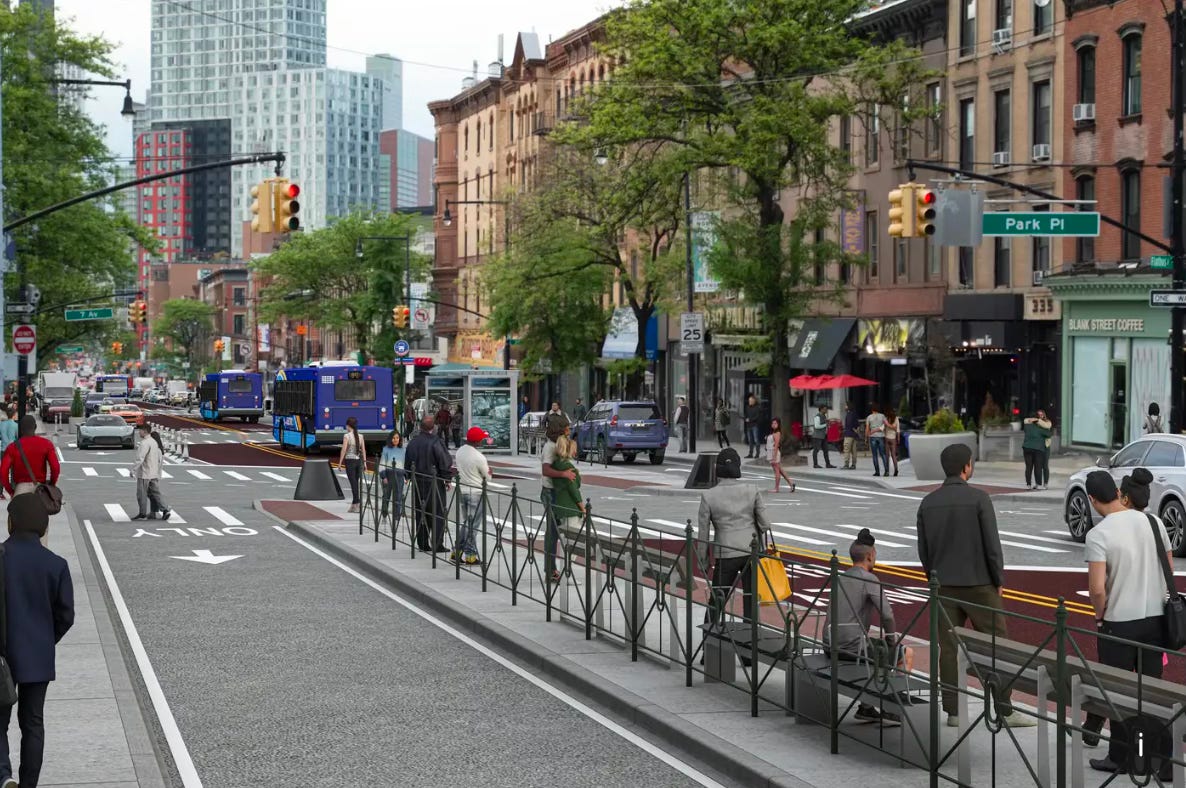
As was litigated extensively during his campaign, the city cannot make fares free — the MTA is a state agency and fare revenue is bonded. He has since conceded that free buses are not coming this year.
What he can do is remake streets. Mamdani has positioned himself aggressively as a streets mayor — sworn into office at the long-shuttered City Hall Station, with his first act the appointment of a transportation deputy who has been moving projects that sat dormant under the previous administration.
This week, Streetsblog reported he is creating the Office of Curb Management to manage what is becoming an increasingly contentious competition for finite public space: deliveristas, Citibike corrals, EV charging, street dining, garbage containerization, street vendors, metered parking, and bicycle storage come to mind. The people without a lobby in that fight — the elderly, the very young, pedestrians who need a clear path — are the ones losing ground quite literally.
Groceries
This big promise is playing small. On groceries, he wants to spend $70 million for five pilots, the New York Post reported.
The money
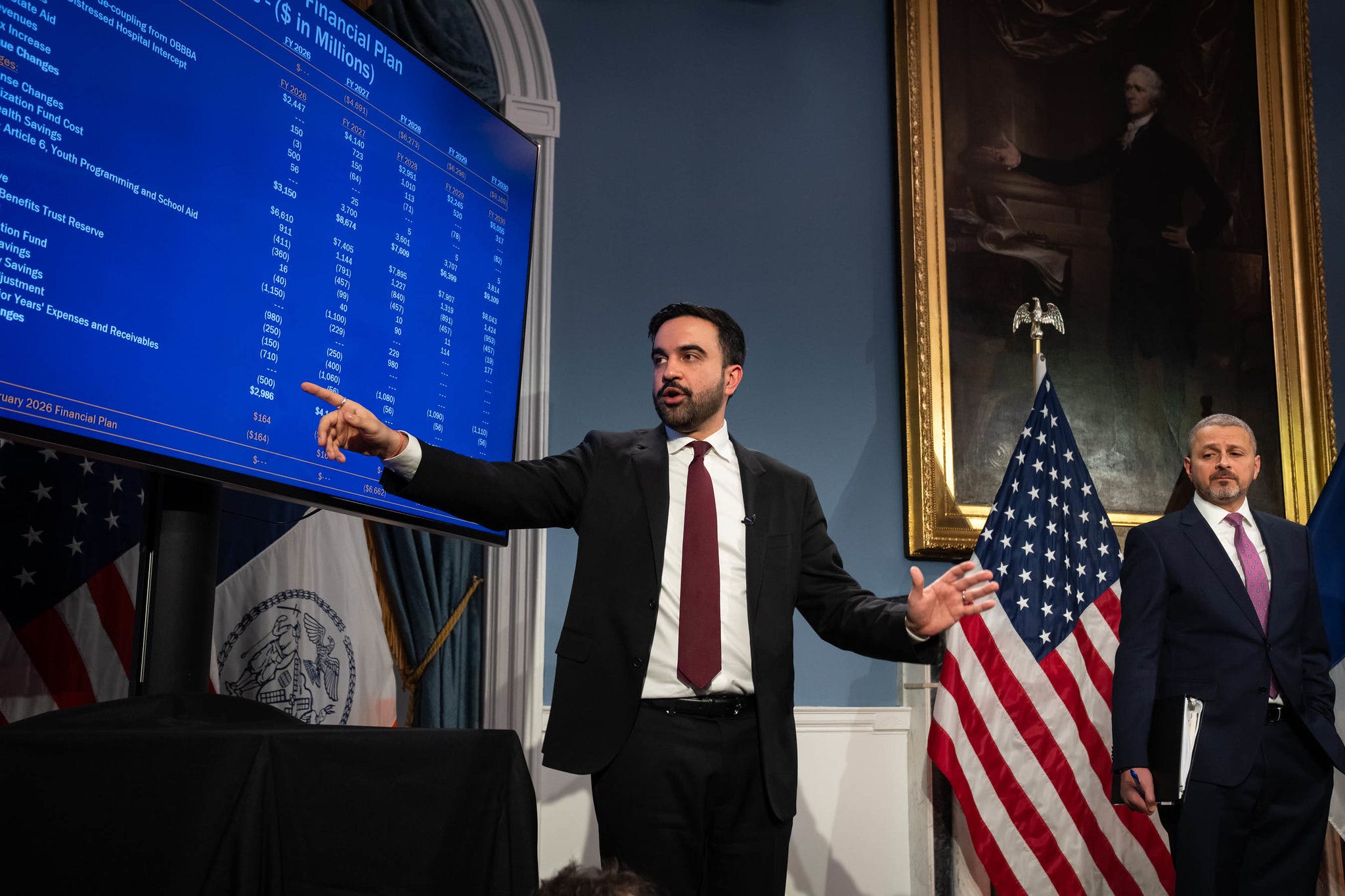
All plans need funding, and Mamdani’s budget is big. $127 billion big, with a $5.4 billion budget gap for FY2027. Governor Hochul has chipped in $1.5 billion to help close the gap, Mamdani claimed $1.7 billion in savings through his Chief Savings Officers initiative; his budget team has disclosed and approved approximately $237 million of that. It’s hard to say what kinds of efficiencies they are taking about — Tal Roded had a piece on this last week.
Mamdani’s preferred solution is to generate revenue from increasing income tax on millionaires and large corporations, or – if that fails – a 9.5% property tax hike. The latter was downplayed quickly after it alienated outer borough voters exactly as predictably as it should have. His preferred solutions, however, require Albany to act, and so far it has not.
Mamdani told Errol Louis of NY1 that he has been in conversations with Gov. Kathy Hochul and state leaders about the deficit.
“[I]t is that partnership with Albany that will help to put the city back on firm financial footing. And what we will see in our city is an honesty about the money that we are spending and also what it costs to provide the services that we want to,” he said.
Meanwhile, the city’s private sector shed roughly 19,500 jobs year-over-year through January 2026. What growth there has been is concentrated almost entirely in low-wage healthcare — not the kind of employment base that funds a $127 billion municipal budget.
The reversals
The new mayor reversed himself on two commitments he had championed as an assembly member and on his campaign trail.
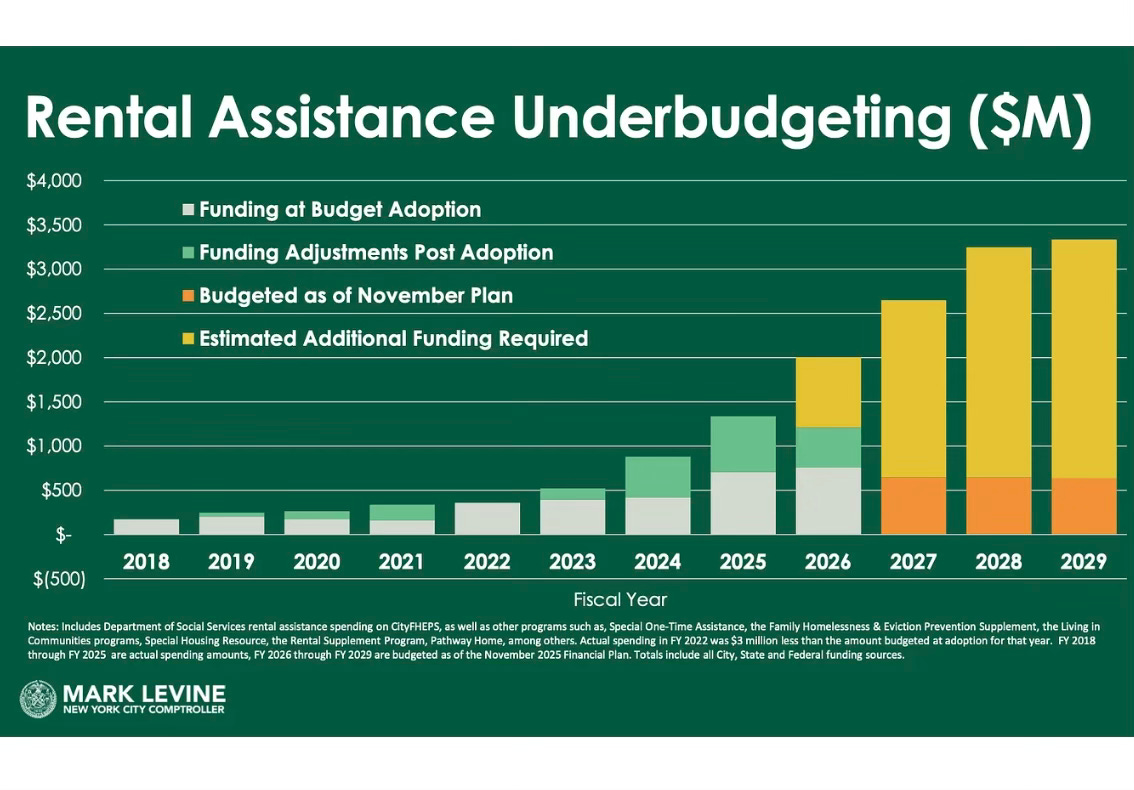
CityFHEPS — the city-funded rental voucher program — over the years has exploded in cost with no ceiling in sight, and like the mayor before, Mamdani is fighting in court to limit it. Class size reduction, a state mandate he supported, would cost more than a billion dollars a year to comply with, and he is asking Albany for a delay.
Both reversals are fiscally prudent, but both are also examples of austerity, whatever he calls them — the thing he promised he would not do — against the constituencies he explicitly promised to serve.
What’s missing
I haven’t written much here about Mamdani’s relationship with the city’s private sector tax base, or his plan to help the city’s economy grow — because there’s nothing there. The mayor has been working on tenant protections, consumer protections, and labor solidarity, but he’s built no real support from the businesses that generate revenue.
But New York’s workforce, and its tax base, are driven by some of the world’s largest corporations. Mamdani won’t be able to build the tax base he needs for ambitious social spending while offering no strategy for attracting the private sector employers who generate it.
The verdict
Mayor Mamdani has made a friend of President Trump and extracted real money from Governor Hochul. He has cleared the snow, filled the potholes, and kept crime down. He has set in motion an ideologically coherent agenda on tenant and consumer protections and early childhood care. He has reversed himself quietly on the two commitments that would have cost the most to keep.
Has he made New York City more affordable for any of its residents? For now, the answer is no. Which is why, for all the genuine approval his personal qualities attract, a third of New Yorkers do not know what to make of him. They can see the effort. They are waiting for the results.
Podcast
Nicole and I tackled Mayor Mamdani's first 100 days, looking at his diluted promises of free childcare, fast and free buses, a rent freeze, and government groceries, as well as his ambition versus budgetary realities and how he’s dealt with the day-to-day challenges of running the city.
Extra! Extra!
Where does a dog belong in the city? City Councilmember Chi Ossé: “I am noticing more dogs in public. And I don’t think I want to comment about how I feel about that because I hope to have a long political career.”
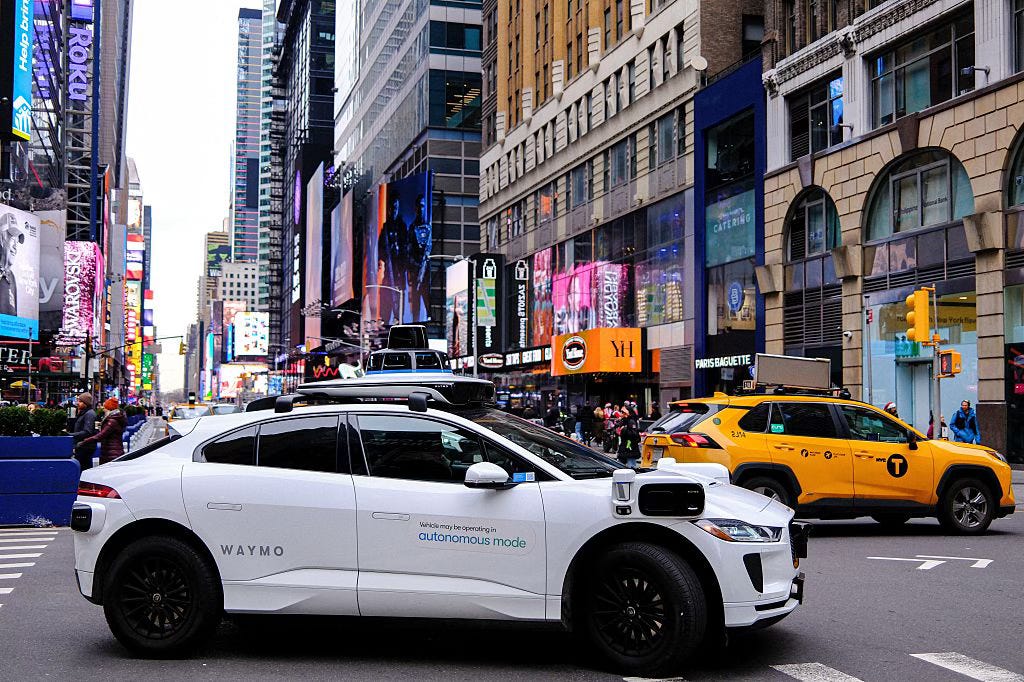
Waymo’s self-driving car test ended at the end of March, Streetsblog reports. What does it mean for regulation, they wonder? My colleague Nicole Gelinas also had thoughts on AV regulation a while back, especially when it comes to labor issues.
good write up! grocery plan is already shaping up to be a massive overspend and not move the needle on affordability (just wrote a piece on it), but he has certainly been active in the first 100 days
Keep a watch on the appointees and staffing totals.