

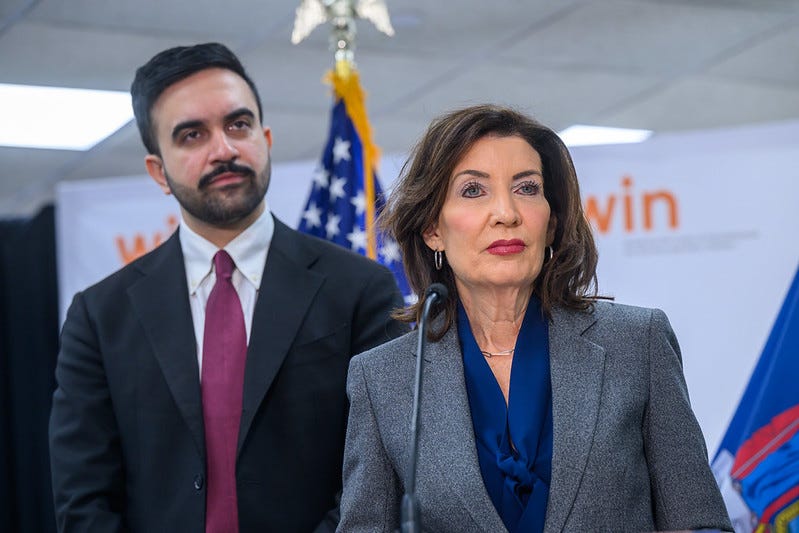
“I know that winning an election doesn’t make your rent cheaper or lower your grocery bill,” Governor Kathy Hochul told supporters Tuesday night. “It doesn’t make finding affordable childcare any easier. But that’s what the next four years are for. To finish what we started with bold ambition and a sense of urgency.”
Gov. Hochul and Mayor Zohran Mamdani seem to agree on most things these days, including spending a lot of money to make the state “affordable.”
But they disagree on one very important thing: who should be paying.
The New York voters who gave Hochul an easy reelection Tuesday offered some direction on that. Nine in ten called the cost of living a crucial or major issue, but they viewed “socialism” unfavorably by a 48% to 39% margin. And the left didn’t punish her for refusing to raise income taxes on the rich—in Mamdani strongholds her share rose from 85% to 90%—and while in 2022, she lost the state outside the city by about 334,000 votes, this year, she won it by about 143,000.
Both Hochul and Mamdani ran on affordability. Hochul, a moderate Democrat, promised middle-class tax cuts and “a path to universal child care.” Mamdani, a democratic socialist, promised free care for every 2-year-old whose family wants it and free buses. He also wants higher taxes on top earners and corporations to pay for it all.
Asked this week when they had last discussed taxing the wealthy, Mamdani said it had been “quite some time since we’ve talked about anything other than the election.”
Hochul now has an opportunity to shape the direction of what is always an unequal partnership between governor and mayor. The city is a creature of the state, and Mamdani’s promises can become real with the governor’s support. That sets the stage for a conflict over state taxation — and an opportunity for Hochul to draw a line.
Three factors will help shape what happens next.
First, Hochul is planning to run for reelection in 2030, she told Politico’s Jonathan Martin.
Hochul’s current power comes largely from the angry backlash to Donald Trump. The two-thirds of voters who disapprove of Trump backed her 87% to 12%, but with a Democrat in the White House, that race could look more like 2022, when the city carried her.
So she has to govern as the moderate the state just backed, without breaking with the city she may need again.
The second is childcare, an issue she had worked on before Mamdani put it in the spotlight.
Hochul has committed to two years of funding for childcare launch for 2-year-olds in NYC and may have no choice but to continue if she doesn’t want to be known as the one who took childcare away. But fully universal care would cost close to $15 billion statewide, Hochul has said, and another estimate puts it at about $20 billion if childcare workers’ pay rises. The state currently budgets $4.5 billion for childcare and pre-K.
Like Mayor Bill de Blasio before him, Mamdani would like the governor to let him tax the city’s millionaires to pay for childcare in the city.
But that comes at a cost. While Albany could set an expiration date, Mamdani’s surcharge, 2 points on income over $1 million, would take the top combined state and city rate to about 16.8%.
She might do what Andrew Cuomo did in 2014, when Bill de Blasio got state money for pre-K instead of the tax on high earners he wanted. But this bill is much larger: the state comptroller says universal care would add $2.7 billion to $8.2 billion a year in the city alone.
Third, a flush treasury makes reform less likely.
Wall Street’s historic bull run — as long as it, and the AI boom on which it relies, lasts — is why Hochul can say she’ll fund childcare “with the current budget that we have.”
Days before the election, the state cut next year’s projected shortfall by more than half and reported a surplus of roughly $9 billion. New York doesn’t lack revenue. The budget raised spending 7% this year, to $277 billion, and state Medicaid spending 16.1%, to $39.4 billion.
The Citizens Budget Commission estimates that $700 million a year in school aid goes to districts with shrinking enrollment. This year Albany also sweetened pensions for public workers hired since 2012 by more than $550 million a year, and is mailing $1 billion in energy rebates. Savings are hardest to implement when money is coming in.
And while the legislature is unlikely to push for savings, it can make refusal to raise taxes politically costly. City Council Speaker Julie Menin says she’ll back a tax increase for childcare in next year’s budget, and Mamdani’s own troops are rallying to “tax the rich.”
Hochul says she doesn’t believe in raising taxes “just for the sake of raising taxes”—which is not the same as not raising taxes. But Hochul has a strong hand, and has already shown she can extract concessions from Mamdani. Before endorsing him, she told Politico, she wanted “a commitment or an understanding” on keeping Police Commissioner Jessica Tisch.
Hochul needs Mamdani much less now, and remains the more moderate counterpart to the socialist mayor. That said, both of their affordability plans are expensive, and neither seems to have much interest in finding cost savings elsewhere to pay for them.
Related: The Limits of New York’s “Tax the Rich” Policy by MI’s E.J. McMahon.
New York’s GOP Doesn’t Have Answers
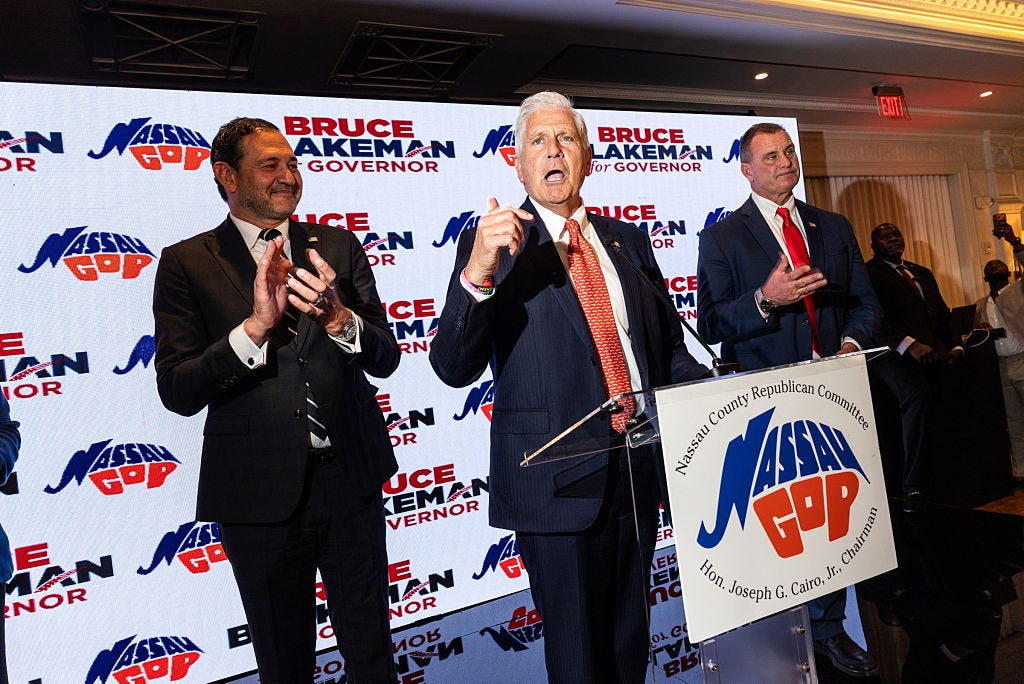
“Empire State Republicans were trounced in part because they lack a distinct, compelling policy agenda,” MI’s Ken Girardin and John Ketcham write in the City Journal. “New York has real problems, including the nation’s highest tax burden and associated affordability issues, public-sector work rules that make government services more expensive, a housing shortage, and utility bills padded with property taxes that voters never see. Each problem has a credible response that Democrats aren’t offering. The state GOP showed little interest in any of them.”
MI Brief: How New York City Taxes Residents Through Their Electric Bills
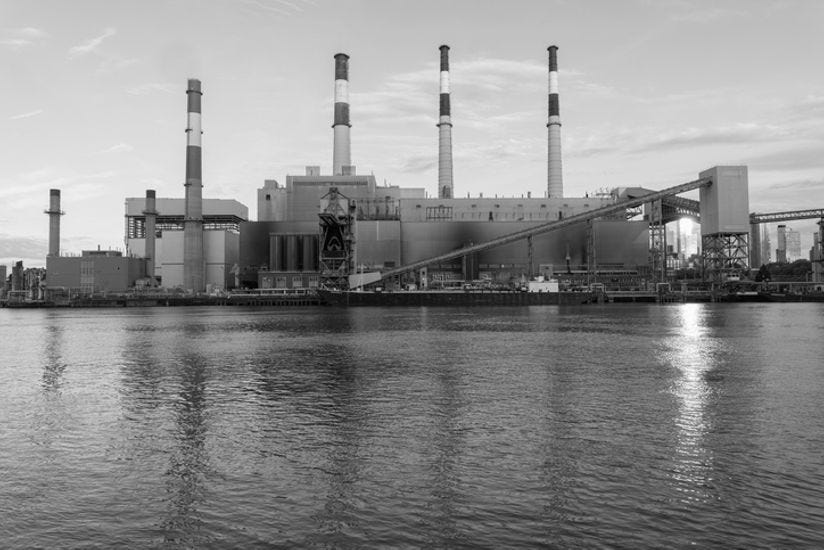
The typical electrical bill for a New York City home rose almost 50% between 2019 and 2025, much faster than the national average, worsening affordability and working against electrification, particularly for vehicles and heating. Part of it due to the city.
“In total, city policy adds what is effectively a 36% to 43% tax on Con Ed delivery rates. That does not include more typical business taxes on Con Ed operations. By comparison, the combined state-local tax regime on marijuana boosts prices by a total of 23%,” MI’s Ken Girardin observes. The current state persists mainly because mostly invisible to ratepayers.
“Con Ed is poised, by early next year, to update monthly bill statements to show the size of its NYC property-tax burden. It is hoped that this will spark a public conversation about how the city uses the electricity system (and other utilities) as a tax-collection mechanism,” Girardin writes. His proposal?
“The state legislature should consider exempting electricity distribution infrastructure from the city property tax entirely and requiring Con Ed to reduce electricity delivery rates commensurately. To partially replace the lost revenue, the state could give the city permission to increase the sales-tax rate on electricity delivery. But the city should not be allowed to surreptitiously pass along billions of dollars in tax liability to electricity customers.”
Extra! Extra!
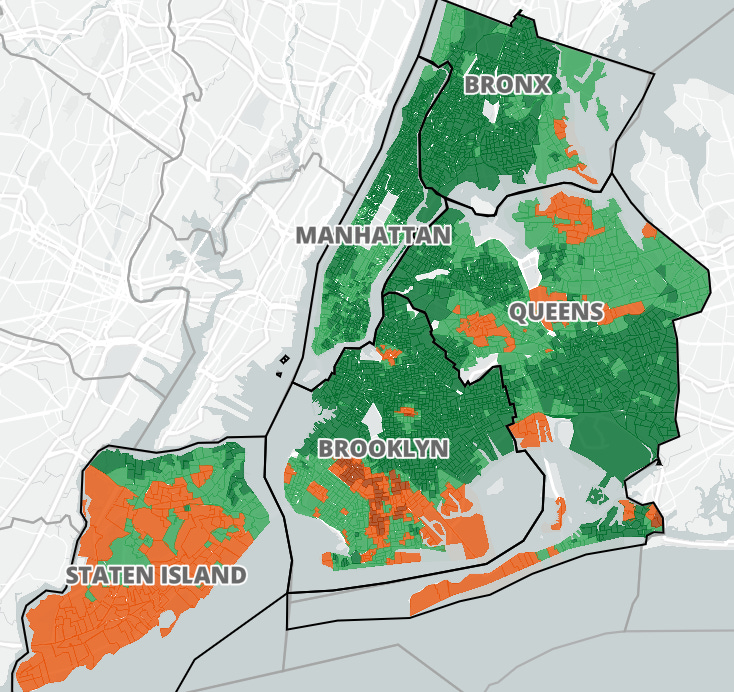
How Southern Brooklyn Democrats Flipped State Seats in Immigrant-Heavy Areas (The City Reporter)
Mamdani Ballot Proposals on Public Space, Street Safety and More Pass in NYC (The City Reporter)
New York City Voters Give Mamdani A Green Light to Transform City Streets (Streetsblog)
Better days ahead for NYC commuters with Democrats in control of Congress, MTA chair says (Gothamist)
Before New York by Eric W. Sanderson surveys the historical landscape of New York. (The New York Times)
Hochul criticizes plan to drop Regents exams, renews push for control of state Education Department (Chalkbeat)
The Towns We Can’t Build. Americans are flocking to walkable small-town downtowns on the edges of big metros, but regulation has made it nearly impossible to build new ones. (City Journal)
Recommend
MI’s Brittany N. Montgomery's Substack Bulletproof Bureaucracy unpacks why anticorruption rules meant to protect government integrity end up "bulletproofing" bureaucracies against progress, drawing on 20 years working in government in New York, Bogotá, and beyond.