

New York lawmakers are patting themselves on the back for finally passing the state budget, which tips the scales at more than $268 billion. But one of the costliest provisions isn’t actually counted in that figure: heading into this year’s elections, Governor Hochul and state lawmakers retroactively “sweetened” the pension benefits for about half of New York’s state and local public employees.
This political pandering will cost taxpayers tens of billions of dollars over the next few decades, with the United Federation of Teachers (UFT) and other teachers’ unions walking away with the sweetest deal of all. Under the new rules, teachers and other school professionals can retire five years earlier—at age 58 instead of 63—with a full, unpenalized, taxpayer-guaranteed, state-tax-exempt pension.
This wasn’t the first time Albany has fallen for this, and unless people start paying greater attention to their mischief-prone state government, it won’t be the last.
Taxpayers Bear 100% of the Risk
As I recently detailed, public-sector unions have been waging a coordinated campaign for years to roll back Albany’s common-sense reforms, enacted during and after the Great Recession, to their pension systems.
For more than a century, New York has had public pension systems to which cities, state agencies, schools, and other public employers have contributed on behalf of their workers. Those contributions get invested, and then the workers get pensions in retirement.
Crucially, these pensions are guaranteed by the state Constitution, meaning they can never be reduced. When pension investment returns come up short, taxpayers have to make up the difference. That’s also been the story as retirees have been living and collecting longer than expected.
Pension rules are set by state law, and an individual’s retirement benefits reflect when they joined the pension system (or which “tier” they belong to).
That distinction, funny enough, has historically provided New Yorkers with a layer of protection. It kept benefits—and liabilities—from getting jacked up during closed-door local union contract negotiations, where elected officials want to avoid politically painful spending cuts or tax hikes by shifting costs to the future. Pension benefits, for more than half a century, have been prohibited subjects of bargaining in New York.
But that statutory system creates another opportunity for mischief: state lawmakers can hike pension benefits retroactively. In 2000, as stock markets were raging toward the top of the dot-com bubble, Albany allowed employees to stop contributing after 10 years on the job and goosed the benefits for people closest to retirement. But pension investments didn’t just fail to keep growing: in some years, they fell.
But there was no going back. The 2000 pension sweetening plus the downturn helped cause public employer pension costs to explode from about $1 billion in 2000 to $10 billion in 2010, driving a massive spike in school property taxes outside New York City.
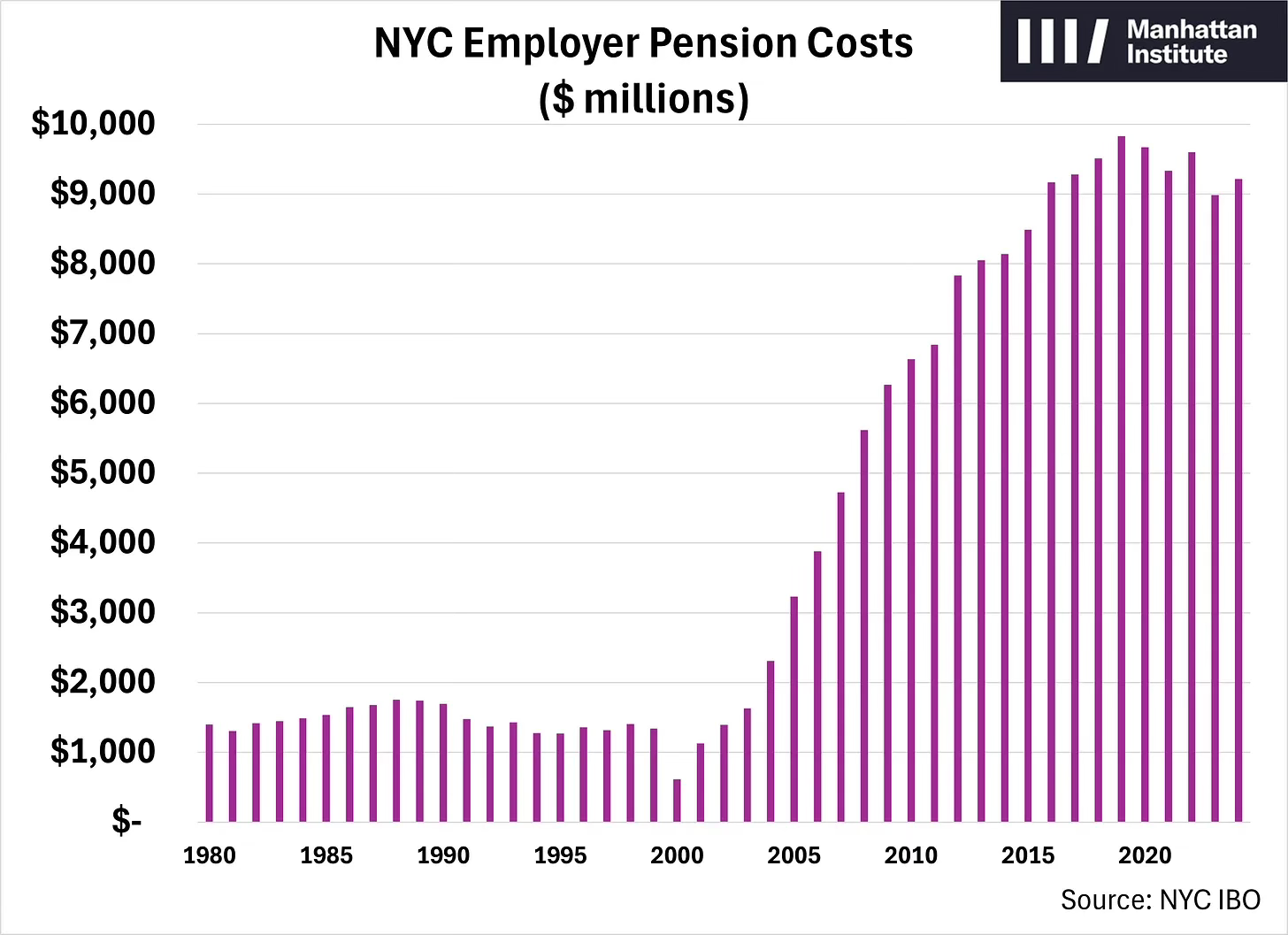
Albany’s response was to enact two rounds of pension reforms in 2009 and 2012, colloquially referred to as Tiers 5 and 6. These changes were a recognition that pension costs were elbowing out other public services, that investments couldn’t be counted on to generate as much return as they had in past bull markets, and that retirees were living notably longer than they had been a generation prior.
The reforms required employees to work 10 years to vest, required them to contribute between 3 and 6 percent for their entire careers, increased the full retirement age to 63, based payouts on a five-year average salary instead of three, and cracked down on late-career overtime manipulation (“pension-spiking”).
These rules allowed New York to bend the cost-curve while remaining exceptionally generous: traditional defined-benefit pensions are increasingly rare in the private sector, where just 14 percent of employees have access to them, down from 20 percent in 2010. But the unions viewed this fiscal discipline as an unconscionable unfairness.
The Phony Case for a “Fix”
The coronavirus pandemic and the economic upheaval that followed handed the unions an opportunity to rewrite history. After state lockdown policies ended, the labor market underwent an unprecedented tightening. By fall 2021, the U.S. Bureau of Labor Statistics’ monthly labor-market survey found that New York had more job openings than job seekers. In several months that followed, BLS found as few as 0.7 seekers per opening. (At the end of last year, it was back up to 1.2 seekers.)
The UFT and fellow labor outfits aggressively exploited this tight labor market, which was challenging both public and private employers alike.
The unions weaponized the situation and blamed the pension changes, saying they were harming recruitment and retention.
The evidence was not, at any point, on the unions’ side. For one thing, the New York state government had done more hiring in 2023 than in any year prior, a record the Hochul administration went on to smash the next year.
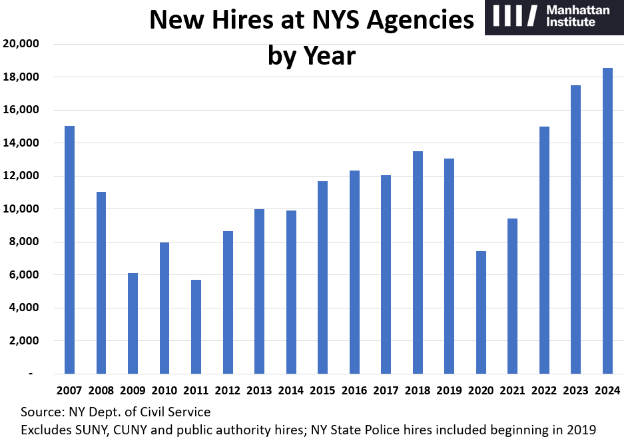
The unions, for all their concerns about recruitment and retention, maintained their fierce defense of various obstacles to hiring in areas ranging from the civil-service exam system to teacher licensure.
The first round of changes went largely unnoticed: Governor Hochul’s first budget in 2022 rolled back the vesting period for pensions from 10 years to five.
An October 2023 legislative hearing billed as an investigation into “recruitment and retention” turned out to be a choreographed airing of grievances for unions before sympathetic lawmakers. A parade of union officers complained about the lack of “parity” between pension benefits offered before 2009 and those after 2012—ignoring the change in how long retirees are collecting and how much taxpayers had been struggling to finance those retirements.
My Manhattan Institute colleague E.J. McMahon warned that rolling back the pension reforms would instantly cost New York taxpayers over $1 billion per year, and more than $2 billion annually by the early 2030s. He genially reminded lawmakers that people in very different tiers had worked alongside each other without incident for decades after Albany’s 1976 pension reforms.
But under the banner of “Fix Tier 6,” the unions next spring sought and got a significant change to how pensions are calculated, as Albany changed the formula to use a three-year average instead of five years. The seemingly modest tweak added about $380 million to annual taxpayer costs, a figure that will keep rising. About half of that price tag was borne by New York City, the state’s largest public employer, and meaningfully contributed to the budget gap that Mayor Zohran Mamdani faced earlier this year.
As the fiscal 2027 state budget was being crafted this year, the unions bused thousands of members to a stadium near the state Capitol for a rally meant to pressure Albany into grinding away even further at the pension reforms.
The most surprising attendee was Governor Hochul herself. While she was careful not to promise specific changes, her very presence was an endorsement of the unions’ grievances.

Keep in mind, every public employee who has complained about what they’re getting from the pension system decided that those benefits were adequately generous to accept their job. What’s more, many of them wouldn’t have been hired if it hadn’t been for the savings produced by the very pension reforms they now condemn. And again, the public employee unions have never presented compelling evidence that the 2009 and 2012 pension reforms actually harmed governments’ ability to deliver services.
The push against Tier 6 boiled down to the unions wanting something from taxpayers and believing that they had enough raw political power to get it. They were partially correct.
They also had another factor working for them: about one-third of state lawmakers are themselves members of Tier 6, meaning they stood to save more than $4,000 per year in pension contributions just from dialing back pension contribution levels to where they stood in early 2012. (Assemblyman Mike Fitzpatrick of Suffolk County has long pointed out this conflict of interest, calling the arrangement “fiscal carbon monoxide” and pushing a bill that would end it.)
News reports indicate the unions, with the blessing of legislative Democrats, demanded changes that would have cost taxpayers an additional $1.5 billion annually, and that Governor Hochul balked. In the end, the sides settled for two major changes.
Teachers with 30 years on the job could retire as early as age 58 without a diminished pension, a double hit for taxpayers who will fund longer retirements over fewer years of service. Non-teachers, meanwhile, would remit a smaller share of their pay toward their pension. For instance, employees making $75,000 per year would pay 3 percent instead of 4.5percent, and the maximum contribution rate would drop from 6 percent to 5.75 percent. In addition, uniformed employees would get to count more overtime pay toward their pensions.
The cost of the change will be approximately $550 million per year and will continue to rise.
Hypocrisy Abounds
New York City Mayor Zohran Mamdani, as well as the mayors of Buffalo and Albany, simultaneously pled with Albany for emergency financial aid to solve their local budget crises while still aggressively supporting the latest round of pension-sweetening.
The New York State School Boards Association, constantly hectoring Albany for more aid for school districts, also endorsed rolling back the 2009 and 2012 reforms.
Meanwhile, many of New York’s “pro-taxpayer” Republicans have lent support to the unions’ cause. A few, including Long Island Assemblyman Doug Smith, the top Republican on the Assembly Education Committee, even attended the union’s Albany rally and gave special guest American Federation of Teachers president Randi Weingarten a standing ovation.

Don’t expect the same enthusiasm when pension actuaries later this year tell school districts and municipalities how much their pension costs are going up as a direct result.
More Is Never Enough
It’s not clear which lawmakers sincerely believed the unions’ bogus claims that their demands were justified, and which ones simply chose to ignore the costs.
One thing is clear: the manner in which Governor Hochul and lawmakers acquiesced to the unions’ demands will guarantee that they are back next year demanding more. Why, they’ll ask, should some employees wait until 63 to collect a pension when teachers retire at age 58? How come, they’ll huff, teachers must pay 6 percent toward their pensions when people with office jobs are paying less?
Yielding to this pressure will fuel, not quench, the unions’ bellyaching about unequal treatment. The unions will not stop chipping away at Albany’s pension reforms until they are completely dismantled, and taxpayers are shouldering the massive burden that they avoided only thanks to those reforms. The UFT will keep pressing for the retirement age to be lowered all the way back to 55; other unions will press to slash employee contributions to 3 percent (or eliminate them altogether).
New York needs to scale back its involvement in the pension business altogether. Instead of expanding legacy liabilities, New York should be placing most new employees—and all new teachers—in the same portable defined-contribution plan offered as an option to (and picked overwhelmingly by) SUNY professors.
The ultimate irony is that the SUNY professors enjoying this flexibility are represented by the same union, the New York State United Teachers, that fights to keep K-12 classroom teachers locked into the traditional pension system. Merely offering a defined-contribution plan option would expand the pool of potential teachers by making mid-career moves more attractive.
Albany politicians have, in just three years, saddled New York taxpayers with upwards of $1 billion per year in entirely avoidable pension costs that will survive even the worst economic downturn or budget crisis.
You can’t blame the public employee unions for asking. But you cannot direct enough scorn at the elected officials for constantly saying yes.
