

A rash of good New York City economic news at the close of 2026’s second quarter is boosting Mayor Zohran Mamdani’s administration. Budget revenue projections for Fiscal Year 2027, which began on July 1, are more likely to pan out, and forecast budget deficits in future fiscal years more likely to prove tractable.
One piece of good news comes from commercial real estate brokers who track Manhattan’s office market.
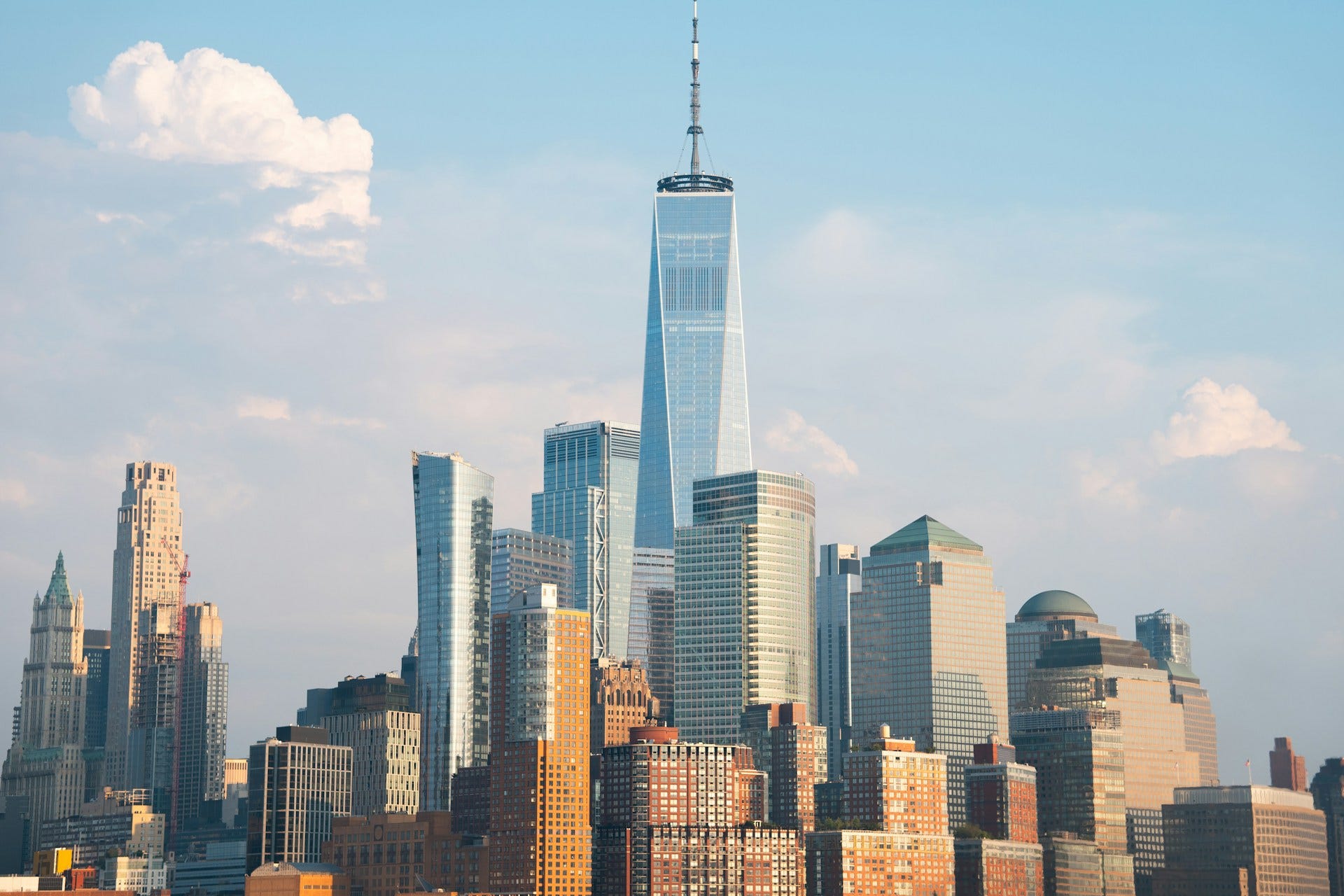
The office leasing market has been in the doldrums since the pandemic, as work-from-home reduced businesses’ need for office space. Now that may be turning around. Colliers reports that office leasing volume jumped in the first half of 2026, compared with the same period a year ago, and represented the best first half since 2002. Manhattan’s average asking rent was the highest since July 2020, and the availability rate (which includes both vacant space for rent and space expected to become vacant) continued to fall, to 13 percent in June.
Colliers attributed some of the tightening of the office market to residential conversions, with over 900,000 square feet of office space removed from the stock in the second quarter of 2026. State legislation enacted in 2024 created a tax exemption for conversion of non-residential buildings to housing, known as “Section 467-m.” The most generous exemption period, 35 years, applies to buildings that commenced construction by June 30, 2026. That gave building owners an incentive to move quickly.
In addition, the office market is getting a boost from employment growth.
In the year to May, New York City gained 44,500 private jobs overall, a gain of 1.1 percent. NYC’s employment is dominated by services, and these can be divided between “key industries,” which are relatively concentrated in the city, compared to the nation as a whole, and those that mainly serve the local population.
The city’s economy depends on the fortunes of key office-based industries, which bring in income from the rest of the nation and the world and fuel the city’s tax base. These are broadly categorized in jobs data as “Information,” “Financial Activities” and “Professional and Business Services,” and “Management of Companies and Enterprises.”
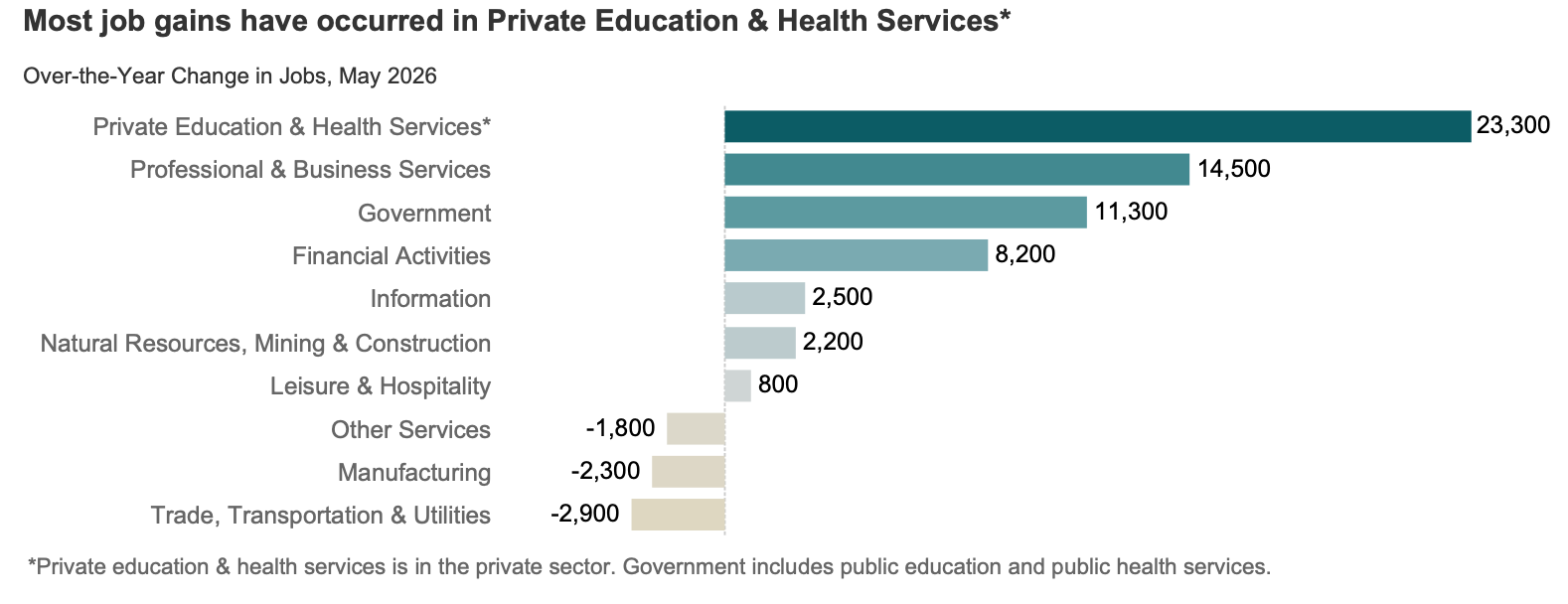
In April, I noted that key office-based industries had broadly stagnated in 2025. Employment has now picked up in the largest of these groupings, Professional and Business Services, which gained 14,500 jobs, or 1.8 percent, in the year ending in May 2026. The office-using Publishing component of Information grew 4.1 percent, while Financial Activities grew by 1.6 percent. Management of Companies and Enterprises grew by 1.5 percent. Among the local-serving industries, Private Education and Health Services had by far the largest growth in the year to May, gaining 23,300 jobs or 1.8 percent.
The mayor’s Executive Budget in May included an Economic Outlook chapter prepared by the city’s Office of Management and Budget. That chapter anticipated the continued rise in office asking rents but was more conservative in its forecast of office-based employment. The new data will keep the city’s revenue forecast on track and, with more people working at relatively high-paying jobs, perhaps lead to unexpectedly higher income tax revenues.
New York City’s ability to continue adding jobs depends on the availability of housing for its workers.
Since the great majority of workers in the city also live in the city, that requires progress in alleviating the city’s chronic housing supply shortfall. Here, the news is more equivocal, but there are some signs of progress.
In March, the city’s Planning Department (DCP) reported that 38,682 new housing units were completed in 2025, the most since 1965. That is a consequence of the rush to vest tax benefits under the Section 421-a program, for which construction was required to commence by June 2022.
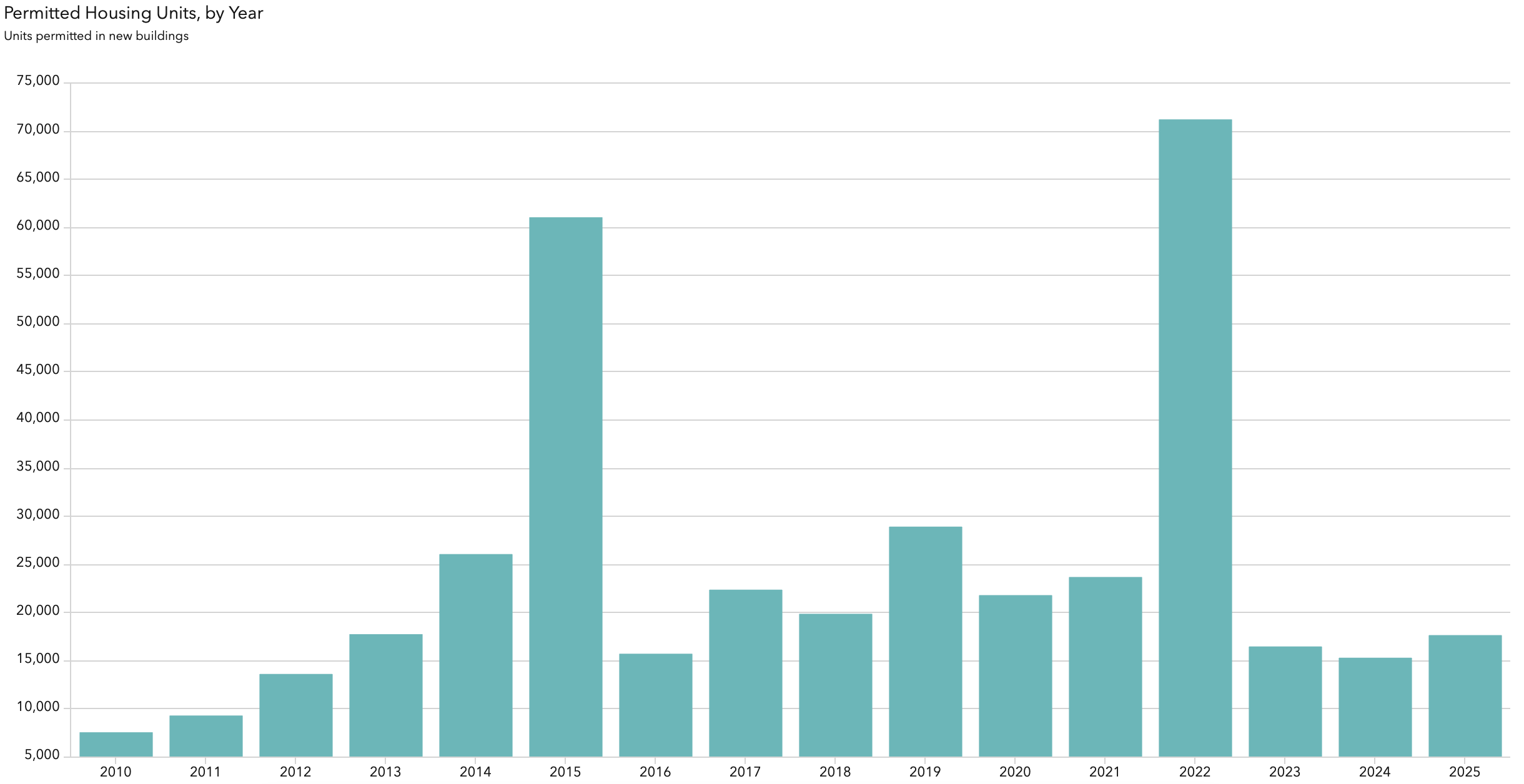
The 421-a expiration compressed several years’ permits into one year. The huge spike in permits in 2022, to 71,226, was followed by a steep dropoff. In each of the next three years, citywide new housing permits were well under 20,000. DCP reported that permits for 63,805 new homes were active but unbuilt at the end of 2025. It is unclear how many of these will ultimately be completed. The 2024 state legislation that created the residential conversion incentive also extended the completion deadline for the vested 421-a developments to 2031.
In 2024, the city approved the “City of Yes” zoning amendments. These were expected to accelerate the pace of housing development, and 2026 housing permit data indicates that might be happening. In the first four months of 2026, NYC issued building permits for 9,705 new housing units, mostly in the Bronx, Brooklyn, and Queens. If it continues, the increased pace of permitting, plus the large overhang of approved permits from 2025, implies that the city may be able to sustain an elevated level of housing completions, compared with the experience of recent decades.
Ironically, Mamdani, who has only been mayor for a few months, is responsible for none of this. However, he gets the credit, just as he would be blamed if the city’s economy went into a tailspin. In any event, the mayor’s avowed democratic socialism has not scared off a sizable number of business decisions to invest in New York City.
Mamdani clearly intends, through his “Block by Block” plan, to make a significant further contribution to alleviating the city’s housing crisis, although the details will be important. He has yet to articulate an economic development strategy, for which he has been criticized in the media. Despite catching a break from the city’s entrepreneurial energy, there is still much he could do, in particular to boost employment in the declining retail, and leisure and hospitality industries, which are large sources of employment for less-skilled and less-educated workers.
The perspective from mid-2026 is much better than that from last year, but much remains to be done to keep the better times going.
Except for "health care," these net office leases are a surprise. I'd like to read an explanation of why this is happening here.
Mamdani’s “Democratic” Socialist tack is bound to put a crimp into these rosy prospects. He has not recanted his desire that the city seize “under maintained” buildings. In other words, the commie will screw it up.