

On January 2, Mayor Mamdani signed Executive Order 07 establishing the Office of Mass Engagement (“OME”). The goal of OME is to create campaigns, venues, and impetus for the mass public to successfully engage with their government.
“We are all too familiar with wanting to participate in City government and not knowing where to go. On a daily basis, this limits the capacity of our government,” said OME’s incoming commissioner, Tascha Van Auken.
This is all fine as stated, but I wonder how much OME is about genuinely helping New Yorkers engage with their government in a civically neutral fashion, and how much it is an attempt to build a permanent campaign apparatus to manufacture consent for, and coordinate people to, lobby for the mayor’s policy agenda. I suspect it is some amount of both.
But how would one know?
One thing I found helpful, like so many other people, was to compare Mamdani to Mayor John Lindsay (1966-1973).
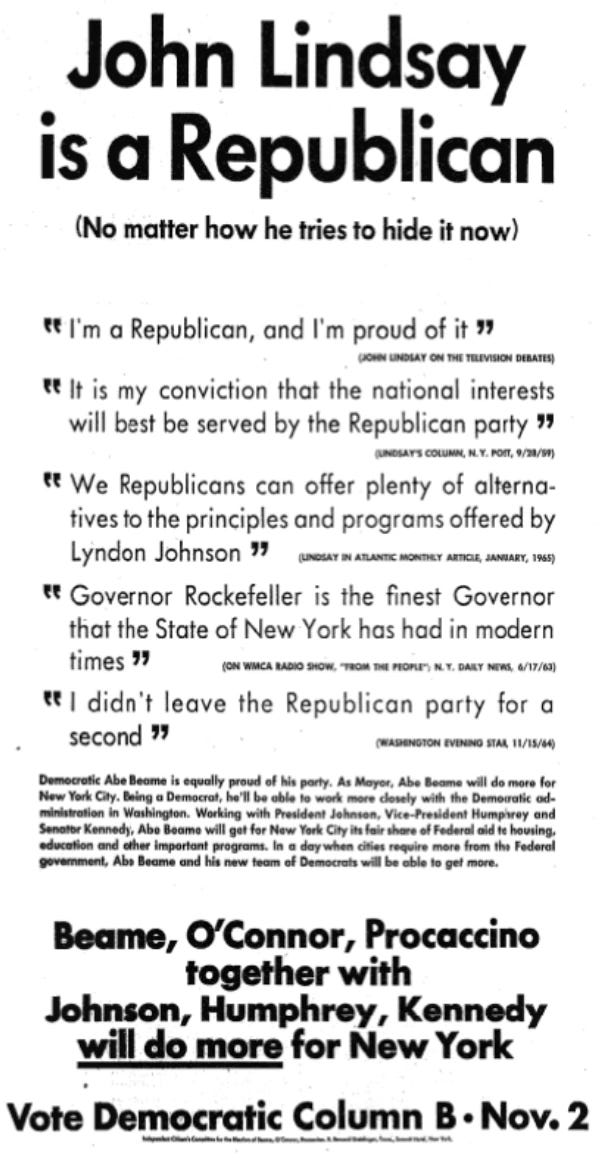
Lindsay was a progressive Republican, and when he ran for mayor in 1965, he heavily courted non-Republican voters while distancing himself from the Republican establishment. He did this to such an extreme that his Democratic opponent, Abe Beame, took out a full-page ad in The New York Times to remind voters that Lindsay was actually a Republican (The New York Times, October 25, 1965, p.28).
This campaign unavoidably produced tension between Mayor Lindsay and more conservative Republicans throughout New York, especially the party bosses in the Republican county committees of the outer boroughs.
So the mayor had to solve two problems: (1) he had tenuous support from city Republicans, and couldn’t rely on their institutional support during his term, and (2) he was mostly courting voters who usually voted for Democrats, so their support did not translate into party institutional support either.
He needed his own, independent machine, and he attempted to solve this dual partisan problem by creating “neighborhood city halls.”
Writing in the Saturday Review, Lindsay suggested that the nation’s mayors ‘might explore the establishment of neighborhood offices throughout their cities to give residents a line into City Hall when they want answers or action on such perennial problems as better street lights, smoke abatement, vandalism, landlord-tenant disputes, and enforcement of dog leash laws.’
Democrats such as City Council President David Ross feared that these neighborhood city halls would recruit candidates to run against Democrats. [Lindsay’s Deputy Mayor] Price hoped to use these neighborhood offices to build a political organization loyal to Lindsay and independent of both the Democratic machine and Republican Party...” 1
Lindsay’s neighborhood city halls, while undoubtedly aimed at helping New Yorkers, were also fundamentally about building power for Lindsay himself. The City Council refused to appropriate money for them, so Lindsay used private donations. By the end of 1967, there were six neighborhood city halls in mostly poor, minority areas across the boroughs: Washington Heights, Flushing-Corona and Flushing-Hillcrest, Brownsville and East New York, and Fordham–East Tremont.2
In the end, the neighborhood city halls failed.
Some of that was due to opposition from existing agencies, who didn’t want their power diluted, and some to Lindsay’s declining ability to negotiate funding with the City Council. Their death was complete once Lindsay left office.
The failure of the neighborhood halls reflects the larger decline of Lindsay’s political capital and his ability to build a power base independent of either of the major parties. Lindsay would ultimately go on to formally become a Democrat after losing the Republican primary in his 1969 reelection bid:
“Shortly after 9:00 A.M. on Wednesday, August 11, 1971, two registrars from the New York City Board of Elections arrived at Gracie Mansion on the Upper East Side of Manhattan. The election officials were escorted into the mansion’s living room and introduced to the mayor of New York City, John V. Lindsay, and his wife, Mary. The registrars presented the couple with two blank enrollment applications, the official document by which voters in the state registered with a political party. The Lindsays sat down to fill out the forms. Both listed Gracie Mansion as their residence. Both indicated their intent to change their party enrollment. And both marked the circle corresponding to membership in the Democratic Party...That brief bureaucratic procedure ended John Lindsay’s theretofore lifelong membership in the Republican Party.”3
To what extent will Mamdani’s OME resemble Lindsay’s neighborhood city halls, in both practice and motive?
While there are certainly strong parallels, they aren’t the same.
Although it promises to be more, OME is (so far) a reorganization of existing infrastructure within the office of the mayor, but it is pre-existing infrastructure, unlike Lindsay’s project. Further, Mamdani came into office with the backing of a machine independent of both the Democratic and Republican parties—the Democratic Socialists of America.
Other Mamdani allies, many of them in the DSA, have also created a new 501c4 called Our Time to advocate for his agenda. Finally, despite being the Democratic nominee for Mayor, Mamdani voted for himself on the Working Families Party line, revealing another strong alliance outside the Democratic and Republican parties. In all these ways, he is far ahead of Lindsay in independent power building.
Only time will tell how much this overshadows the facially laudable, small-d democratic goals of the new OME.
My personal barometer for the latter will be whether he takes on the challenge of training community board members well, especially on parliamentary procedure. CBs already exist in a state no one would call sterling, and section 5 of the executive order establishing OME mentions them specifically as a priority. Upgrading CBs is a test of enhancing and maintaining what we already have, and declining to upskill them in favor of building a parallel process of engagement would be telling.
The Ungovernable City: John Lindsay and His Struggle to Save New York, Vincent J. Cannato, 2001, p.111
The Ungovernable City: John Lindsay and His Struggle to Save New York, Vincent J. Cannato, 2001, p.111-112
New York State and the Rise of Modern Conservatism: Redrawing Party Lines, Timothy J. Sullivan, 2009, p.1

Why spend money NYC doesn't have on this? There are existing mechanisms like public hearings. Mamdani's expertise with social media could bring out good attendance at public hearings.
OME's funding is new or (so far) just resorted from existing staff? I can see patronage opportunities.