

New York City’s politicians spend most of their time talking about an “affordability crisis” for city workers — but a hard look at the workforce suggests something more like an opportunity crisis.
According to one recent report, just 35% of jobs in New York City require a four‑year degree. At the same time, New York has a larger pool of well-educated residents, and a pre‑pandemic city report shows that 17% percent of workers with at least a bachelor’s degree were employed in occupations that typically do not require one.
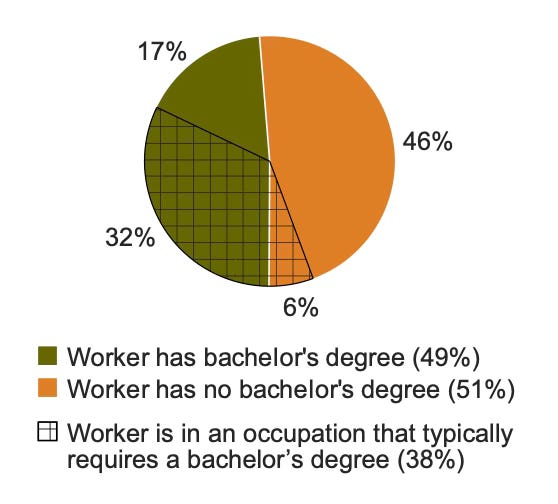
The troubling takeaway: a potentially large share of college‑educated residents — already bracing for the disruption brought by artificial intelligence — are either underemployed in roles that do not require their credentials, or struggling to find work at all, as non‑degree jobs continue to dominate the city’s employment base.
Nationally, about 5.6% of recent college graduates aged 22–27 were unemployed as of May, higher than the overall unemployment rate and not far below the 7.2% unemployment rate for young workers without a bachelor’s degree, narrowing the traditional gap between them.
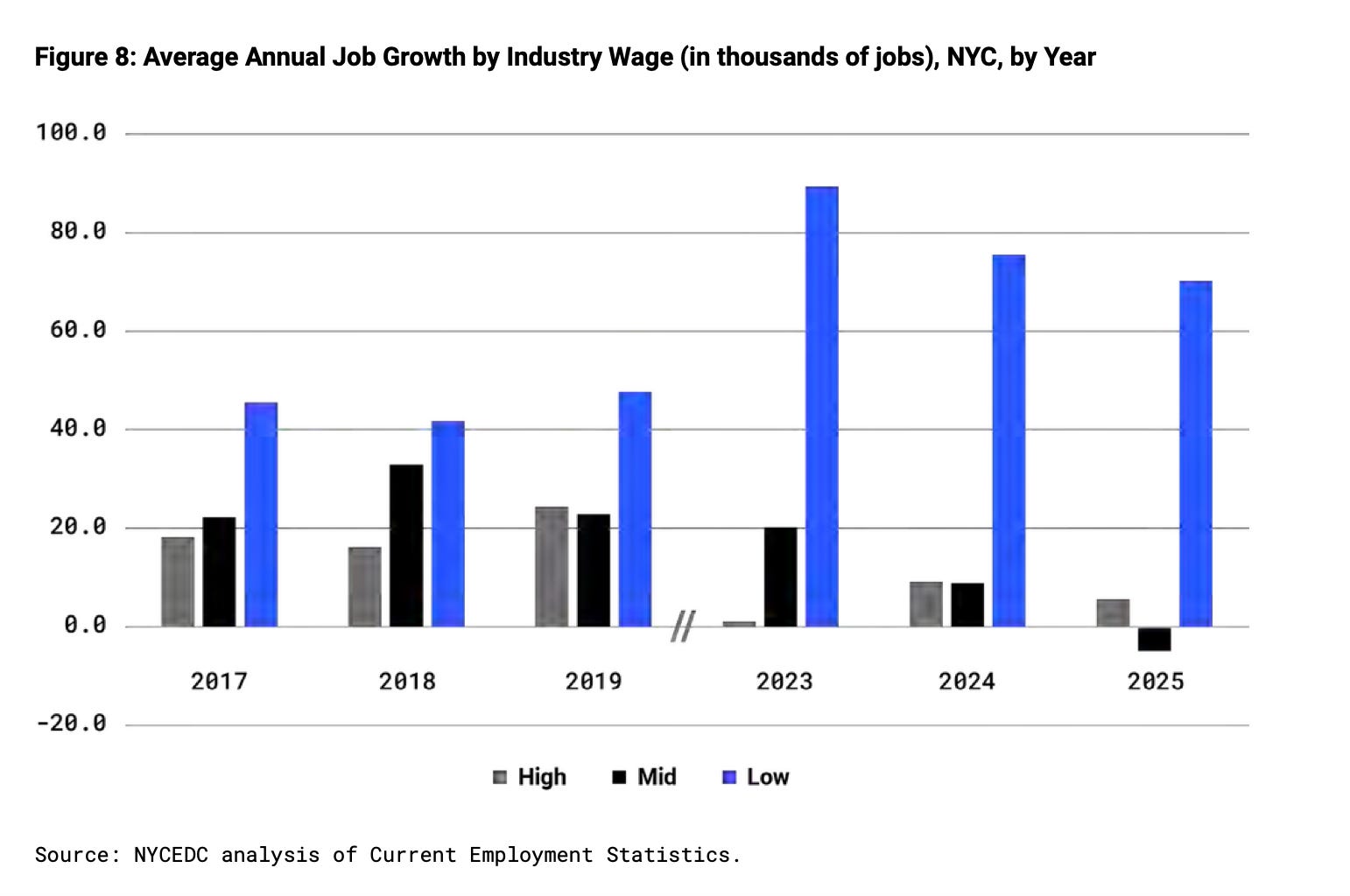
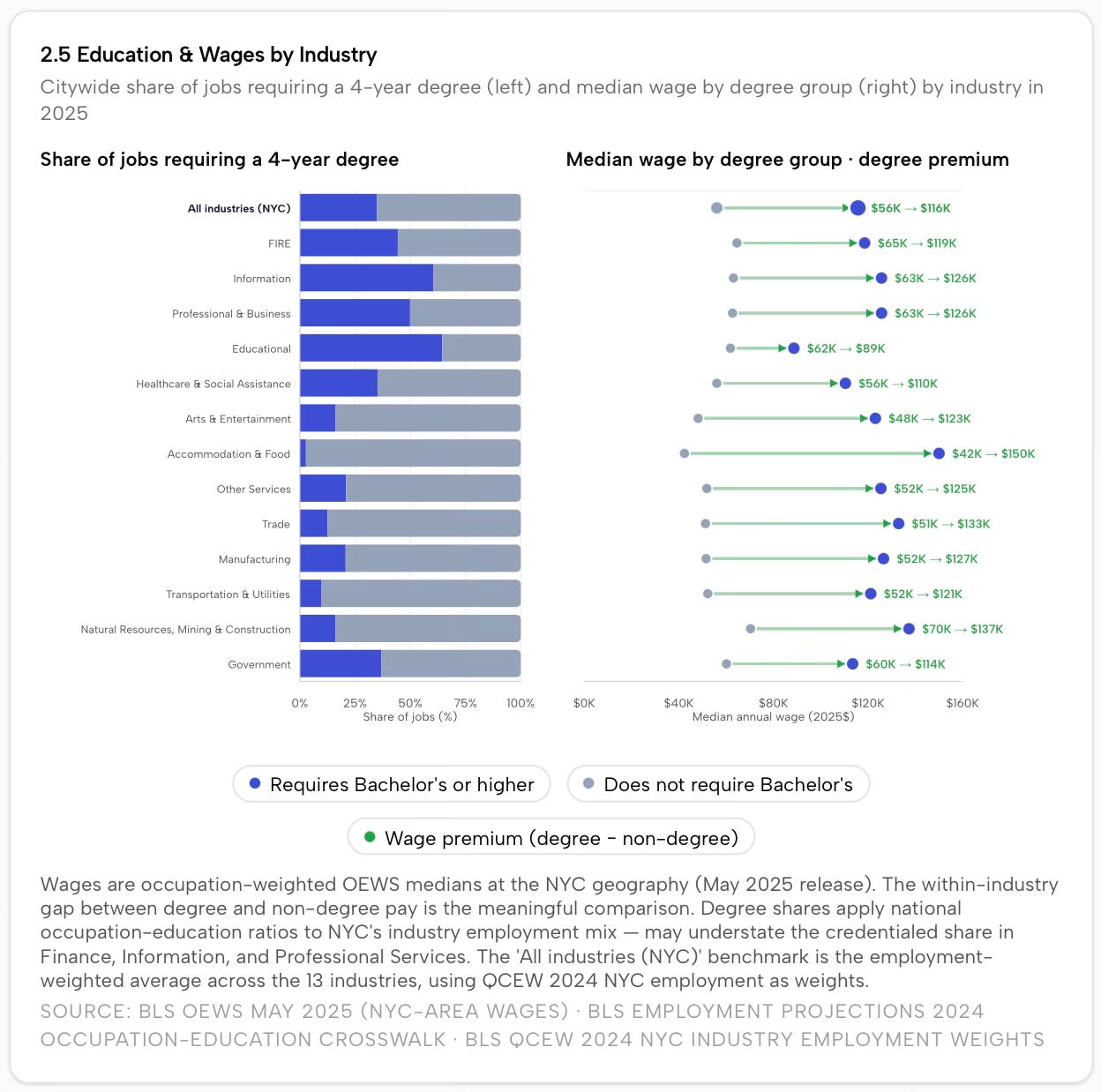
Jobs that require a degree pay more and lead to greater upward mobility, yet most of the job growth within the city has been in the low-wage service and care sectors that, for the most part, do not require advanced degrees, a trend that New York State projects will continue.
Downward mobility and underemployment help explain the angry politics that produced Zohran Mamdani. Unfortunately, his solutions are aimed at softening the blow — not at fixing the underlying mismatch between workers’ education and their opportunities.
New York City’s Job Slowdown
NYCEDC’s May 2026 Economic Snapshot shows that New York City lost 5,400 private‑sector jobs in April, leaving a net gain of just 4,700 private jobs for the first four months of 2026. The city’s unemployment rate fell 0.1% to 5.6% in April and labor force participation fell 0.7% to 62.7%.
MI’s Eric Kober wrote back in April about what the recent trends in employment numbers mean for the city whose private‑sector job growth has slowed sharply compared with 2024.
The Need for Better Jobs Explained
ABNY’s Making Growth Matter report (by HR&A) offers a good starting point for understanding the city’s labor market, and what its dynamics mean for the residents, whether they can afford market rate apartments, or children, and how trends compare among various metro areas.
The bottom line: low-wage jobs in sectors like health care and social assistance are expanding quickly, high-end finance and tech jobs continue to do well. The result is a barbell-shaped labor market that deepens the tale of the two cities for many residents, with most of the new jobs paying poverty wages. Meanwhile, the scarcity of medium-wage opportunities makes it increasingly difficult to move up from low-wage work into a job that matches the city’s cost of living, even for people with experience or credentials.
The Job Quality Problem
In a recent piece in Vital City, Tal Roded looks beyond the impact on individuals to how the city should approach the economic challenges of its polarizing labor market.
City Hall should stop treating any job as a win and instead prioritize expanding “good jobs” as defined by the Comptroller’s four criteria: a wage that meets local living costs, basic benefits like health insurance and paid time off, predictable and stable hours, and safe, dignified working conditions, he argues.
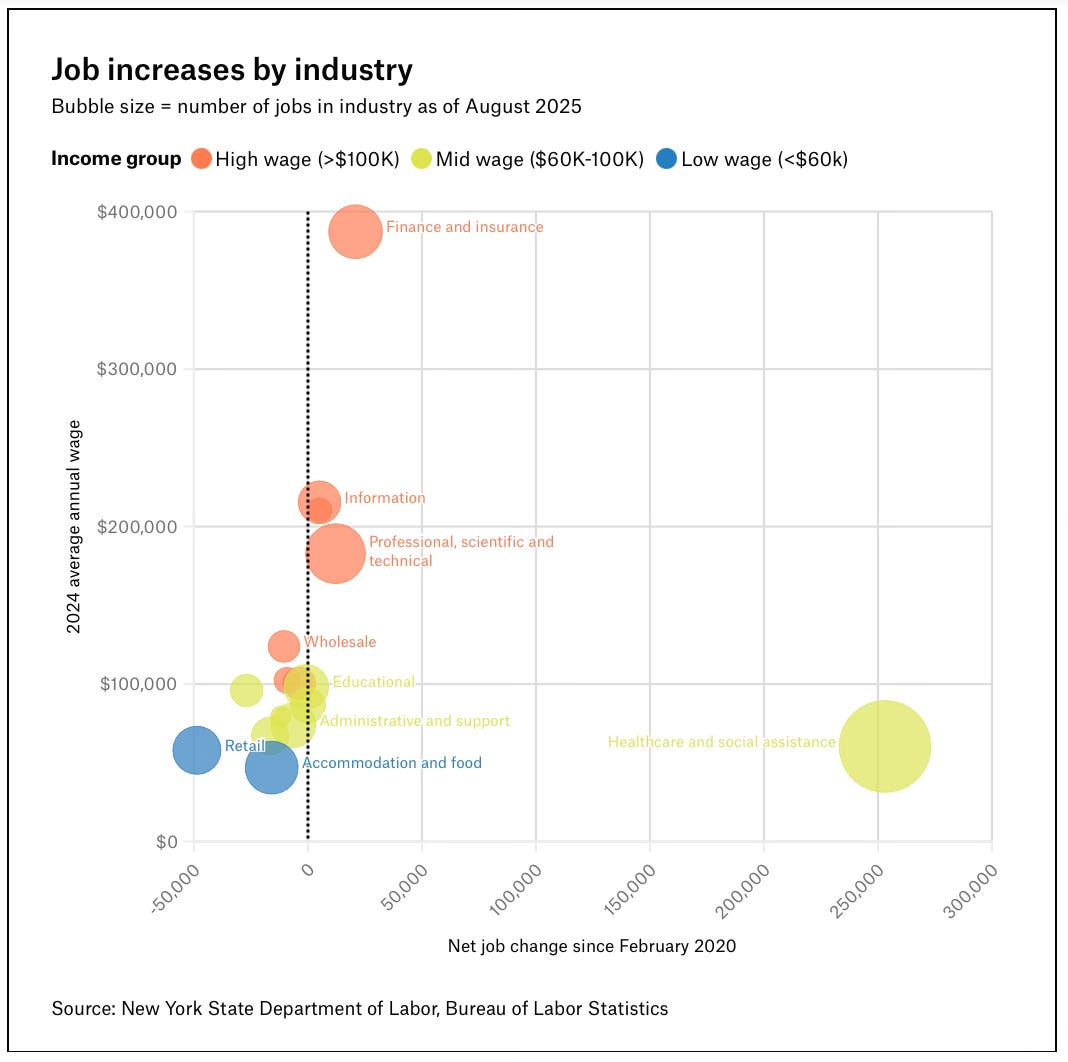
“New York should think and act strategically to diversify job growth by nurturing and attracting employers that complement the growth in the care economy,” Roded writes. “At the same time, reforms should be pursued to make health care and social assistance jobs more desirable and financially rewarding.”
Class Size Law as UFT Jobs Program

New York’s rising per-pupil spending is driven less by student needs and more by using the Class Size Law as a de facto jobs program to preserve UFT teaching positions despite a sharp enrollment decline, MI’s Danyela Souza Egorov writes.
Full compliance with the law would require spending billions on new teachers and space that the system doesn’t have. So the city now pays bonuses of up to $8,500 to thousands of teachers in oversized classes, while also “holding harmless” school budgets even as students leave—effectively funding empty seats and union headcount rather than tying staffing and dollars to actual enrollment or learning results.
The Mayor’s Job

The city, facing a cash flow problem, is considering delaying payments to non-profits, NBC New York reports.
Between basketball and soccer, it’s showtime in NYC, and our mayor is ready. On top of being ubiquitous, Mamdani is trying his hand as a TV host of his own “Morning Pitch”, giving our local TV stations a run for their money with daily morning updates like this

Extra! Extra!
We need shade! As we deal with yet another heatwave and the coming summer will probably be hotter than the last, we should work more on planning for shade beyond planting trees, Diana Lind argues.
We need more street lighting! If crime goes up when the sun goes down, there’s now research from New York City housing developments that crime goes down when lights go up, and by more than a third, Vital City reports.
Sounds like too many are wasting too much time and money getting degrees.