


As a member of my community board, I have the pleasure of attending monthly full board meetings. At these meetings, local representatives or their liaisons from City Council members to State legislators provide whatever updates they so wish, typically on legislation the elected official has introduced or recently had passed.
Initially, I was greatly impressed by the parade of bills and resolutions being touted. As the procession repeated itself with each passing meeting, however, I began to wonder why all our City’s problems weren’t fixed yet, given the impressive volume of legislation being passed in the City, State, and federal chambers.
As I began having conversations with workers at city agencies and political advocates doing on-the-ground work, a more complete picture of these policies emerged.
While agencies often supported the policies being passed, they were frequently exasperated with the burden of new work being piled on without resources to implement them. These unfunded mandates ultimately undermine public trust in government effectiveness when the law says one thing, but the government is unable to enact or enforce it.
City Council Fiscal Impact Statements
Since the passage of the current New York City Charter in 1989, which abolished the Board of Estimate and massively expanded the City Council’s role in NYC governance, some version of fiscal impact statements has been required to vote on proposed legislation.
The New York City Charter requires that all proposed local laws and budget modifications must be accompanied by estimates of “the fiscal impact of the law or modification on the revenues and expenditures of the city” for the fiscal year the legislation would become effective, the following fiscal year, and the fiscal year in which the “full impact” of the legislation is expected to occur.
Regarding the accuracy of these estimates, however, the Charter is much more forgiving: “If the estimate contained in a FIS is inaccurate, such inaccuracy does not invalidate the local law or budget modification”.
Critically, appropriating the funds to cover the expenditures outlined in the FIS is not required, and while the costs of new legislation must be identified, they can thereafter be ignored by the Council. An FIS can acknowledge that a proposed local law would entail massive budgetary expenditures, yet no funding or revenue sources for the legislation are specified.
Introducing The City Council Fiscal Impact Tracker
Despite the limitations, these Fiscal Impact Statements provide a starting point for measuring the costs of new legislation. But it is not easy, as they are provided in unstructured Word document attachments on Legistar.
To better understand the totality of the potential costs of mandates and legislation being passed by the NY City Council (NYCC), I aggregated all fiscal impact statements since 2014 into the NYC Council Fiscal Impacts Tracker.
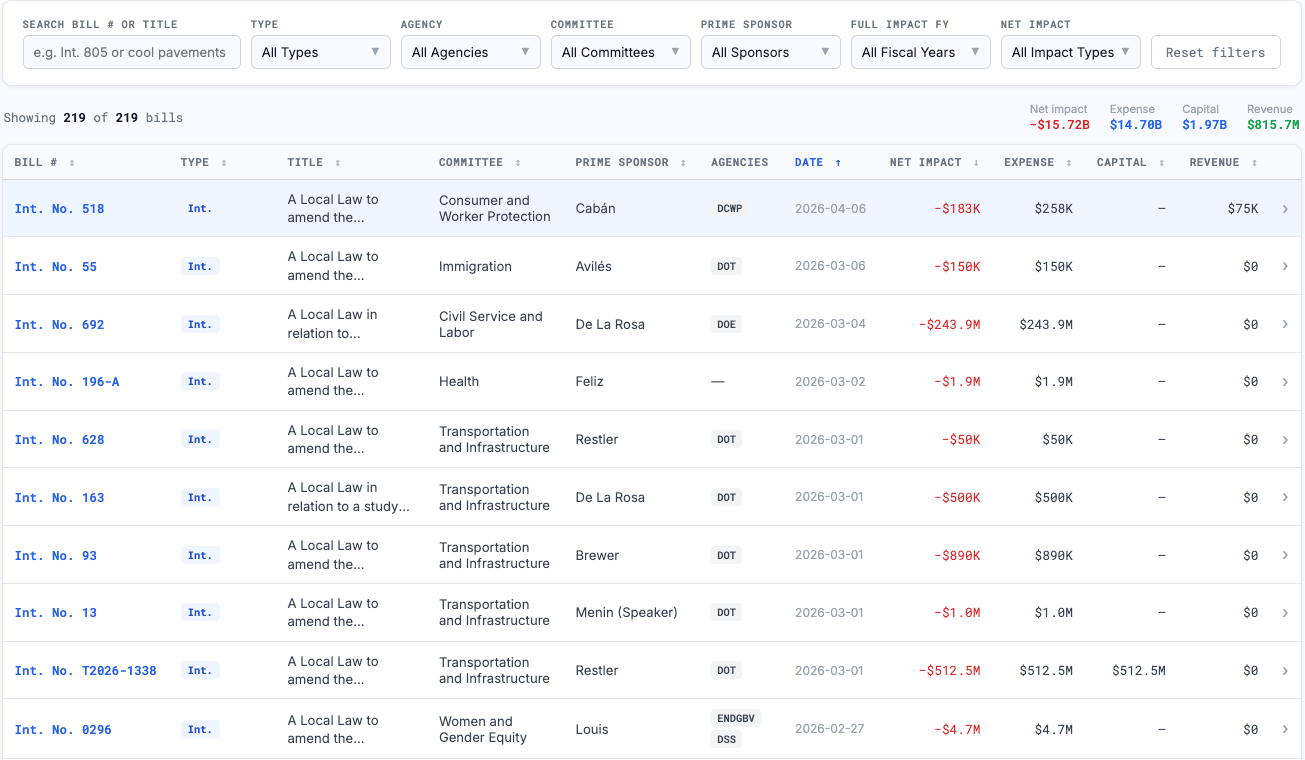
The tracker parses available FIS1 to break them down into the estimated revenue, expenses (operational and capital), and net fiscal impact of the associated local law.
Of the 1,563 fiscal impact statements in the Legistar API for Jan 2014- Apr 2026, 219 were added to the table. The FIS not added to the table were either because both revenue and expense impacts were zero (1,108 cases), no revenue or expense impacts could be found/extracted by Claude (183 cases), or there were duplicates with proposed bills and enacted local laws (~90 cases).
What The Data Tells Us About New Costs
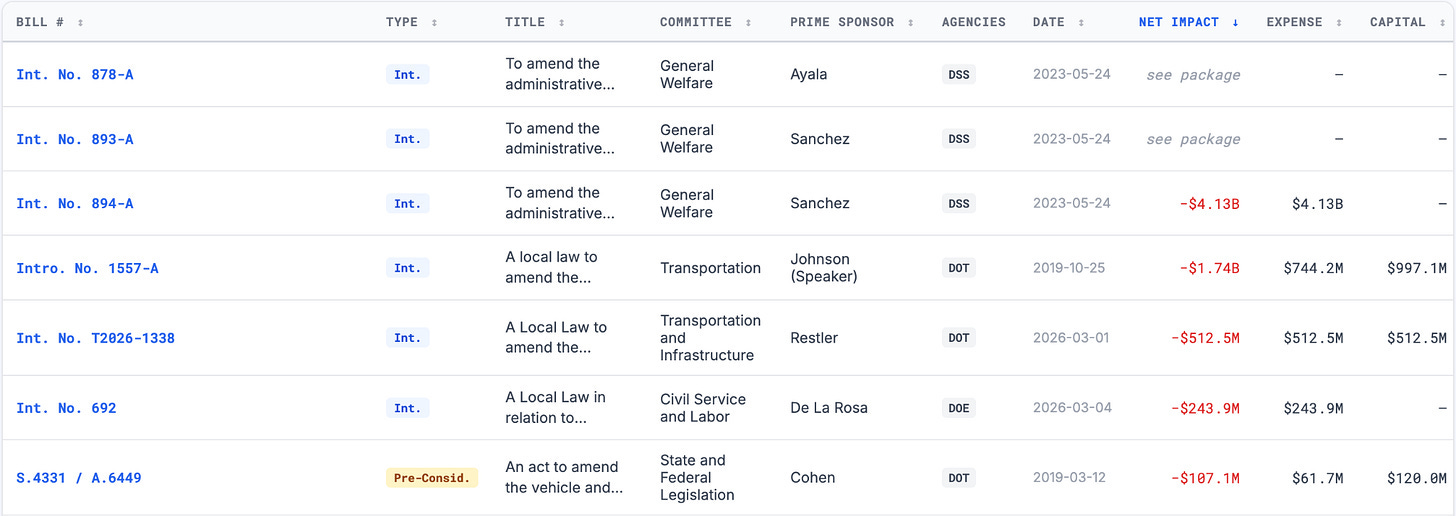
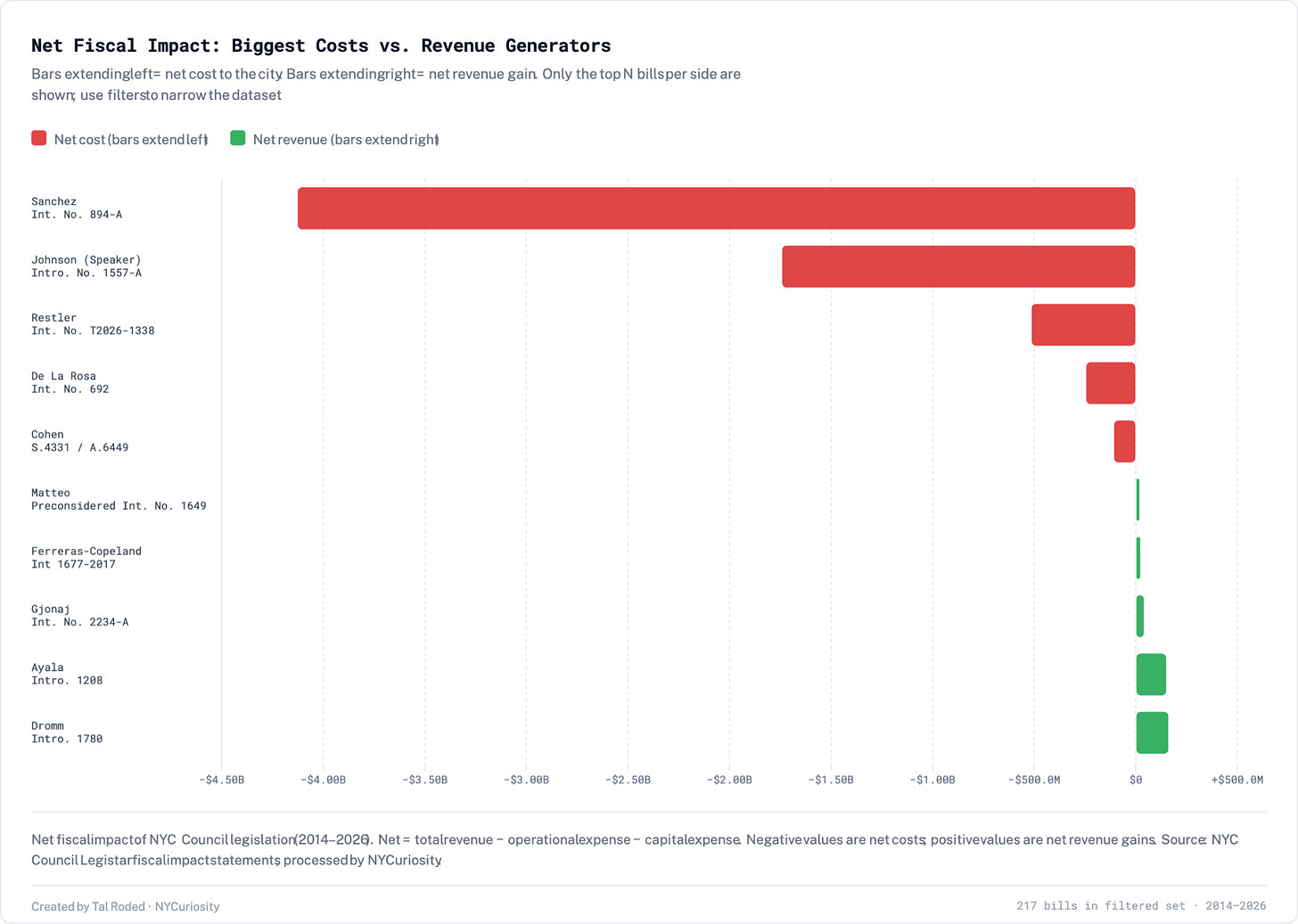
Even with the limitations to what data could be scraped, the database contains over $7.5 billion in net fiscal impact (operational expenses + capital expenses - revenues) for City agencies introduced by Council legislation between 2014 and 2026.
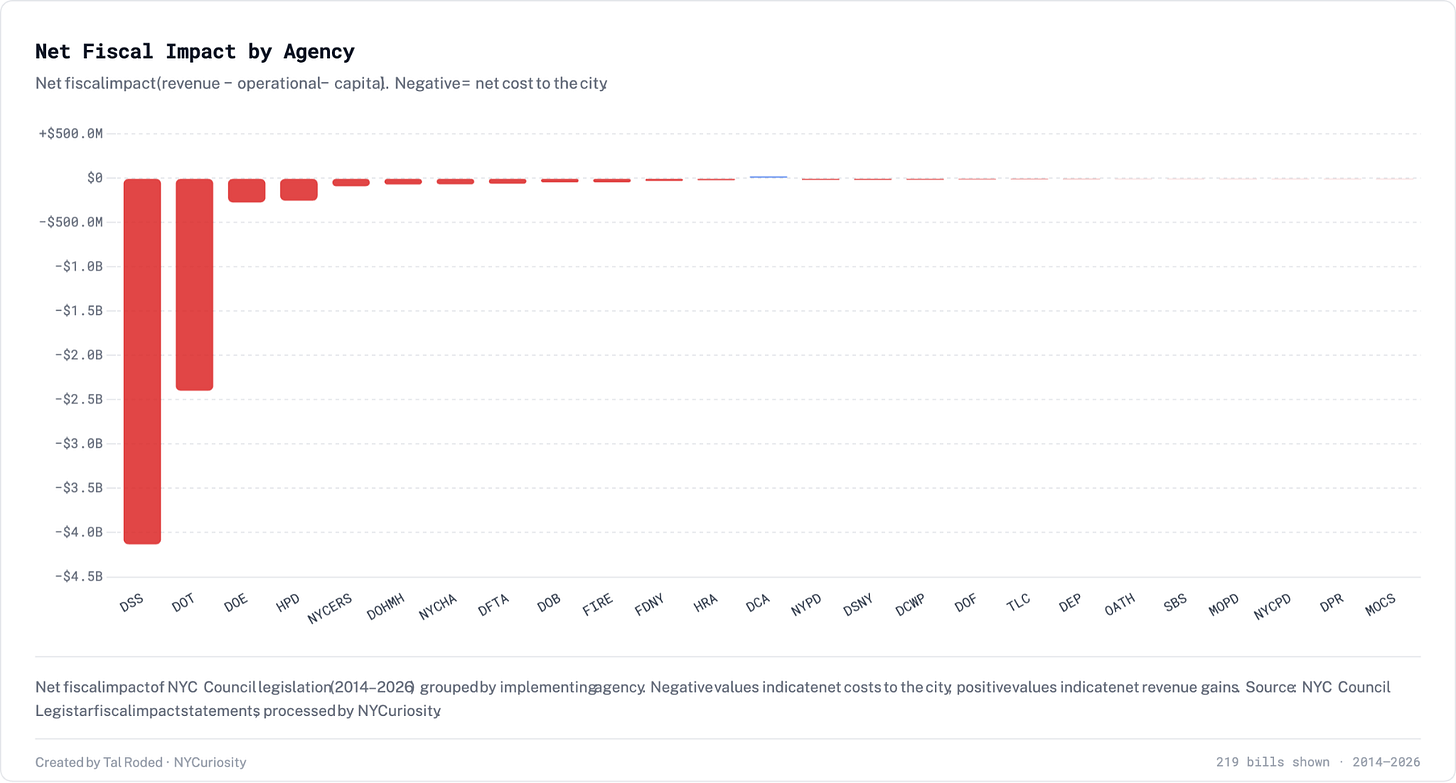
The Council’s unfunded legislation had the biggest financial impact on the Department of Social Services through CityFHEPS, on the Department of Transportation through the Streets Plan and on the Department of Education (DOE) through mandates on payments to school paraprofessionals. These three policies alone have added over $6 billion in expenses to the city budget in the past five years, and no new revenue or specified source of revenue.
This is similarly reflected when looking at the net fiscal impacts of Council legislation by agency: DSS ($4.1 billion) and DOT ($2.4 billion) far outweigh the others, with DOE and HPD each carrying over $250 million in added expenses.
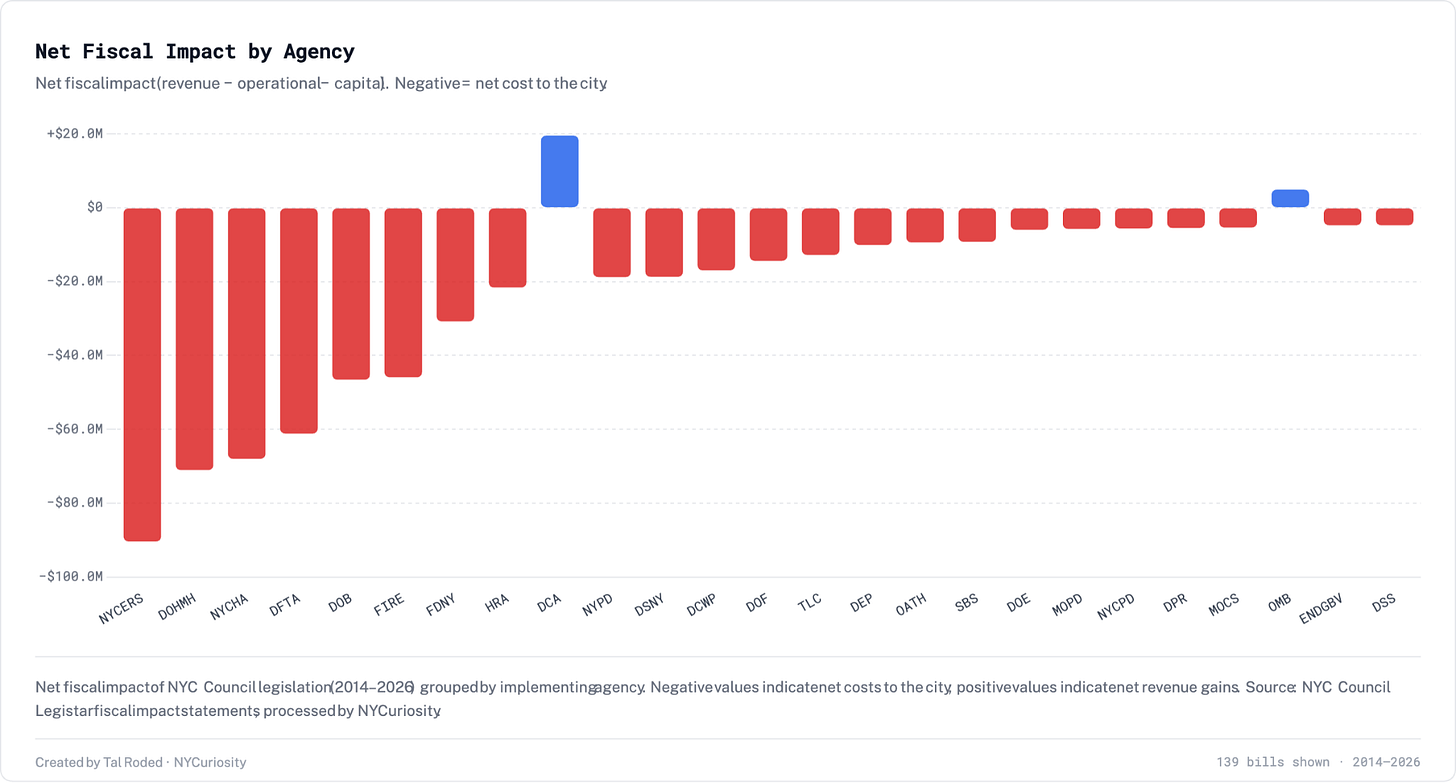
Without these four agencies, costs are much more evenly distributed – there remain 139 bills with over $500 million in net expenses, primarily operational. Interestingly, DCA is one of the few agencies with a revenue-positive net fiscal impact, receiving nearly $20 million in new revenue from eight relevant local laws, offsetting expenses.
While overall expenses added to these agencies are much smaller, total agency budgets are also much smaller, so that the proportional impact of the legislation remains large. For many affected agencies, the added costs from the past decade of legislation are at or near the total agencies’ FY2025 budget.
While in some cases these new expenses are offset by new revenue included in the legislation, 97% of the local laws in the tracker state only that funding will come only from the General Fund, meaning no dedicated funding source to cover the new expenses.
This effectively kicks the can down the road, severely constraining future mayoral administrations’ ability to introduce new policies as unfunded commitments from prior legislative sessions continue to accumulate. That’s also why NYC now faces exploding budget gaps in upcoming years, as well-intentioned but unfunded programs like CityFHEPS and the Streets Plan eat up fixed revenue streams, problems that MI’s E. J. McMahon warned about back in 2024.
Reviewing the current litany of mandates facing every agency and their yearly costs could also identify where the largest cost savings exist, on a much larger scale than what the Mayor’s Office shared from the Chief Savings Officers’ plans. Eliminating outdated, unnecessary, or redundant mandates would be a double win, enabling agencies to move faster and more effectively while reducing costs.
The lack of accountability for these expenses, which accumulate each year, explains why the City is frequently unable to comply with the new mandates. If DOT’s budget is not raised to cover the new costs from the Streets Plan mandate, along with other rising expectations for DOT’s curb management and ongoing costs, it is to be expected that the agency will not deliver on its goals.
Holding Legislators Accountable
The 2024 Charter Revision ballot proposal was a good start to add more teeth to FIS. These new rules make FIS more accurate and a more prominent part of the debate over proposed legislation. A better understanding of the true costs of new mandates would force Councilmembers to face the trade-offs of endless new rules and regulations for City agencies. But these adjustments to the FIS rules did not go far enough.
In an ideal world, Councilmembers would not introduce new legislation without specifying where the funding to enforce or carry it out would come from, and would work with agencies to determine the most cost-effective way to implement it. There could be exceptions to such a rule, such as applying only to legislation with expected fiscal impacts above a certain threshold.
In reality, however, Councilmembers are incentivized to introduce as much legislation as they can, to show their constituents their hard work and make the case for their re-election.
But hopefully, this tool can serve as a basis to hold City legislators accountable for new expenses they introduce.
In California, state legislators last year announced a program called Outcomes Review, which will look back at a sample of legislation passed by the State Assembly and review whether the outcomes of that legislation aligned with their intentions. The goal is to shift legislators’ focus from maximizing legislative output to maximizing the impact of legislation.
Maximizing the number of new bills introduced or passed in a session should not be the target for legislators; ensuring that each introduced bill addresses a real problem with a solution that can actually be carried out by the implementing body would be a better goal.
Constituents armed with the knowledge from this new database can and should contact their legislators and hold them accountable for providing additional funding to the affected agencies. The Council and the Mayor’s office, together, can and should also be pressured to provide the necessary funding for existing mandates before introducing new ones. Accountability should not stop once legislation is passed; properly funding and ensuring policy implementation is just as, if not more, important.
I want to fully acknowledge that this database is not perfect - I used Claude Code to help me pull and parse the data, and there are likely many missing records. Legistar’s API has not been the easiest to use for pulling these attachments historically (see more about this in my methodology doc here), and the FIS themselves have not followed a standardized format over time. While recent FIS often include a table listing expenses/revenues, older ones involve paragraphs of unstructured text, where I used Claude to extract relevant numbers (not quite as reliable). I have done my best to manually validate all results, but there is a lot of data to sort through. Given potential extraction errors, I encourage users to click the row for any legislation they find in the table and follow the Legistar link to verify the exact numbers.

Thanks for quantifying something that I’ve felt for a while but haven’t had data to back up. The mismatch of incentives for legislators is particularly interesting, especially given that misaligned incentives between legislation and administration is what caused the “city manager” form of government to emerge. I’ve often wondered even beyond the council handing over a funded mandate, what would it look like for the legislators and administers to approach governance collaboratively with the mutual goal of positive citywide outcomes? How might this overlap with our current parochial council system that incentives reelection?
Replacing the Board of Estimate was a fateful choice for NYC.