

To put New York City’s welfare spending in perspective, MI’s Stephen Eide wrote this week about the limits of what the city can do when it comes to taking care of residents anxious about affordability.

“New York City faces a multi-billion dollar budget deficit thanks, in part, to a recent ramp-up in social spending. The economy’s not in recession. But the local welfare state has, of late, registered impressive growth. Local policymakers reason that, since low and moderate-income New Yorkers are up against it, and federal programs aren’t expanding, this city must take the initiative,” Stephen Eide writes.
Take the city’s rental housing voucher program, CityFHEPS. It is expected to nearly double to about $3.1 billion by 2030 even without the expansion the mayor is in court to stop, and officials in City Hall argue the demand for vouchers now exceeds what the city alone can sustain.
“When you talk about wanting a voucher program to be an entitlement program or a universal program, the only scale of government that can sustainably provide that is the federal government,” Leila Bozorg, Mamdani’s deputy mayor for housing and planning, told POLITICO.
“New York City is doing what only a national government can reasonably sustain,” Stephen concludes. “It is loosening targeting and expanding benefits without a clear plan to fund them, and its vision to lift its residents up is to offer them government jobs. In the long run, a system built this way will come under pressure from the city’s budget, its tax base, and the people it is meant to serve.”
Not Everyone Wants Universal Childcare

This week, Mayor Mamdani cut the ribbon (or rather ran through red tape) to announce the opening this fall of seven new early childhood centers — 240 3-K seats — into a system the Independent Budget Office says has roughly 17,000 unfilled seats already.
Laser focused on delivering Universal Childcare, since taking office, the mayor has launched 2-K with Governor Hochul; opened 3-K and Pre-K applications with outreach in 13 languages; announced 1,000 new 3-K seats in 56 ZIP codes; launched a citywide childcare map; created a provider-permitting portal; and advanced a free childcare pilot for municipal workers.
Asked about enrollment, the mayor said this week the numbers are “lining up with where we were last year.” The administration blames an outreach team Adams effectively “disbanded” — but if Mamdani’s extraordinary marketing skills couldn’t lift it, maybe demand isn’t the issue.
The Supply-Demand Mismatch
The number of children in NYC has fallen dramatically since Pre-K (2014) and 3-K (2017) were launched. The city’s under-5 population peaked around 566,000 in 2015 and fell to roughly 451,000 in 2024—a 20% drop. The under-3 cohort, the leading indicator for future demand, declined from 335,000 to 260,000.
The early education system has carried substantial vacancies for years, with large geographic variation. The IBO found 16% of 3-K and 20% of Pre-K seats unfilled in 2023–24. The DOE’s section in the Mayor’s Management Report shows the pattern worsening: School Day enrollment dropped 3% from SY 2023–24 to SY 2024–25, and unfilled seats rose 15% to 17,497. Total 3-K and Pre-K enrollment was roughly 103,000 in SY 2023–24, well below the de Blasio-era peak near 131,000 in SY 2019–20.
This could simply mean that everyone who wanted to send their child to Pre-K has, and the DOE seems to acknowledge as much, writing that “the declines in Pre-K enrollment reflect the growing need to age down the early childhood education system.” But it also reflects the fact that the number of children keeps falling, and we are not adjusting.
The same demographic wave is rippling through K-12: the city has spent roughly $1.6 billion cushioning school budgets from enrollment-related cuts, a “hold harmless” policy, Mamdani now has to decide whether to continue. “Despite a nearly 92% increase in early childhood spending since FY 2018, enrollment has not increased commensurately,” the NYC Comptroller reported in 2024.
“As Mayor Zohran Mamdani seeks to fill his $5.4 billion to $7.1 billion budget hole, he has so far shown little willingness to cut Department of Education spending,” MI’s John Ketcham and Danyela Souza Egorov write in the New York Post. “But he’ll never balance the books if he keeps throwing good money after bad in the city’s public schools.”
Center-based care in NYC is expensive, and parents who need 8- or 10-hour days often can’t find or afford them. But only 5% of Pre-K and 10% of 3-K seats are Extended Day and Year-round. The rest follow the school day, which, for working parents, is not a substitute for the childcare they need to rely on. We also need to acknowledge that many parents will choose to continue caring for their children themselves.
Mamdani noted accurately in January that: “If New Yorkers are not choosing to opt into the system, it’s a reflection of inadequacies in the system itself.” The inadequacy may not be that people don’t know about free childcare, but that the demand simply isn’t there for what’s being offered.
Busy, Busy Mayor: Mamdani’s War on Too-Expensive Eggs and Too-Cheap Luxury Second Homes
In this The Bigger Apple Podcast episode we talk about Mamdani’s plans for municipal grocery stores and whether green carts and farmers markets are already doing this work, the mayor’s proposed Pied-à-terre tax, the state’s war against insurance schemes, and more.
Meanwhile, in Albany …
“The war no one in Albany seems eager to talk about may determine how long the money lasts,” MI’s E.J. McMahon writes.
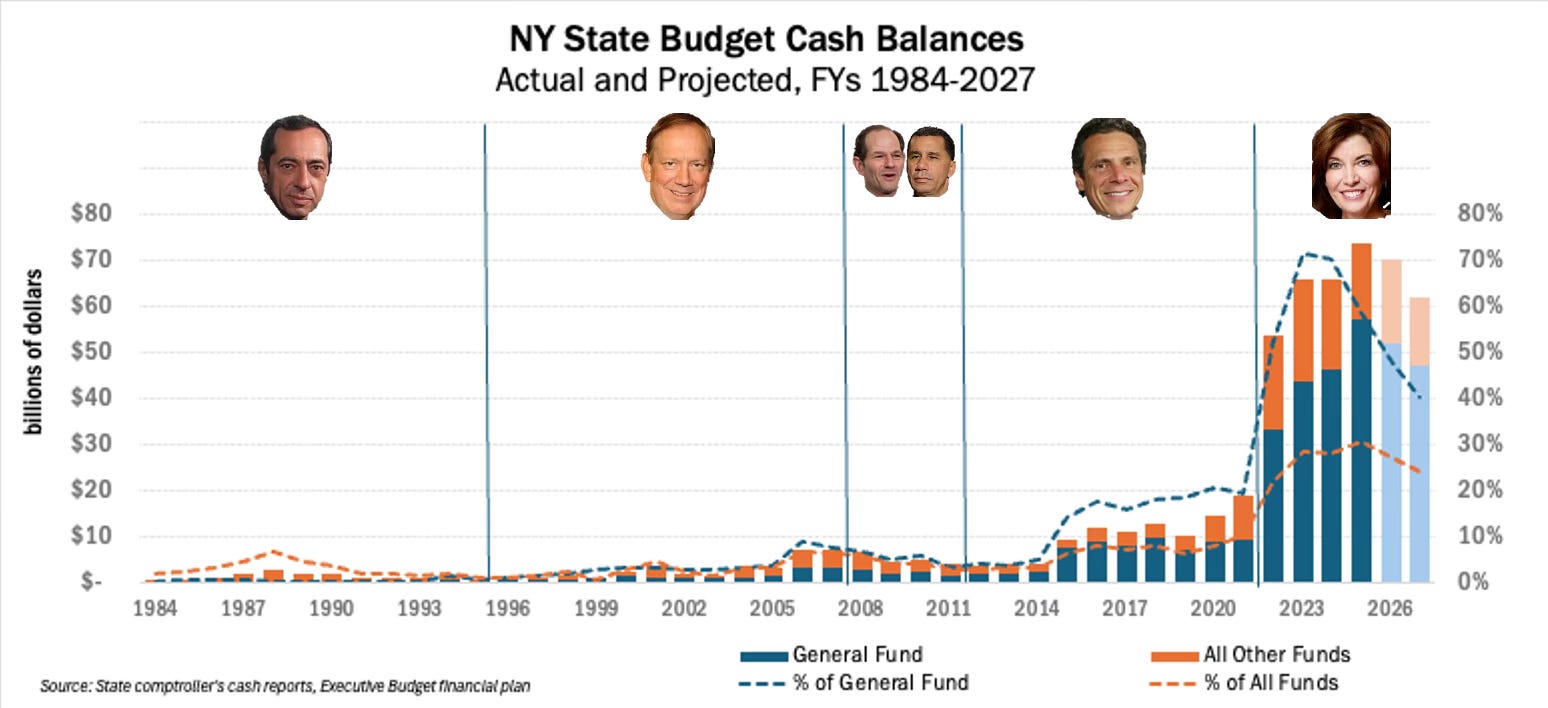
Much of the state’s unusually large current reserves built from pandemic aid, booming tax receipts, and investment gains are already committed through tax credits, prepayments, and other maneuvers, leaving it less truly flexible than the headline numbers suggest, he argues.
With spending set to grow significantly faster than recurring revenue, New York looks flush in the short term but remains highly exposed to a downturn.