

It is the end of August, even the mayor is out of town on holiday, and there’s time to consider questions like — Should one consider moving for tax reasons? Can NYC get to 700,000 new housing units over the next 10 years? Is it a good idea to fight council-approved bonuses for teachers’ aides? Our fellows’ takes on that and more below.
Mamdani Sets Ambitious Housing Goal
A draft “Fair Housing Growth Strategy” released by the Mamdani Administration this week sets the goal of producing 700,000 units over 10 years to relieve the housing crisis. It also sets out five-year, non-binding housing goals by community district, sketching out the outer borough past low-growth neighborhoods expected to see the highest growth, while avoiding specifics of how it plans to get there.
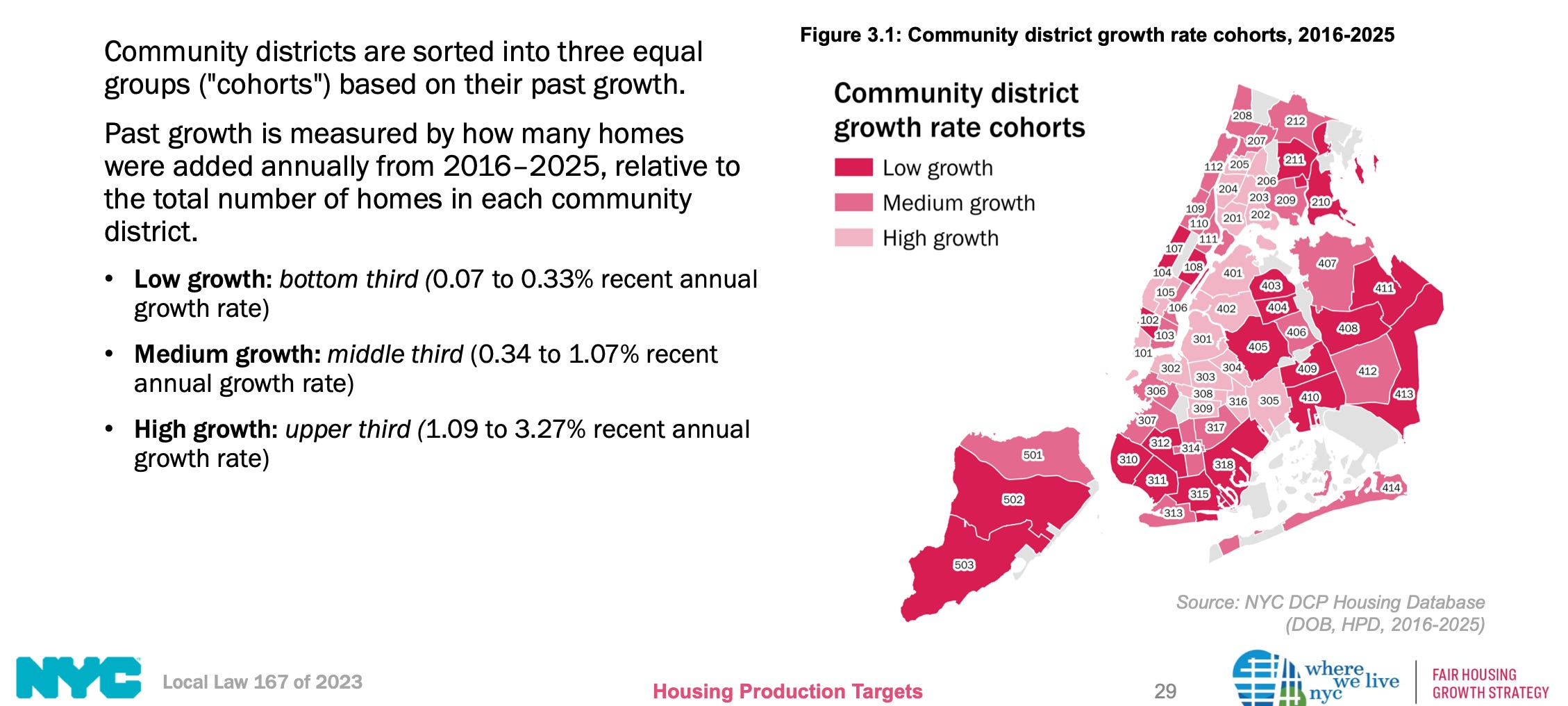
“The maps comparing high- and low-growth areas have a lot of overlap with the maps depicting areas that supported Mamdani and those voting for his principal challenger, Andrew Cuomo, in the 2025 mayoral election,” MI’s Eric Kober observes. Mamdani owes little to the low-growth areas, and has the powers to facilitate much more housing development.
“What’s needed is clarity from the administration on where and how it intends to utilize the mayor’s new land use powers. It is probably unrealistic to expect council endorsement of these plans, but there needs to be enough of a working understanding with a majority on the council so that city government can continue to function, even with continual bickering,” Kober concludes. “Until that happens, the council will continue to lash out, as with the Mangin nomination – and the tools that can get the city closer to meeting its housing needs will fail to fulfill their potential.”
Related: Another housing fight the city doesn’t need is over John Mangin’s confirmation to the Board of Standards and Appeals. “The BSA needs a chair who understands New York’s complicated land-use rules and will exercise good judgment in applying the law,” MI’s Eric Kober and John Ketcham write of Mamdani’s nominee in City Journal. “Mangin is a strong fit on both counts.”
The Trouble With Bonuses
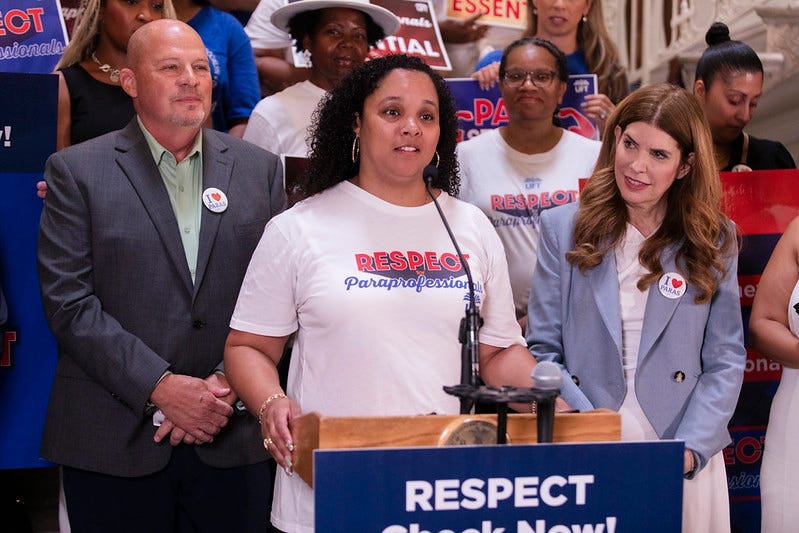
The City Council unanimously passed the RESPECT Check Act, requiring the city to pay up to $10,000 in “workforce stabilization payments” to paraprofessionals employed by the city’s Department of Education. The council argues that a starting salary of $33,000 leads to vacancies, which contributes to the high cost of Carter cases.
The mayor let the legislation become law this week and instead opted to sue the council, even though he had promised to support the payments during his election campaign. The administration is arguing that the council’s move circumvents conventional labor bargaining and would open the door to similar fights in the future.
"The mayor is taking up an important fight, the outcome of which will have enormous implications for the city,” MI’s Ken Girardin explains. “The Council has essentially told the city's public employee unions that they can get goodies outside the give-and-take of the bargaining process, where mayors weigh costs and tradeoffs. Why should a union agree to efficiencies or other reforms in exchange for raises? Why should they eat vegetables when the Council they helped elect is handing out dessert?"
In fiscal year 2025, the city spent $1.3 billion on Carter cases, where it pays for special needs children to receive education the city cannot provide in private settings, something that needs to be reined in, MI’s Jennifer Weber writes, by bringing more special education services into the public school system.
The Moving Dividend

Just what is the premium we are willing to pay to live where we want to?
MI’s Daniel Martino has created an interactive tool that allows anyone to examine hypothetical moves to see roughly just how much more (or less) in taxes they may be paying by moving from one metropolitan area to another.
“My new income tax tool shows that not only the rich, but also low- and middle-income Americans, have a lot to gain from moving across state lines,” he writes. “If Democratic-controlled states do not keep tax rates in line with those in Republican-controlled states, the middle class in those states might begin to flee as fast as the rich.”
Related: Escape from New York may not be easy.
The Bigger Apple Podcast: Why Small Classes Won’t Save Our Schools
On the latest episode of The Bigger Apple, Nicole Gelinas and I talked with education policy expert and MI fellow Jennifer Weber about the history of school choice, the limits of small schools and small classes, and reforms that could help the city improve its schools. Listen to the episode wherever you get your podcasts.
Sweden Doesn’t Mandate Childcare Ratios. Why Does America?
“Child-to-staff requirements in daycares raise costs without delivering clear benefits,” Chelsea Olivia Follett, a Research Fellow at the Cato Institute’s Center for Global Liberty and Prosperity, writes in City Journal.
All U.S. states have such mandates. But Sweden, often looked to as an example of universal childcare, does not regulate staffing ratios for preschools serving 1- to 5-year-olds, proving that “the choice isn’t between mandates and bad care,” she writes. “Sweden’s approach asks policymakers to place their confidence in childcare professionals and families instead of micromanaging these arrangements. If Sweden can trust parents and providers to deliver quality care, so can we.”
Related: Center for New York City’s modeling estimates that Mamdani may need $5 billion more each year, for a total of $9 billion, to provide the kind of universal childcare the city envisions, largely due to expected higher wage costs. Full report here or you can read the writeup in the New York Times.
More from MI:

The Hidden Costs of Affordable-Housing Mandates
“Inclusionary zoning can reduce construction and raise rents. Some cities are starting to rethink it,” Shawn Regan writes in City Journal. “Last month, San Francisco sharply scaled its program back, cutting the requirement from 15 percent of units to 5 percent across much of the city and exempting projects with fewer than 25 units altogether. The retreat comes as new research finds that inclusionary zoning comes with a steep hidden price: fewer homes, higher rents, and costs far greater than other affordable-housing programs.”
New York suffers from a municipal “resource curse”— “a condition in which abundant revenues weaken the pressure to spend wisely and govern efficiently,” MI’s John Ketcham writes, but “Mamdani’s reluctance to pursue genuine reform creates political openings for Hochul and Menin.”
Gov. Hochul and Speaker Menin can help break the curse by controlling the state’s costs, resisting the council’s move to expand the CityFHEPS housing-assistance program, which has ballooned from $25 million to $2 billion in just 7 years, and pushing for an overhaul of the city’s property tax system.
Safety vs. Labor Unions

“In Democratic jurisdictions, a coalition of labor unions, anti-tech activists, and politicians have kept driverless vehicles off the streets,” Rogé Karma writes in Atlantic, California being a notable exception. “They argue that the new technology would make the roads more dangerous and throw millions of human drivers out of work, all to enrich a handful of tech oligarchs.”
But when it comes to Waymo, data seems to prove them wrong on safety, and how to reconcile the benefits to many with the costs to the few is up for debate.
“Democrats’ main job in blue states and cities with robust mass-transit networks is not to protect driver jobs, but to make sure that we don’t have a repeat of the Uber and Lyft price wars,” MI’s Nicole Gelinas says. “That is, any movement from the transit system to a low-occupancy car, whether driverless or not, is an urban failure.”
Related:
How To Make Driverless Ride-Hail Work in New York (Vital City)
The Bigger Apple Podcast episode with Sam “Gridlock Sam” Schwartz on autonomous vehicles from earlier this year.
In a new-ish report, Hunter College and Open Plans, a street advocacy group, looked at what lessons New York should take from California when it comes to autonomous vehicles. (When it came to safety, they got their numbers wrong and had to retract that section of the report.)
Extra! Extra!
DSA leader Gustavo Gordillo has it good in NYC, while lefty wunderkind Morris Katz struggles to pay $6,500 a month rent? (New York Post)
Mamdani’s ‘Bro’ Culture in City Hall (The New York Times)
This Preliminary Mayor’s Management Report provides a baseline for judging Mamdani’s performance.
Congestion pricing did not improve air quality, city report finds. (Gothamist)
More Subsidies for Groceries? The city is considering tax abatements and zoning benefits for grocers competing with city stores, Dan Rivoli reported for NY1.
Newark’s food pantries look more like grocery stores. (Gothamist)
Here’s how grocery prices work. (Vital City)
For the first time in 100 years, a river otter has been spotted along the Bronx River (Gothamist)
One to watch: A grassroots campaign called “Serve NYC, Afford NYC” is organizing around $30-per-hour minimum wage and 6.5% annual raises ahead of DC37 contract negotiations, which would have serious implications for the budget. Mamdani campaigned on a $30-per-hour minimum wage and DC 37 endorsed him before the primary.
 Harper Freeman@harpfreeeNEW: Members of the largest union of municipal workers in NYC who last year successfully pushed union leaders to endorse Mayor Mamdani now have their sights set on winning yearly 6 percent raises in negotiations with the city set to begin later this year.thechiefleader.comDC 37 members' next target; 6 percent raises & a $30 minimum wage - The Chief5:32 PM · Jul 14, 2026 · 3.13K Views7 Replies · 6 Reposts · 26 Likes

