

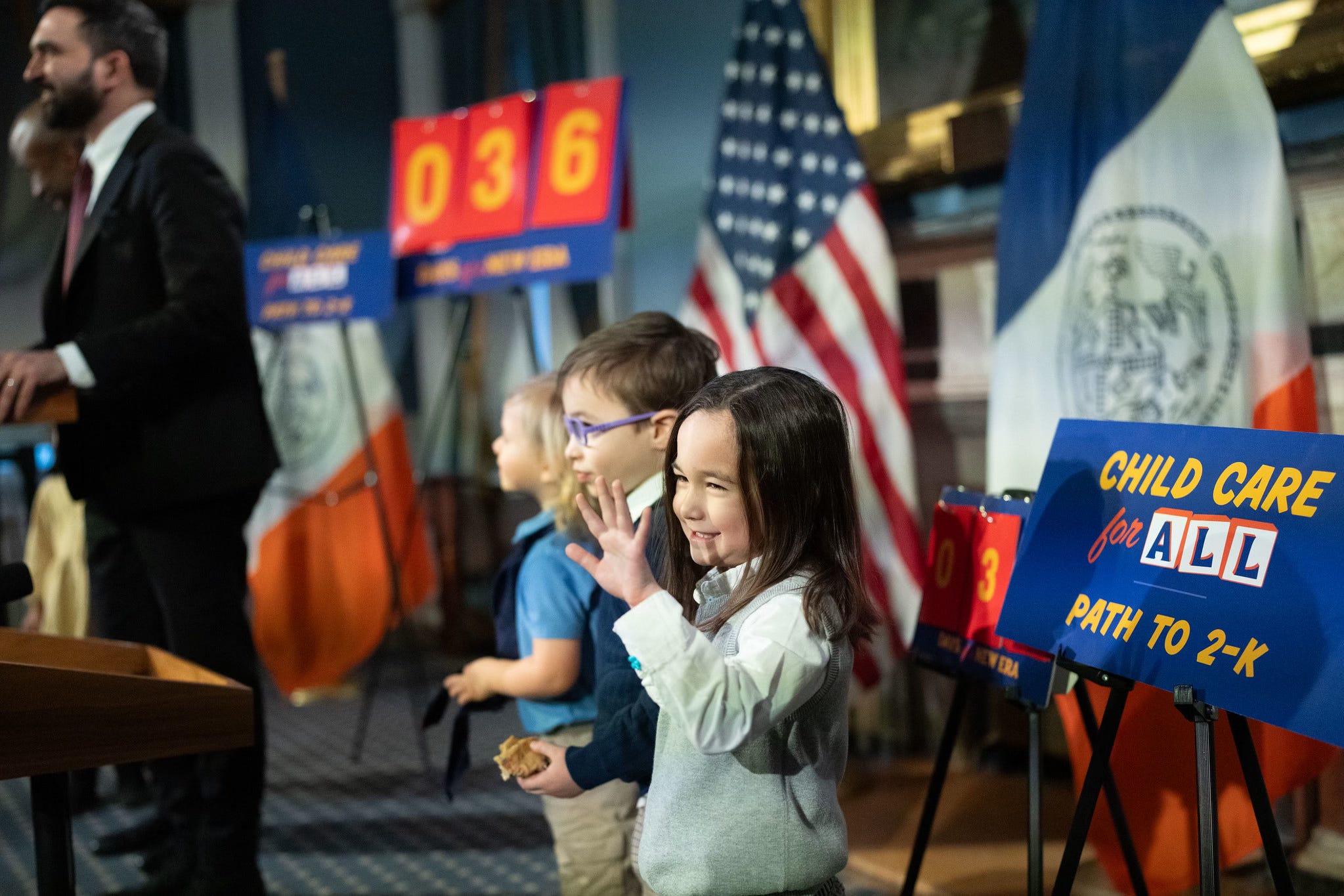
Yesterday, Mayor Mamdani announced that a new, standalone city run daycare center will open on the Upper East Side. The renovated building that has been sitting empty for months will serve 132 three and four-year-olds come September, “more than doubling pre-K capacity and fully quadrupling 3K capacity within this ZIP code.”
“I can’t tell you the number of parents who have said to us, ‘If we do not get affordable childcare, we’re going to leave the city’,” City Council Speaker Julie Menin said at the event.
With current 3-K and Pre-K enrollment numbers in line with those of last year, it’s worth taking a look at what the last year’s numbers show.
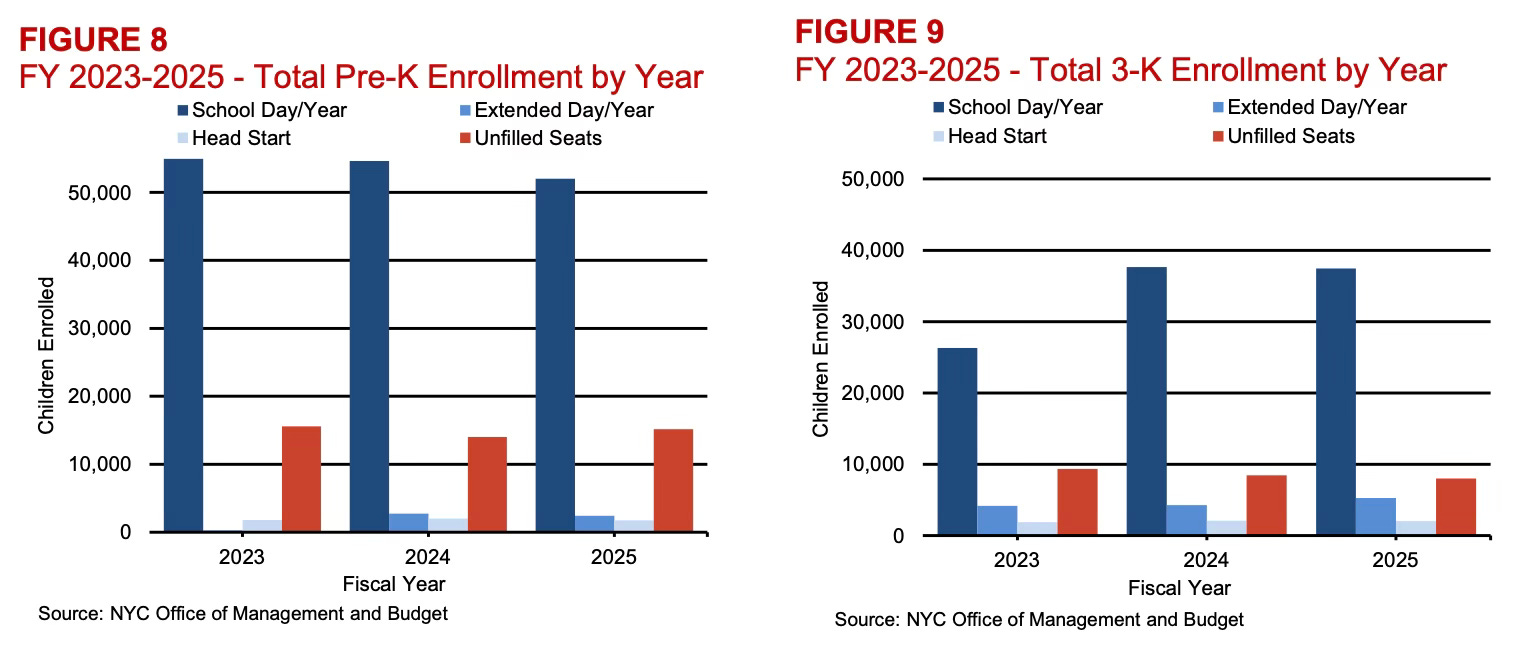
Last year, Pre-K enrolled 56,184 children, the fewest since 2015, and more than 13,000 below the program’s peak in 2017. Over 15,000 seats, 27% of total capacity, sat empty. Meanwhile, 15% of 3-K seats went unfilled.
Combined, that's about 23,000 empty seats, a mismatch between supply and demand the city has been struggling to fix. Demand shifts among neighborhoods from year to year as demographics and parental needs change, supply is hard to correct.
There were about 454,000 kids under five in NYC in 2024, 80,000 fewer than there were in 2020, a 15% decrease.
It costs the city about $20,000 to take care of a child in the standard 3-K and Pre-K programs, just slightly less than what a voucher pays for.
Demand for low-income childcare vouchers has exploded among those eligible. They offer parents the opportunity to pay for more flexible care than schools and childcare centers can offer. Such vouchers last year paid for the care of about a fifth of all of the city’s three- and four-year-olds enrolled in care, and if you include all kids under five, it’s closer to a third.
After Governor Hochul expanded income eligibility and nearly doubled voucher value from an average of $154 per week in 2019 to $301 in 2024, enrollment jumped from under 9,000 in 2022 to nearly 70,000 in 2025 (includes kids in all age groups, not just under five). Voucher popularity is outpacing the government’s ability to fund them, leaving over 13,000 kids on the waitlist.

Mamdani says he wants to expand childcare in high need neighborhoods first.
There may be more need for traditional daycare centers in the more middle class neighborhoods where vouchers don’t help as much, demand for facilities is consistently high, and that have been labeled childcare deserts by the state, like Southern Brooklyn and parts of Queens. And yes, that map includes parts of the Upper East Side, too.
Local News
Mayor Mamdani this week:
Presented his preliminary budget, which cancels his predecessor's plan to hire 5,000 additional police officers. Mamdani also proposed library budget cuts, despite pledging not to use them as pawns in budget negotiations in December.
Threatened to increase property taxes lest the governor tax the rich to fund his budget gaps. MI’s Eric Kober thinks they ring hollow.
Walked back his promise to leave homeless encampments alone. The new plan involves more outreach before clearing the encampments.
Appointed six members to fill the vacancies on the Rent Guidelines Board, hoping they “will do the right thing” when it comes to setting next year’s rent increases (Mamdani supports a rent freeze). RGB is supposed to be independent and objectively analyze market data, but Mamdani’s appointees form the majority of the board.
Mamdani’s Hollow Tax Threats
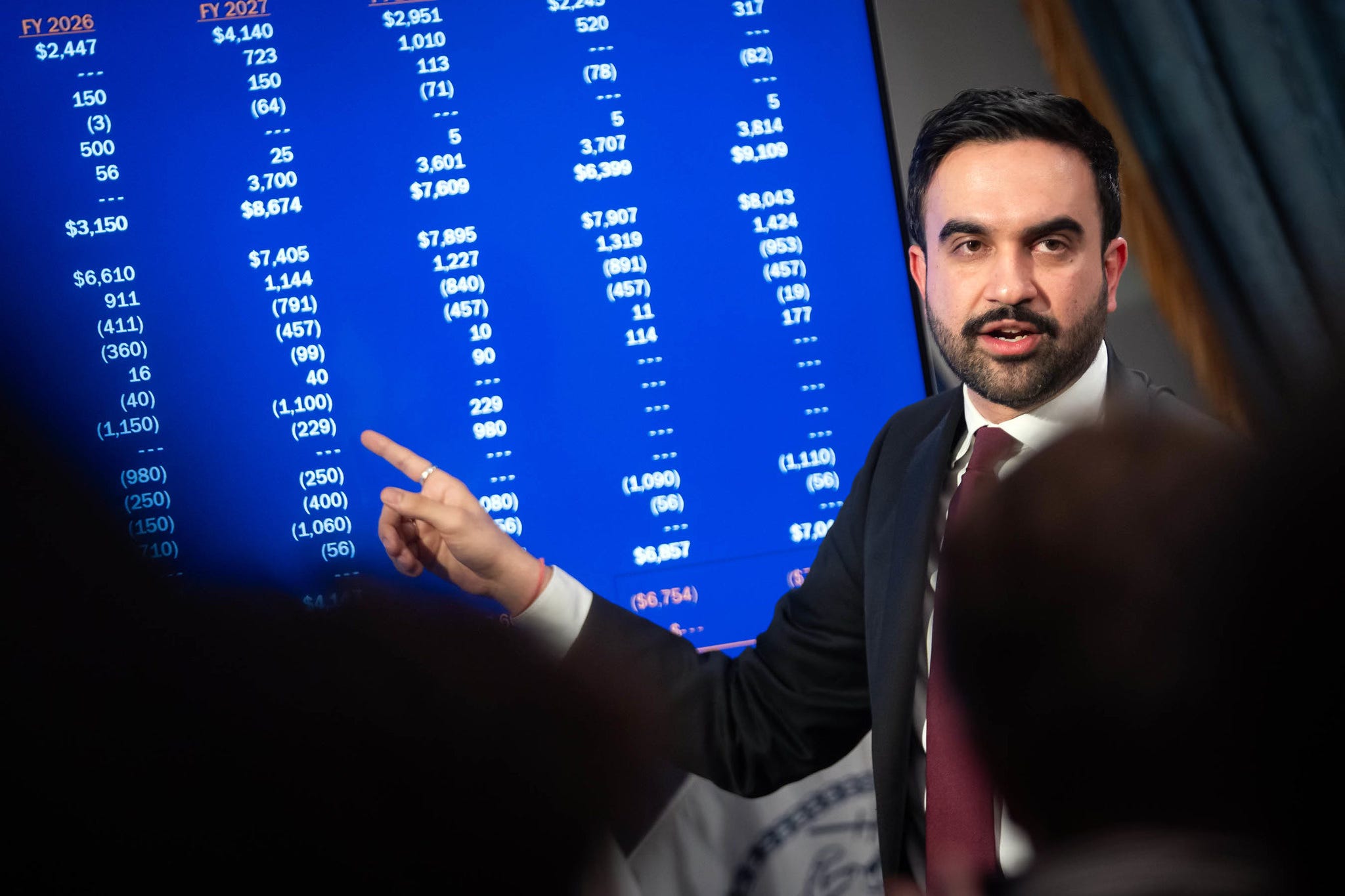
“New York City should be able to balance its budget without a tax increase in a year when base tax revenues are rising by four percent, and the state is offering an additional $1.5 billion in aid,” MI’s Eric Kober writes. “But Mamdani clearly wants his tax increase on the wealthy. If Hochul and the Council leadership stand fast, the alternatives will come into play.”
What are some of the alternatives?
Before resorting to drastic across-the-board agency cuts, he could target cuts to services where demand is shrinking or where costs are skyrocketing, Kober suggests. He could stretch out capital spending, use technology to improve productivity, bring unduly generous benefits in line with national practice, or raise revenues, say by more aggressively monetizing the value of the city’s on-street parking spaces, among other options.
By MI Fellows
Stephen Eide on encampment sweeps in City Journal:
Mamdani’s embrace of common sense on encampments deprives us of clarity on what a socialist approach to homelessness would actually look like. Socialists traditionally pride themselves on their principled commitment to a holistic vision, rooted in the work of Marx and other theorists. In his inaugural address, Mamdani paid homage to that tradition by speaking of “the warmth of collectivism,” which is how theoreticians, not ordinary New Yorkers, speak. But on homelessness and education—and arguably on crime—Mamdani’s socialist rhetoric seems to be mostly just that. Core policy remains shaped by external pressures, just as it was for his predecessors.
Jennifer Webber on mayoral control in the Post:
Mamdani, who opposed mayoral control throughout his campaign, and Schools Chancellor Kamar Samuels now describe their oversight not as “control,” but “accountability.” That sounds great, except they link the phrase to family empowerment and community voice — a fair enough goal but no substitute for real accountability.
“Mayoral accountability and family empowerment are not mutually exclusive,” notes Samuels.
He’s right. But they’re clearly different concepts: Family empowerment is about participation. Accountability is about responsibility for student outcomes.
Jarrett Dieterle on Mamdani’s war on delivery apps in Reason:
From day one on the job, the Mamdani administration has made its anti-gig bent clear. On inauguration day, Mamdani's pick to head the city's Department of Consumer and Worker Protection (DCWP), Samuel Levine, was already signaling to the press the coming gig economy crackdown. Even prior to Mamdani's official inauguration, Levine's appointment to head DCWP was accompanied by language accusing gig companies of misclassifying workers as independent contractors instead of full-scale employees.
[..] Mamdani's war on gig is getting a lot of press. But beyond the flashy headlines, it's clear that both workers and consumers are likely to suffer.
MI Research

Reassessing “Carter-Case” Spending for Students with Disabilities in New York City Schools, a new report by Jennifer Weber, argues that reassessing Carter cases in NYC is essential to rebuilding the nation’s largest public school system’s capacity to provide education to children with special needs.
Currently, the city pays for the private education of children with special needs that it cannot accommodate itself.
“When private placements become the default, public schools lose the capacity that they need to serve students well. Families who are able to do so can navigate due-process secure placements that many others cannot access,” Webber writes.
“Reassessing Carter cases is not about taking services away from children. It is about ensuring that the services that they receive are consistent, equitable, accountable, and part of a system that can meet their needs without resorting to litigation. The billions of dollars that NYC spends on tuition reimbursement each year are not investments in instruction, program development, or long-term capacity building.”
Read more on the issue and potential solutions.
Extra! Extra!
Vital City looks back at the 2025 crime trends in NYC with a lot of tables and charts.

We’ll have more on the role of media in cities, and especially New York, next week, for now here’s the NYT’s Viral Videos Helped Mamdani Win. Can They Help Him Govern?


Thanks so much for the link!
Thanks for the link! I’m so jealous that NYC has a cool newsletter like this keeping track of important changes!!