

Artificial Intelligence’s effect on New York City is uncertain. Maybe the changes coming are absolutely unprecedented. Or maybe past experiences with technological change can, at a minimum, inform speculation.
When the internet came online, New York’s manufacturing heyday was long past. The city had managed deindustrialization better than many other old, cold places, thanks to an expansion of the white-collar economy in the 1980s and 1990s.
By the same token, New York seemed more vulnerable than elsewhere. The city’s vast corporate back office and status as the nation’s media capital made it look primed for tragedy. What had saved the local economy would prove its downfall, thanks to the threat new technology posed to white-collar employment. Similar warnings are being voiced now with respect to AI’s threat to “knowledge-intensive white-collar work”; “this is a revolution coming squarely at white-collar workers”.
Technological Change Requires Financing
Back then, though, New York made it through. One reason was that massive technological change takes financing. Therefore, if you want your city to benefit from massive technological change and you can’t be Silicon Valley itself, your second best option is to be Wall Street. Issuing debt to hire talent and fund data centers, handling IPOs, structuring mergers and acquisitions: that all takes financial expertise on the back end.
The dotcom era was outstanding for New York. State Comptroller data on the Wall Street bonus pool show that 1999 and 2000 posted annual increases of 49% and 44%, respectively, the third and fourth highest annual increases over the last three decades. The Giuliani administration’s FY99 budget announcement heralded the “Largest [Surplus] in City History.” (Though one 1999 bond offering cautioned investors that “The year 2000 presents potential operational problems for computerized data files and computer programs which may recognize the year 2000 as the year 1900, resulting in possible system failures or miscalculations.” Between 1996 and late 1999, the city government spent $350 million prepping for Y2K, an impressive sum that itself speaks to that period’s budgetary cushion.)
Yes, the dotcom bubble would burst and intensify 9/11’s economic pain. The volatility of a Wall Street-centered economy, particularly when coupled with New York’s steeply progressive income tax, has been understood by everyone for a very long time. New York’s budget will benefit from the IPOs of SpaceX, Anthropic and ChatGPT, though state and local policymakers are already committed to mismanaging whatever windfall is realized. (Incidentally, Giuliani mismanaged the windfall in the 90s.[1]) But the point for now is that New York squeezed more resources out of the commercialization of the Internet than most other cities, thanks to Wall Street.
The Age of AI Will Coincide With The Age of Aging
Another point to bear in mind is that AI’s not the only factor that’ll be shaping the economy of the future. The state labor department maintains a database of local employment data broken down by industry. Comparing 1990 to 2025, the data show that some tech job categories did indeed boom, but so did the health and human services, and the loss of manufacturing was another major change.
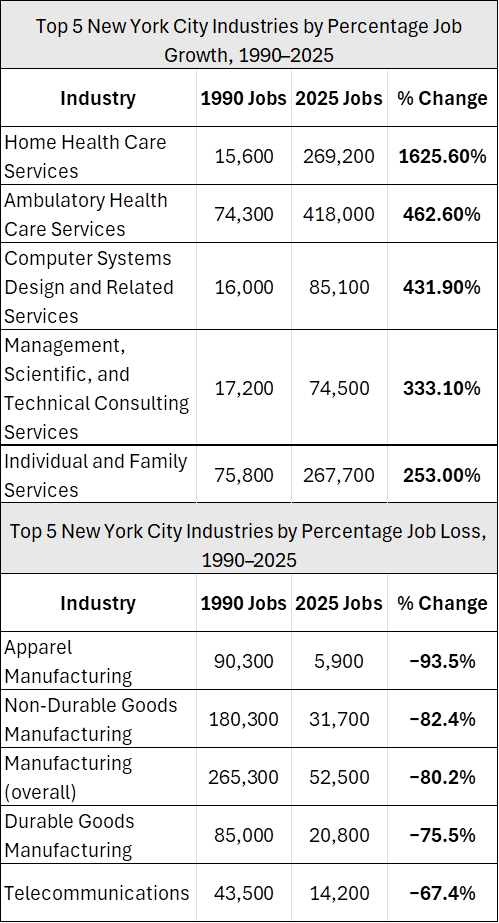
Trends in home health aide employment were at best indirectly related to the internet’s diffusion throughout society and the economy. The age of AI will coincide with the age of aging, which will push employment in the health and human services ever higher. Even if AI makes healthcare more efficient (quicker notetaking and diagnoses, chatbot therapists), that value will most likely be plowed back into more healthcare jobs. And perhaps retail employment now stands in about the same position as the garment industry did in 1990, set to fall farther.
The Internet Changed the Government in New York
The digital age’s emergence coincided with New York’s transition from notorious dysfunctionality to a city that other cities turned to for advice on how to whip their own municipal operations into shape. The phrase “the ungovernable city” was coined by Nathan Glazer in 1961. But New York reached its true governance nadir in the 1975 fiscal crisis. Writes Thomas Dyja in New York, New York, New York (2021) “[t]he City had lost control in the ‘70s not just because of debt, but because it couldn’t effectively manage its information.”
The internet—or, digital technology more broadly—helped the New York government come back from that brink. Compstat is the most important example; another would be 311. Compiling, organizing, and usefully analyzing government data had never been possible at such a scale before. And where the internet proper came in was really with transparency, by making all that information on municipal operations easily and immediately accessible. To the extent that transparency equates with accountability, the internet contributed to the cause of good government in New York.
The internet and related innovations also made the government’s job easier by making the drug and sex trades less geographically bound. Mobile phones eased tensions over crack turf, likely pushing down the murder rate. The virtual red light district that is the Internet helped drive traditional red light districts like Times Square out of business.
Of course, the internet giveth and taketh away. The decline of local journalism struck a blow to accountability that has not been offset by the increase in data-informed citizen bloggers. Further, while tech gurus recommend taking new technologies and building 100% new enterprises around them, that obviously can’t be done with government. Accordingly, ideas for how cutting-edge technologies can improve the public sector tend to be anti-moonshot stuff, small hacks for low-priority problems. In the 2010s, London-based DeepMind tried to help reform the UK’s NHS, a very high-priority problem. Results were mixed. Anthropic CEO Dario Amodei says that he’s far more bullish on AI’s ability to advance science and medicine than democratic governance.
And the government can misapply technology. Recognition of that was reflected in Albany’s recent school phone ban. It was also reflected in community policing, which involved a certain walking back of the once innovative idea that moving cops en masse from foot patrols to radio-equipped cars, cut off from communities, was the future of policing.
It Takes Leadership to Make the Most of Technology to Benefit Government and Taxpayers
Michael Bloomberg was a sui generis mayor in so many ways, one being his status as a top-ranking technologist. Having made billions melding finance and tech, Bloomberg had an instinctual faith in the benefits of data and analysis to improve government.
New York’s current socialist leadership has a much more cabined notion of tech’s potential. While Mayor Zohran Mamdani pays lip service to “modernizing city government,” his hero Bernie Sanders calls for seizing control of the AI industry. At the time of Sputnik, the Soviet Union’s leadership believed sincerely that the managed economy would outperform capitalism on technological innovation. The modern DSA doesn’t appear to care about competing on such terms.
The DSA owes much of its rising power to old-school organizational abilities like door knocking. Mamdani’s recent primary successes, contrasted with the failure of Los Angeles mayoral candidate Spencer Pratt’s AI-viral-video-centered campaign, represent a win for the world of atoms over the world of bits. There are bigger problems with DSA governance than its minimal interest in technological dynamism. But let its minimal interest in technological dynamism be noted for the record.
New York’s Exceptionalism
It was different for New Yorkers in the 1990s to contemplate their digital future than it is for New Yorkers in the 2020s to contemplate superintelligence. The internet emerged during the ‘holiday from history,’ between the fall of the Berlin Wall and 9/11. Due, among other reasons, to the absence of great power competition, Americans then were more optimistic, more patriotic, and had more trust in institutions than now. The internet was less often likened to nuclear energy (or electricity or fire) than AI is. The debate over AI is more anxious. Concerns over great power competition shape every question, and the pace of development is breakneck. The AI industry—which already generates more than $100 billion in revenues annually—is growing at a faster clip than the internet did in its early stages.
What makes all this doubly uncertain for New York is that it’s always hard to know what the right benchmark is for New York. Cleveland, Dallas, San Francisco, London? New York’s uniqueness imbues every policy debate, including around technology, with special nuance. Ridesharing was a different debate in New York because of the taxi industry’s prominence and the imperative to manage traffic density in core Manhattan. Airbnb was a different debate because of a tourist economy no other U.S. city approaches and sensitivity around housing affordability. New York needs to worry more about all varieties of terrorism than Cleveland does.
Increased white-collar unemployment would be bad news for tax receipts. But many laid-off white-collar workers would simply leave the city if they don’t own property and aren’t dependent on a local benefit program. One reason why deindustrialization hit places like Detroit and Pittsburgh so hard is that many auto and steelworkers owned their homes, creating a long tail effect for those regions.
Speaking of long tails, the internet had one, too. Remote work, which for the time being may be shaping labor dynamics more than AI, was caused by the internet’s invention decades before remote work’s normalization during and following COVID. Even as New York contemplates how AI will shape its future, it’s still not done being transformed by the technologies of the past.
[1] “Giuliani, after coming into office with a promise of reducing government, had opened the spending spigots during the boom of the late 1990s.” Fred Siegel, The Prince of the City (Encounter 2005), p. 296.

The most remarkable economic story in NYC at the moment is the recovery of the office-commercial market in areas such as midtown Manhattan.