


I got a lot of feedback about last week’s story about Midtown’s felony assault spike — and a lot of questions about what the numbers show about the rest of the city.
So — with the help of Claude — I spent a little time this week building a tool to analyze publicly available data for all 78 of New York’s police precincts. I hope you’ll check it out, and tell me what you find, and what questions it raises about crime policy across this giant city.
New York, Precinct by Precinct shows how crime has changed in every precinct since 2019, how this year compares with last, how quickly police and ambulances arrive, and how many reports were filed near any address you type in.1
A couple of my main takeaways:
This year, citywide most crime is falling, but assaults are not. As of October 25, murders are down 18% compared to the same period last year, robberies are down 13%, and burglaries down 14%. Felony assaults are up 0.7%, and misdemeanor assaults 1.9%. (Vital City’s midyear review looks at the same trend in detail.) Data varies between precincts.
Help is taking longer to arrive. Citywide, the typical time for NYPD to reach a critical call, such as a shooting, a robbery or an assault with a weapon, rose from 3.3 minutes in 2019 to 4.2 minutes in 2025. For ambulances responding to life-threatening emergencies, the typical time rose from 6.6 to 7.6 minutes.2
Check your block at Precinct by Precinct.
Can NYC’s Dog Poop Problem be Solved by Emoji?
As it gets darker, dog owners need to pay more attention to where their pet does his business, a task that seems to be challenging at all hours, if city data is to be believed.
The city keeps trying to educate residents through “curb your dog” signage and posters of potential $250 fines, to little effect. My colleagues Brittany Montgomery and Jennifer Weber think that public education campaigns leaning on humor might do better.

They look at cities that have successfully influenced residents’ behavior through such humorous measures, and explain the reasoning why it works. They suggest that the city experiment with deploying a poop emoji mascot, and we mapped the spots it should head to first. You can read the full story here.
Election Time
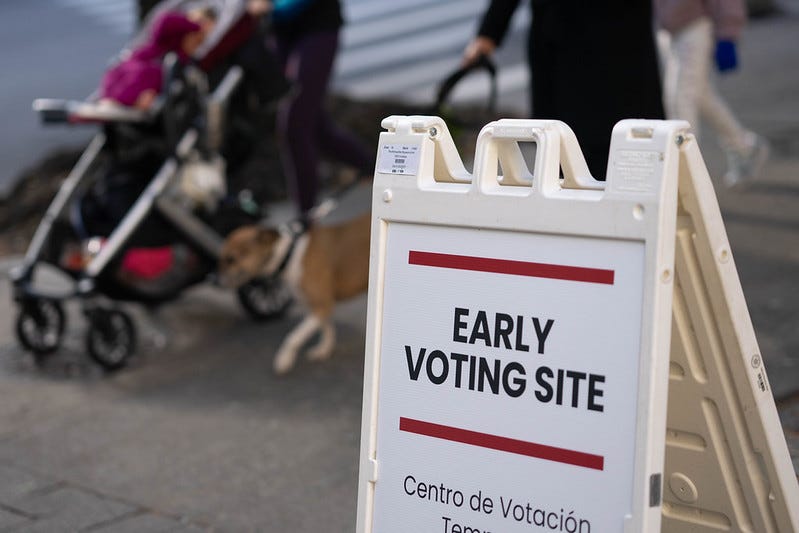
Early voting in the local elections ends on Sunday, in-person voting is on Tuesday, November 3, and in the deep blue city where most surprises come in June during the primaries, we are paying attention to three assembly and one senate seat that Brooklyn Democrats are hoping to flip.
It will also be interesting to see how residents vote on the ballot questions, which the Mayor has been promoting, which aim to accelerate decision making by City Hall, some at the expense of public and interagency consultation and council approvals. Here are the ballot questions.
City & State created an excellent in-depth cheat sheet to NY super PACs for this year’s election.
Education: Enrollment Drops
City Comptroller Mark Levine released a report this week on student enrollment in NYC public schools, generally in line with projections of the School Construction Authority, but with more detail.
“The steepest drop in enrollment is between 5th grade and 6th grade, when parents need to decide where to send their kids to middle school,” his office finds.
MI’s Danyela Souza Egorov writes that the city’s Schools Chancellor Kamar Samuels is right to focus on closing under-enrolled schools, something he has identified as a priority: most are financially unsustainable and propping them up has already cost billions.
“There is even a high school that is so tiny it can only afford one math teacher, and students must take night school to get enough credits to graduate—all for $46,000 per pupil,” Souza Egorov writes.
Related:
What to Do About NYC’s Empty Schools (Manhattan Institute)
700 choices, one algorithm: Making sense of NYC high school admissions (Chalkbeat)
An Education Agenda for New York City (Manhattan Institute)
Nikole Hannah-Jones blames segregation. Linda Quarles, president of the Citywide Council On High Schools in New York City, blames a system that stopped expecting anything of children.
Extra! Extra!
The numbers behind New York’s AI economy (Crain’s)
The new Midtown bus terminal: Decks over Lincoln Tunnel approach and a new park (Gothamist)
Malls are becoming the midtowns of the future. (Planetizen)
Can We Make a Dent in the Housing Crisis? Two Projects Say Yes. (The New York Times)
Pied-à-terre tax’s fate hinges on appeals court as city races against deadline (Crain’s)
Some US transit systems weigh whether to run trains without a human at the controls (AP)
The site was built using AI tools, code is public on GitHub. While efforts were made to ensure accuracy, mistakes are possible.
Comptroller Mark Levine’s October report found that, counting from the moment a 911 call comes in, the average ambulance response to a life-threatening emergency grew 3 minutes and 50 seconds slower over the past decade, a 41%. The city’s latest Mayor’s Management Report, which starts the clock when the ambulance call is created, puts the average at 10 minutes and 32 seconds in fiscal 2026, up 20%. Averages are pulled up by a minority of very long waits; the typical (median) response, which the tool uses, rose from 6.6 minutes in 2019 to 7.6 in 2025, and to 8.6 minutes so far this year.