

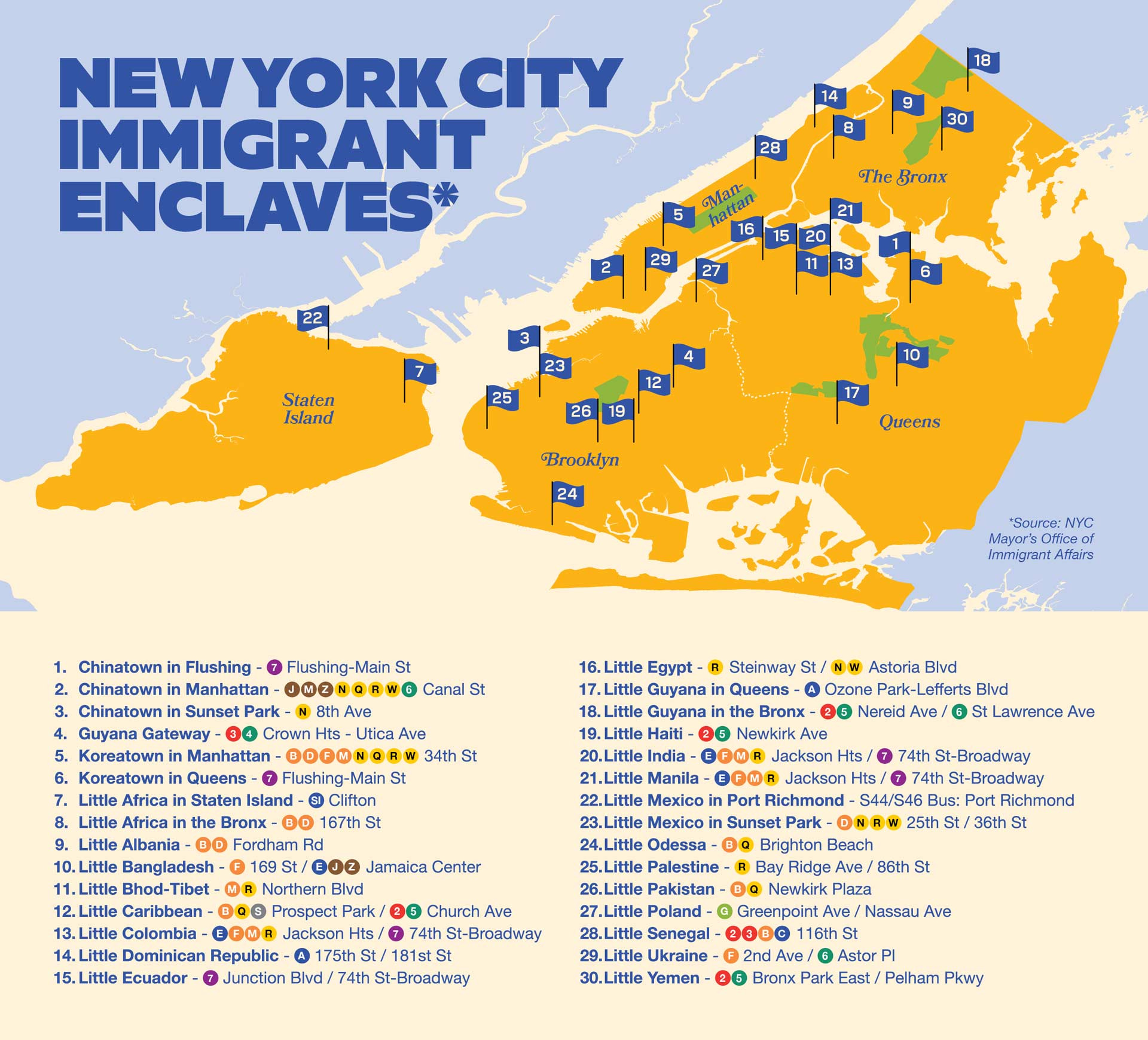
This week, the Mayor’s Office of Immigrant Affairs came under fire for its choice of ethnic neighborhoods featured in the World Cup guide called “New York City: A Cultural Map.” The guide states that locations chosen “reflect the richness of New York City’s cultural life and its extraordinary diversity, particularly in the many immigrant enclaves such as Little Senegal, Little Colombia, Little India and numerous others.”
On a map crowded with “Little” neighborhoods, the absence of Little Italy was hard to miss, adding insult to injury of Italy not qualifying for the World Cup. Following the backlash, Mayor Mamdani announced today that Little Italy will be added to the map after all.
The decision about which 30 neighborhoods to include on a map in a city that prides itself on translating official documents into 10 languages (one of which is Italian) and providing interpretation in over 100 others is ultimately political. Not every enclave can be put on a map, and to be mapped is to say that this community is part of the official story the city wants visitors to see. Being omitted risks being treated as culturally past tense.
Demographically, the neighborhoods that attracted massive numbers of Italians during the 20th century no longer do so, and while there are still many Italian-Americans in New York City, their share of the population continues to fall. Yet Little Italy remains a vibrant tourist destination, keeping the memory and heritage of the community that played a major role in shaping the city alive through institutions like the Italian-American Museum on Mulberry and Grand, and offering visitors a glimpse of a bygone era—exactly the kind of experience World Cup visitors might seek.
It is the public spaces, the streets, and the commercial strips that define ethnic neighborhoods for visitors. We do not know who lives behind closed doors, but we do notice when streets fill with people who speak a language we may not understand, when shop signs are in a language other than English, or when there is a higher concentration of ethnic restaurants, setting a neighborhood up as a destination for those interested in exploring its heritage.
New York is a city of ethnic enclaves that ebb and flow with waves of migration, but they do not fade as quickly in communal memory as statistics may suggest. In favoring some communities over others to showcase our diversity, the city would do well to remember how deeply those who have assimilated or left still claim the neighborhoods their ancestors passed through—and how tightly they hold onto those memories.
Bensonhurst in Brooklyn may no longer be Italian by the city’s numbers, and for the third of the city’s roughly 3 million foreign-born residents who arrived in the United States after 2010, only traces of the Italian neighborhood exist along 18th Avenue in cultural icons like the Villabate Alba bakery, Il Centro Community Center and the neighborhood’s churches. But Bensonhurst, like Arthur Avenue, like Little Italy, remains Italian in the hearts and minds of the descendants of the Italian immigrants who settled there, keeping alive the memory of the old neighborhood as it was, too soon to be erased.
City’s International Affairs in Spotlight
MI’s Adam Lehodey reports that Mamdani’s Commissioner for International Affairs was planning to meet this week with Iran’s ambassador and permanent representative to the United Nations.
Good Economic News for Mamdani
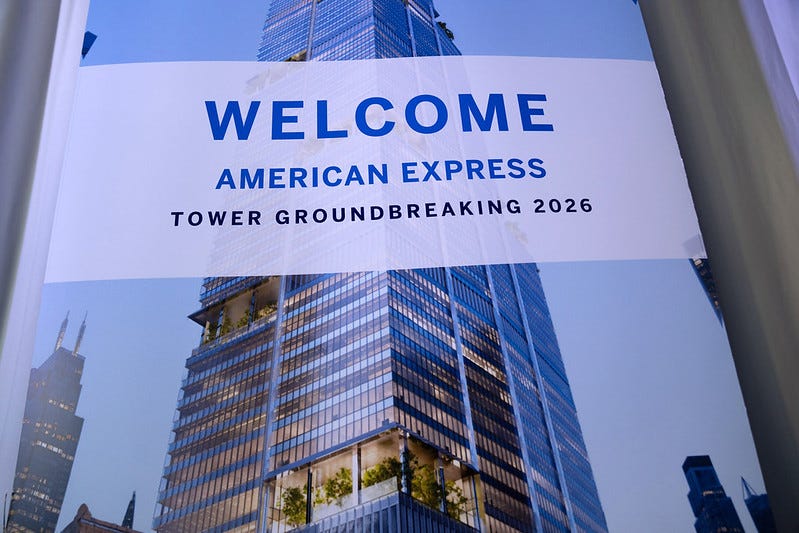
Recent good economic news is buoying Mayor Zohran Mamdani’s administration: the job numbers are up in the key industries, office demand is strong, and housing starts are promising.
“Mamdani clearly intends, through his “Block by Block” plan, to make a significant further contribution to alleviating the city’s housing crisis, although the details will be important,” MI’s Eric Kober writes. “He has yet to articulate an economic development strategy, for which he has been criticized in the media. Despite catching a break from the city’s entrepreneurial energy, there is still much he could do, in particular to boost employment in the declining retail and leisure and hospitality industries, which are large sources of employment for less-skilled and less-educated workers.” Read the full story.
Related:
Some of the biggest names in banking, law, and AI are expanding in Manhattan and Brooklyn. (The City Reporter)
Anthropic plans to double its New York City workforce to 1,000 people this year. (The New York Times)
Buses & Residential Parking Permits
The new “Next Stop: Fast Buses, Better Service” plan is the most recent attempt to overhaul the city’s slow bus system to deliver on the “fast” part of Mamdani’s campaign pledge to make the city’s buses “fast and free.” The plan targets a 20% speed increase across 50 priority corridors, proposes a high-speed Bus Rapid Transit-like network on five major avenues, and phases in system-wide all-door boarding via OMNY by late 2026. All with support from the state.
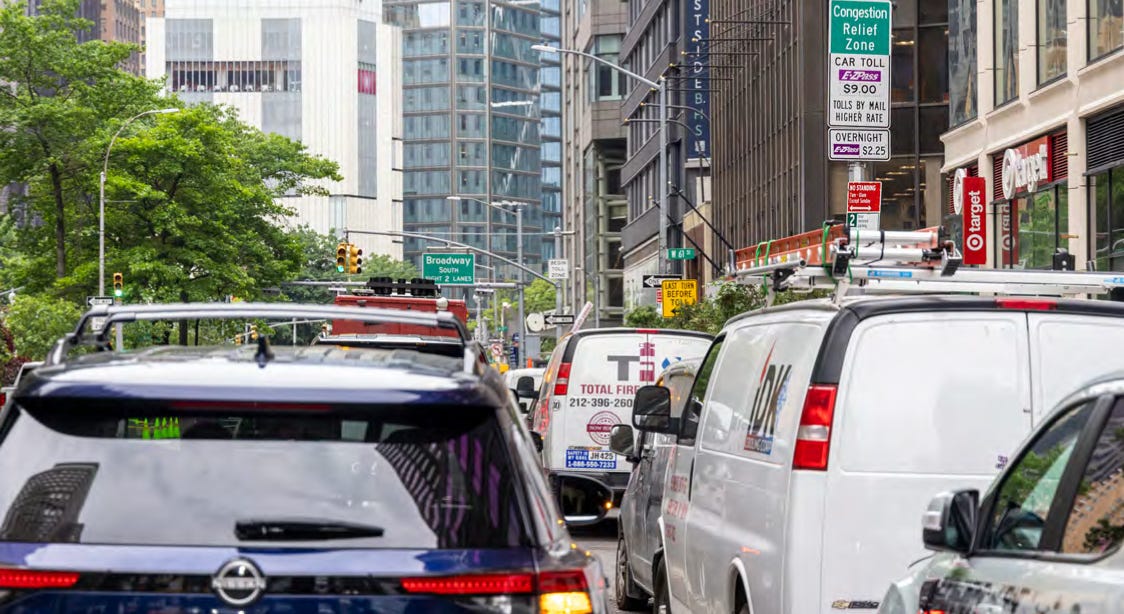
Congestion pricing has not triggered the parking crisis critics feared. The Congestion Pricing Parking Study found that parking availability inside the toll zone remained stable, while double parking actually decreased by 10%. Neighborhoods just outside the zone saw no major spillover from drivers dumping their cars to avoid the toll, failing to make a “compelling case for the implementation of a Residential Parking Permit (RPP) program.”
Michael Harrington and the Democratic Socialists of America
MI’s Stephen Eide looks in depth at Michael Harrington and his attempts to make America socialist, observing that the current Democratic Socialists of America are unlikely to be more successful.
“The heart of early twenty-first-century socialism is urban college graduates energized by DSA messaging around ideas that cannot work nationally. The New York-based DSA is like the viral influencer who can’t make a living in the real world. Its record in America, past and present, shows that socialism can maintain either a broad appeal or a deep appeal—but not both,” he concludes.
Related:
Ed Kilgore ponders the conversation of whether Democrats are moving left rather than just rejecting the establishment in New York Magazine, and writes that “With the right tone, an “abundance” centrist enraged by bureaucratic and interest-group resistance to housing construction and infrastructure projects might strike some of the same anti-Establishment chords as a Democratic Socialist.”
A Rhode Island DSA candidate is fundraising in Brooklyn, Gothamist observes.
Frustration with the economy has been the most important factor in the surge in DSA membership, the New York Times reports.
Plus an interesting podcast episode with Grace Mausser, Co-Chair of New York City DSA:

More from MI

We have three education pieces this week you may be interested in.
The teachers’ unions have filed another lawsuit aimed at limiting educational options for New York families by targeting the transfer of a charter school network to another provider, Danyela Souza Egorov writes.
Looking at the approved education budget, Danyela observes that the city continues to “spend lavishly on underperforming, under-enrolled schools and invest in initiatives unlikely to reverse these trends.”
The experiment to eliminate gifted programs and tracking to reduce racial inequalities has proved wildly unpopular, Neetu Arnold reports. “In a postmortem of the 2024 presidential election, Democratic pollsters found that the most unpopular K–12 education policy was eliminating tracking in public schools.”
Related:
Since some PTAs raise more than $1 million for their schools a year, some think NYC schools need to redistribute PTA wealth. (Gothamist)
Mayor has devoted his attention to childcare, with K-12 education plans unclear six months in. (Chalkbeat)
Extra! Extra!
Mamdani administration’s officials are reaching out to local business owners to reassure them about the proposed public supermarkets, the New York Post reports, while The New York Times notes that national chains are slashing grocery prices in response to weakening demand.
A NYCHA plumber made more than $465,000 with overtime, and the city is now investigating. (The New York Times)
The vacancy rate of rent-stabilized apartments is increasing. In 2025, the citywide vacancy rate for rent-stabilized apartments was approximately 5.6%, up from 3.7% in 2016. (The City Reporter)