


This week, the United Nations General Assembly is taking place in New York, and Mayor Zohran Mamdani has been holding court, welcoming President Donald Trump and various foreign heads of state. Over the weekend, he hosted mayors from far-flung cities during the 2026 Urban 20 (U20) Mayors Summit.
The mayor also found time to talk with Norwegian Prime Minister Jonas Gahr Støre about AI in schools at P.S. 59 in Manhattan and, together with Irish Taoiseach Micheál Martin, visit seniors (and play bingo) in Queens. He planted an olive tree at Gracie Mansion, and announced a partnership with the Metropolitan Opera for another free ticket lottery.
What he’s so far neglected are the city’s schools. Schools like the ones The New York Times’ writer Nikole Hannah-Jones exposed on Sunday as massively failing their students (gift link). Unlike at P.S. 59, where more than 8 out of 10 students are proficient in English and math in 5th grade, at P.S. 307 in Brooklyn, fewer than 15% are. Kids should not have to be lucky to get a good education in our city, or the mayor’s attention.
It’s reasonable to expect Mayor Mamdani to focus on this issue, given he has full control of and responsibility for the city’s school system, and education is the single largest item in his budget, accounting for almost a third of it.
“As the next mayor of New York City, I would be proud of investing in New York City public school students. And at the same time, I think we desperately need better outcomes. I think that sometimes those outcomes, as you were pointing to, are not always directly related to additional investment. They also have to do with prioritization. They also have to do with follow-through,” he told The New York Editorial Board during his campaign. “I do think that some of this is indicative of: is this a priority for you?”
But Mamdani did not want to have control of schools (something he changed his mind about shortly before taking office), and from his track record so far, K-12 education has not been a priority.
When it comes to children, his focus has been almost exclusively on expanding childcare, but 2K, 3K, and Pre-K account for only three years of a child’s life. Even if he makes it more affordable for some parents to stay while the kids are little, are they going to stick around when it’s time for elementary school?
Back to Basics

“How does a child with two educated, affluent, involved parents, in the highest-spending school system in the country, reach ninth grade without knowing fractions?”
That is the question MI’s Jennifer Weber poses in her latest piece in City Journal dissecting the issues raised by the Nikole Hannah-Jones article referenced earlier.
“The failures that Hannah-Jones recorded demonstrate how schools trained teachers in ill-conceived but fashionable instructional methods—at the expense of proven approaches—while also incorporating equity policies that eroded standards and made no one truly responsible for student learning,” she writes.
Pedagogy failed Hannah-Jones’ daughter and her classmates, she concludes. Pedagogy is something leaders can fix.
Related:
School Choice: Necessary But Insufficient
“Nearly 50 years ago, education researcher Ronald Edmonds asked why some urban schools succeeded with poor children while others serving similar students failed. Across several cities, effective schools shared strong leadership, high expectations, order, a clear academic mission and frequent monitoring of student progress,” Roland Fryer, senior fellow at the Manhattan Institute, writes in The Wall Street Journal (gift link). “Decades later, Will Dobbie and I studied charter schools serving similar children but producing different results. Five practices distinguished the most effective: more instructional time, high-dosage tutoring, frequent teacher feedback, data-driven instruction and a culture of high expectations.”
But how does one create effective schools at scale? Should it be the invisible hand: giving parents reliable information, letting the full amount of money follow the child, and leaving the rest to the market? Or should we let the government do the job of the market?
“Competitive markets require consumers who can judge quality and suppliers that can respond to demand,” he writes. “School districts reliably provide neither.”
Parents Need Options
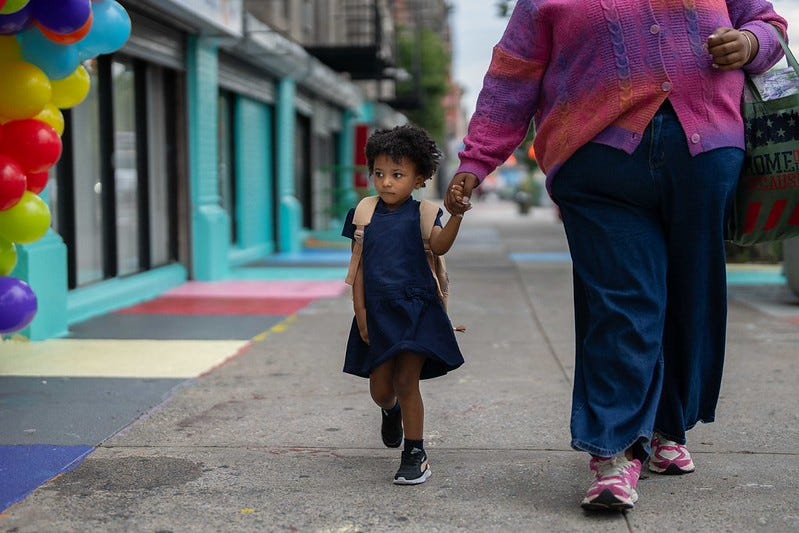
This summer, New York City told the parents of more than 150,000 children that their kids aren't reading and writing at grade level. Fewer than half of 5th graders are above grade level. Falling behind reduces their chances of getting into a well-performing middle school, and limits their options thereafter.
Good tutoring is expensive, as are private and parochial schools. Charter schools have limited seats, assigned by lottery, as do well-performing screened public schools. Many parents whose kids the city’s public schools are failing have limited options to help them in time.
The Federal Tax Rebate for Scholarships, if Gov. Kathy Hochul opts New York in, would create an opportunity to get some help from outside the system for public school kids as well as those in non-public settings.
Related:
Why I’m Sending My Black Son to Private School (The Atlantic, gift link)
From 3,000 students to about 90: Inside the decades-long failure to fix or close NYC’s smallest high school (Chalkbeat)
New York City’s Prime Economic Challenge: Middle-Class Family Affordability

New York's affordability crisis is disproportionately squeezing out the middle class families, and Mamdani's treating affordability as a roughly uniform issue, except for the very rich, misdiagnoses it, Jordan McGillis, a fellow at the Economic Innovation Group, argues in Vital City. “[A]ffordability means dramatically different things to differently situated New Yorkers.”
Based on Census data across the 2021–2024 ACS samples, McGillis estimates that when it comes to domestic migration, “about 89,000 married couples with children under 18 left New York City for its suburbs or other parts of the country, while only about 17,000 such families moved in. The estimated number of children in the departing families exceeded the number in the arriving families by more than 100,000.”
For every middle class family with children that moved to the city between 2021-2024, almost 6 moved out.
The reasons are many, but all come down to the need for appropriately sized housing the family can afford, of which there simply is not enough. That extra bedroom remains elusive.
Related:
NYC’s Family-Sized Housing Shortage (The Bigger Apple)
Building Family Friendly Cities (Manhattan Institute Report)
Mamdani Sets Ambitious Housing Goal (The Bigger Apple)
Pothole Politics or Sewer Socialism?
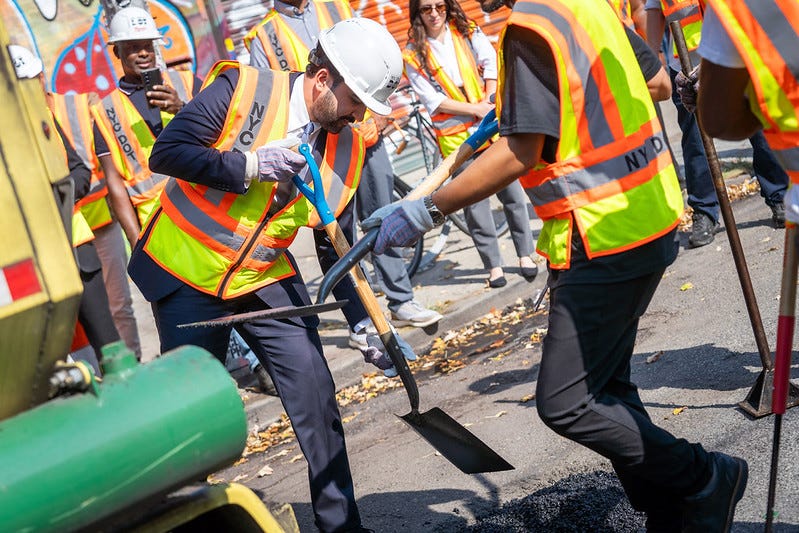
MI’s Stephen Eide looks at the early performance of two socialist mayors — New York’s Zohran Mamdani and Seattle’s Katie Wilson — and argues that Wilson is the more authentic “sewer socialist” on substance, even though Mamdani has claimed the mantle too, via his pothole-filling.
“Sewer socialism” is old-school shorthand for city government judged on delivering essential, capital-intensive services rather than ideology, and for Eide, transit is the modern test: “’Sewer’ connotes municipal services that are essential, too-often-taken-for-granted and just large, capital intensive. Which system checks all those boxes? Transit, especially with big cities.” Wilson cares passionately about transit.
Yet being the more substantive sewer socialist hasn’t made Wilson the more successful one: she’s far less popular and politically effective than Mamdani, Eide argues, and her path forward likely means drifting toward San Francisco Mayor Daniel Lurie-style centrism rather than further left.
Related:
Smoother streets are not the same thing as better government. (City Journal)
From A Press Conference
Asked what’s next for sewer socialism:
Mayor Mamdani: You know, I think the next step is, what are the issues that people are dealing with in terms of their quality of life. We’ve seen New Yorkers come forward to say it’s the pothole on their block — that’s a priority for us. We’ve seen others come forward and tell the Council member, the Council member [has] brought it forward of, “I need a place to be able to take my kid when they need to go to the bathroom.” That’s the priority for us.
Anything that a New Yorker is struggling with in their day-to-day life, that’s a priority for us, because we want to show that City government can help you live a better life in this city, and for far too long New Yorkers have been rightfully skeptical of that.
Extra! Extra!

“New IRS data confirms millionaire exodus to low tax states is a myth,” Fiscal Policy Institute writes. MI’s Ken Girardin thinks they are stretching the data.
MI Report: Automatic License Plate Readers: Benefits, Risks, and Sensible Regulation.
Mamdani bans NYPD from responding to 311 calls on homeless encampments. (New York Post)
DoorDash agrees to $131.5 million settlement for underpaying Deliveristas. (New York Post)
NYC expands J-51 tax break for repairs at co-ops and condos. “[E]ligible owners will be able to receive relief worth up to 100% of what the city determines to be the reasonable cost of renovation work, up from 70% under the previous version of the program, with the benefit spread over as many as 20 years.” (Crain’s)
NYC lawmakers want ‘low-traffic neighborhoods’. (Gothamist)
The case for a portable benefits pilot for gig workers. (CUF Report)