

This week, we look at the influence of socialists and labor unions on city and state budgets, the city’s first major rezoning initiative, another public grocery store, and more.
Mayor Mamdani’s Budget Isn’t Socialist
New York’s budget is so burdened by legacy costs and institutional obligations that even a mayor elected to dramatically expand government ends up governing conventionally unless he is willing to cut, reform, or restructure the existing system first.
“It says a lot about New York City that in order to afford socialism, we’d have to cut spending first,” Nicole Gelinas observes in an excellent piece in the City Journal.
“Mamdani has proven politically pragmatic, preferring modest victories, relative to his campaign promises, to protracted fights with the ageless institutions, from unions to anti-poverty advocates, that make up New York City’s permanent government,” she writes.
As a result, his first budget is more of a continuation than a disruption.
Why the LIRR Strike Matters
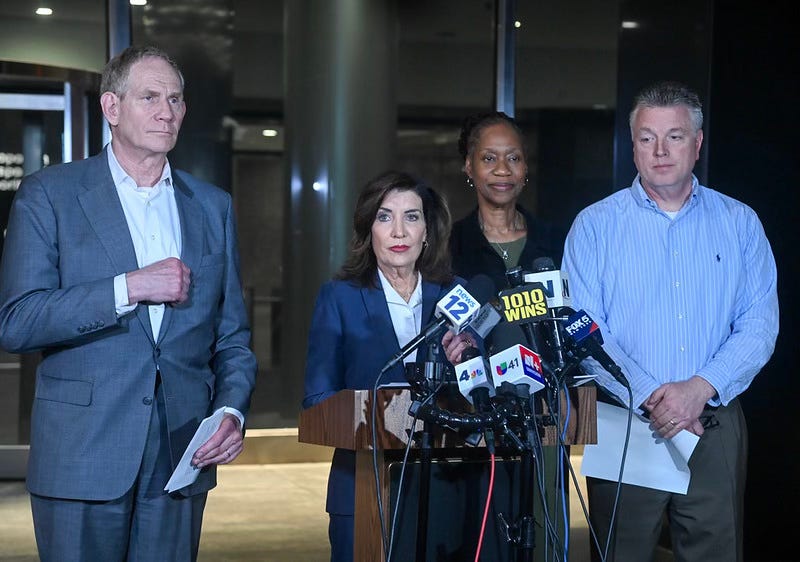
The basic takeaway from the three-day Long Island Rail Road strike is that it could have been worse—but it also could have been better. The tentative deal includes a compromise on raises but no meaningful work-rule reforms, even though those rules are a major reason the LIRR is so expensive to operate.
For example, a train engineer who operates both a diesel and an electric train during the same shift, or moves a passenger train to a yard after service, gets paid for an extra day’s work.
The agreement matters beyond the LIRR itself because it could set a precedent for future negotiations with other transit unions. Should the governor have held out longer? MI’s John Ketcham has more.
Podcast
This week, we spoke with E.J. McMahon, New York’s preeminent expert on public finance, about the LIRR strike, the proposed state and city budgets, and the outsized influence unions wield over both.
Here’s a snippet on unions:
Listen to the full episode (and subscribe!) to The Bigger Apple podcast.
Second Public Grocery Announced
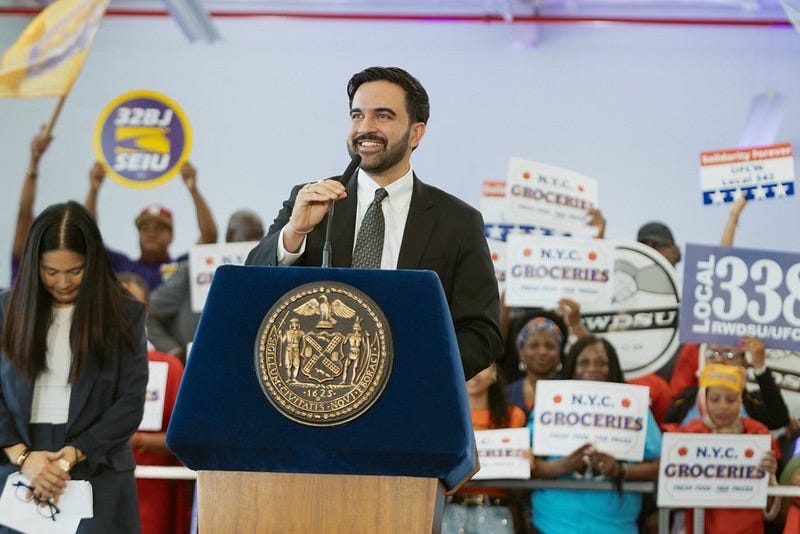
The 20,000-square-foot public grocery store is expected to open in 2027 at The Peninsula, a 740-unit, 100% affordable housing project to be completed in Hunts Point, the South Bronx.
“Mamdani’s plan proposes, in essence, that the city will compete with local grocery stores—using public subsidies to lower the cost of staple foods—and that it will do so while paying store employees union wages,” MI’s Eric Kober wrote earlier this year, when the first store was announced in East Harlem. “It is by no means clear that both objectives are possible without additional subsidies.”
The mayor believes the store will prove that government can be a force for good.
“And standing here this morning, I cannot help but think of the words of our 40th president, Ronald Reagan. He famously said, “The nine most terrifying words in the English language are: I'm from the government, and I'm here to help.” It's a good quote, but I disagree,” Mamdani said at the announcement.
Mamdani’s First Rezoning
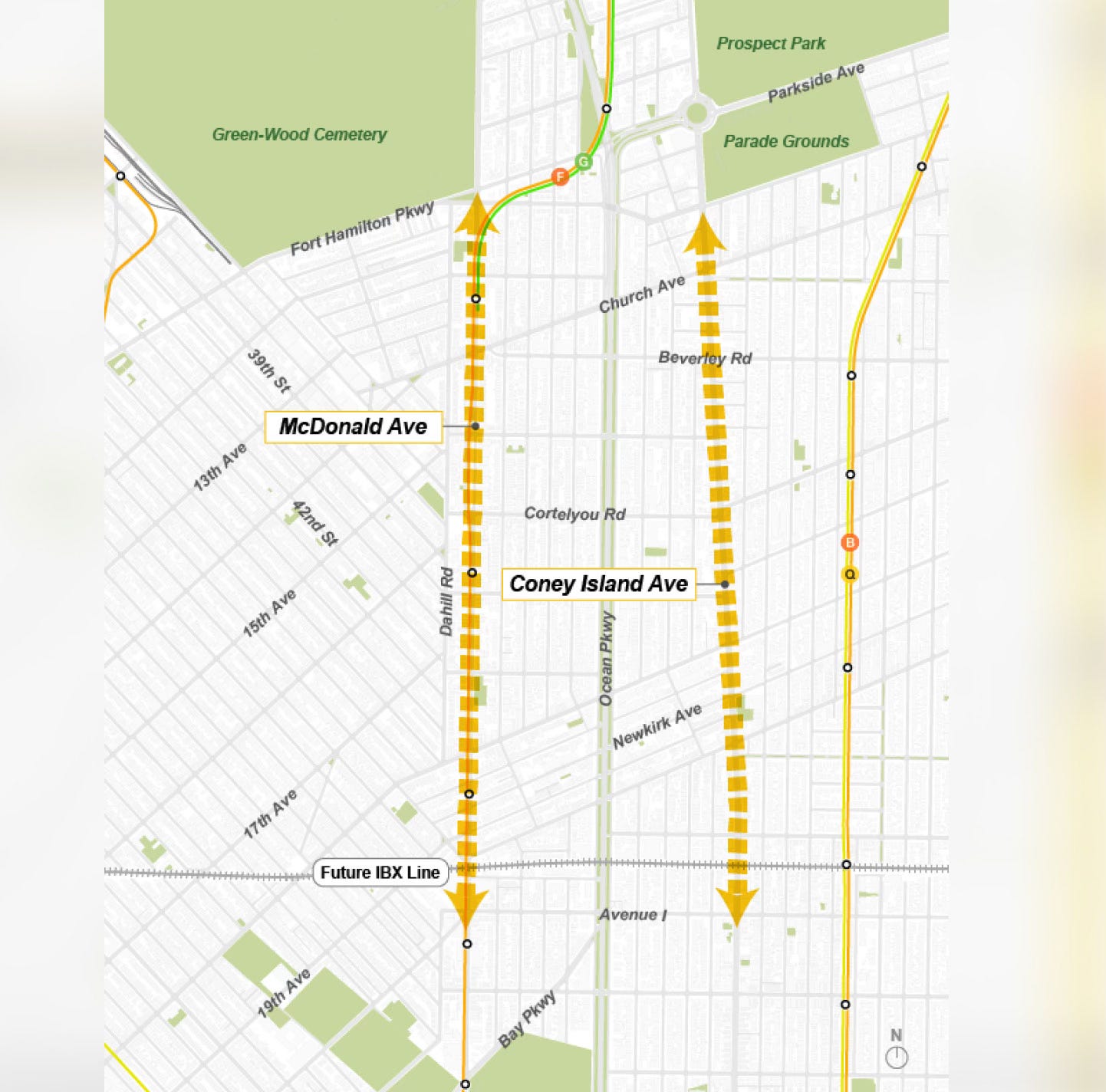
The administration has announced its first major rezoning initiative, targeting an area south of Prospect Park and Greenwood Cemetery in Brooklyn.
The rezoning offers an opportunity to reverse a pattern of exclusionary land use in neighborhoods long constrained by restrictive zoning and historic-preservation rules, MI’s Eric Kober writes.
I’ve shared my thoughts on landmarking in the area before, and there is great potential for more housing here. But as we think about housing, we should not forget to talk about what it takes to make this city run: the two major corridors under consideration are local truck routes and service roads for the city — the proverbial back alleys. Should the city have no back alleys?
“The land-use pattern in this area offers the potential for a mix of small and large multifamily buildings, for sale and for rent, subsidized and unsubsidized, accommodating a diverse population,” Kober writes. “The Mamdani administration should demonstrate planning wisdom and ideological flexibility and allow that to happen.”
SPEED up Affordable Housing Development
Mamdani’s SPEED initiative could meaningfully reduce delays in affordable-housing development by streamlining environmental review, permitting, and lease-up processes, but administrative reforms alone will not solve New York’s housing shortage without broader changes to the city’s political and regulatory environment surrounding housing production, writes MI’s Daniel Golliher.
Extra! Extra!
Mamdani’s inaugural Talk with the People streamed across social media channels on Thursday afternoon. Joined by guest co-host and influencer Moose, the mayor answered questions posed in a Twitch chat. (TechCrunch has more.) Mayor Fiorello La Guardia and his Talk to the People radio show served as the inspiration, and Mamdani once again leaned on Frank Sinatra—though I probably would not have chosen the lyric “Start spreading the news, I’m leaving tonight” as the intro.
Risky Business: NYC Comptroller’s report on AI warns that New York City’s fiscal health is increasingly vulnerable because its tax base depends heavily on high-income, white-collar industries that generative AI could significantly disrupt through slower hiring, weaker wage growth, and declining demand for office space.
Not Enough Demand: Roughly the same number of children were enrolled in Pre-K and 3-K programs this year as last, despite Mamdani’s massive outreach push to drive up enrollment, as he plans to expand the programs that may have reached their saturation point.
Penn Station: Feds promise $8 billion for a bright design by Penn Transformation Partners.