

A decade of the City Council’s unfunded mandates has run up a tab of more than $7.5 billion. Public sector pension sweeteners may be heading for your property tax bill. New York's political landscape has settled into something resembling a three-party system. That, and more, in this week’s newsletter.
Reihan Salam: What’s the Opposite of Mamdani?
In a wide-ranging WSJ profile, MI’s president Reihan Salam lays out the case against Mayor Mamdani's "punitive egalitarianism" and "tin-cup urbanism," points to MI scholars’ work taking on the mayor (Nicole Gelinas on fiscal and public-safety assumptions, Eric Kober on the city-run grocery plan, Rafael Mangual on public order), and talks about the future. (Gift article.)
Unfunded Mandates: $7.5 Billion

The City Council routinely passes legislation creating new spending obligations with little regard for how the city will pay for them.
To better understand the full cost of mandates and legislation passed by the Council, Tal Roded aggregated fiscal impact statements required of all new legislation into the NYC Council Fiscal Impacts Tracker, finding that unfunded mandates over the last decade exceeded $7.5 billion. CityFHEPS, Streets Plan, and mandates on payments to school paraprofessionals alone have added over $6 billion in expenses to the city budget in the past five years.
“While in some cases these new expenses are offset by new revenue included in the legislation, 97% of the local laws in the tracker state only that funding will come only from the General Fund, meaning no dedicated funding source to cover the new expenses. This effectively kicks the can down the road, severely constraining future mayoral administrations’ ability to introduce new policies as unfunded commitments from prior legislative sessions continue to accumulate,” Roded writes.
New York City’s Emerging Three-Party System
An interactive dashboard created by MI’s Jack Santucci shows how fusion voting and political fragmentation are reshaping our city elections.
“New York City’s recent council elections suggest a de facto three-party system, driven by cross-endorsements and growing competition on the left and right, that is straining rules built for two parties,” Santucci writes. “On the ballot, the fragmentation shows up as distinct blocs: Democratic–Working Families candidates, regular Democrats, and Republican–Conservative tickets, along with smaller parties that can still win an occasional seat. In practice, voters are not choosing between just two parties but among overlapping coalitions.”
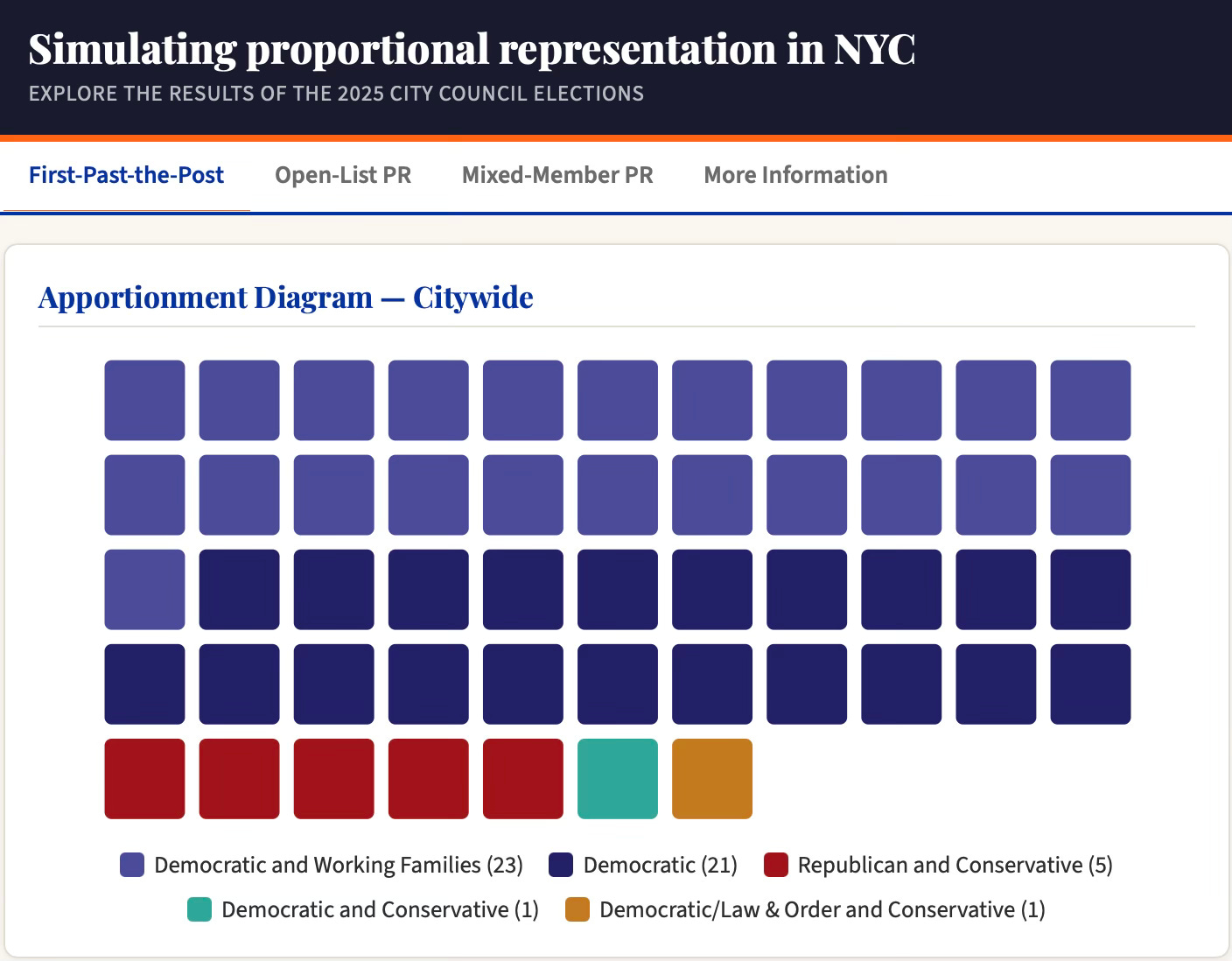
To better understand what’s happening, read the whole story, and to see for yourself, check out the dashboard here.
Podcast: Let’s Talk About Housing
Earlier this week, Nicole and I explored rent regulation, why we are not building six-story rental buildings anymore, how NYC absorbs new immigrants, and many other questions with MI’s pre-eminent housing expert, Senior Fellow Eric Kober, former director of housing, economic and infrastructure planning at the New York City Department of City Planning.
Watch the video above or listen to the podcast.
From City Journal
Governor Hochul's decision to opt New York into the federal Scholarship Granting Organization tax credit tucked into the One Big Beautiful Bill is the right one, MI’s John Ketcham writes.
Starting next year, taxpayers can claim a $1,700 credit for donations to SGOs, which fund scholarships, tutoring, and educational expenses for families earning up to roughly $437,000 in NYC. The funds also cover after-school programs and tutoring for public and charter school students.

Pension Sweeteners — and What They Mean for New Yorkers’ Property Taxes
MI’s Ken Girardin explains:


Ken wrote about this earlier this year: How Would You Like to Retire at 55 — for Free? More of New York’s Public Workers Soon May.
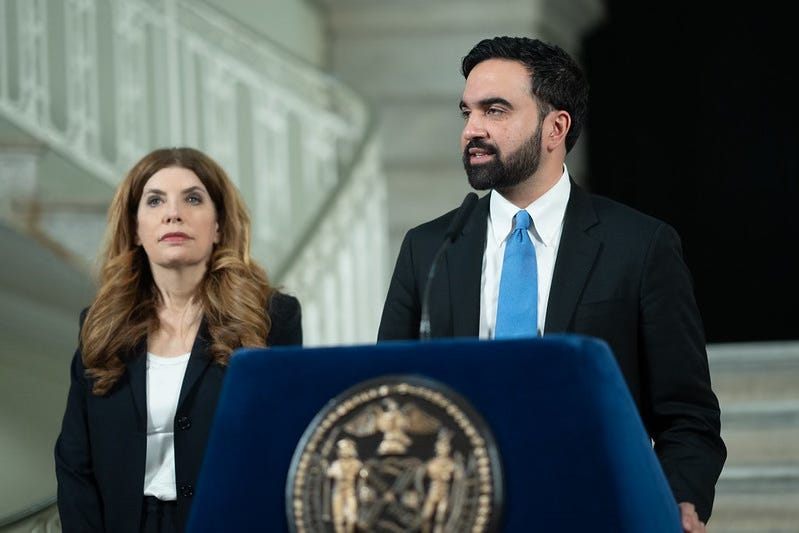
(Top image: Michael Appleton/Mayoral Photography Office)
I have the solution for the city's finances and its housing problem. Are you ready?
END NYCHA. It's really the only way.
Auction off ALL 2,500 acres - in staggered auctions every 40 months. Manhattan and Queens East River waterfront first. Then the rest of Queens. Then Brooklyn, then SI and the Bronx.
Demolish the buildings and replace 80% with mixed use or resi towers. 350-400 feet tall on the waterfront, 240 everywhere else but BKLYN, 180 in BKLYN. Re-zone to allow billboards, cell towers and 100% market units.
Including air rights in the auction.
Buy out the existing tenants for an average of $100K/tenant. No housing assistance or any assistance after that - you make $100K now, or $200K for most households - you don't qualify. It's GTFO money, for everyone but the tenants who are also NYCHA workers (I think it's about 1 in 8). But it's life-changing money for them. Win-win.
Buy out the employees for 2 years' base pay - over a staggered period in line with the auction. They'll get jobs on the rebuilds anyway - 2 years' severance is double dipping for them. Negotiate a PLA with the unions and offer 50% increase to abatements if 75% of the work completed by the GC and subs uses union labor.
For the 20%, build schools, parks, libraries, senior centers, pools, etc...
Allow 10% of the space to be redeveloped as hotel, another 10% as parking garages and 10% as condos. Bring at least one, preferably 2, corporate campuses to BX.
Allow the top floor of each of the 420 foot buildings to be condo. Democratize harbor views!
I'm getting total buyout costs of $40BN of which $3BN comes back in municipal tax withholding.
But you're eliminating a $78BN NYCHA capex backlog and $1.5BN in annual employee costs.
You're also bringing in billions in property tax and individual and corporate municipal income tax revenue, every year.
The auction proceeds would probably be in the range of $70-100BN. Doing Manhattan and Queens waterfront first would raise the highest numbers PSF - especially given the allowed heights of the buildings. That would be huge.
AND think of the follow on development when that is done and it's safer and more profitable for people who own non-NYCHA property nearby to redevelop those lots.
So, there should be enough for the city's portion of site upgrades - probably $20-30BN - to use to pay down debt, shore up the pensions, and restore the city's credit rating.
Doing this on a staggered basis would ensure the capacity (capital and labor) to complete the project and it would avoid creating a rental market that was too skewed toward tenants - it WOULD reduce rents, but not to the point that landlords would go under - just enough to resolve the affordability crisis.
The NY City Council, like the NY Legislature, is never to be counted on for fiscal checks on the executive.