

This week, we look at the risks of an ideological approach to childcare provision, the staggering difference in the time public and charter school students spend in the classroom, and the sway public-sector unions, especially the Teachers’ Union, have over our politicians. In addition, our latest research on how proportional representation might work in the city.
Childcare for All?
In March, following essentially flat enrollment in the city’s preschool programs, which the Mayor worked hard to promote and expand, the city finally decided to ask parents what they actually want and announced a partnership with the left-leaning think tank New America and the Robin Hood Foundation to survey parents of young children on childcare.
While local results are yet to be released, we already know that parents want more time with their children and more money, as New America’s recent national survey found. No single work, childcare, or leave arrangement dominates their preferences.
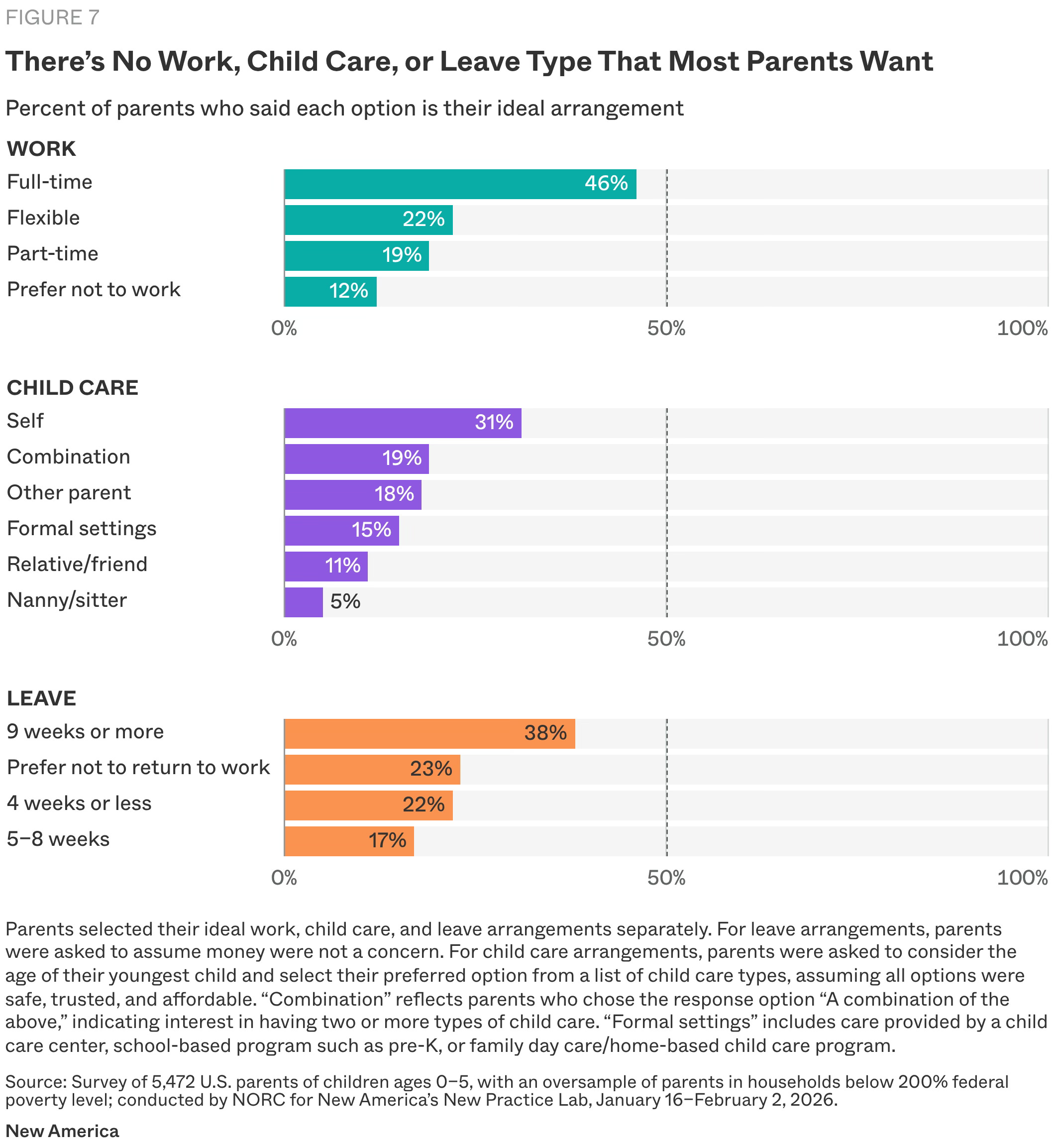
I expect New York parents’ preferences will broadly mirror those nationally.
In NYC, 55% of married couples and much higher numbers of single mothers and fathers with children under 6 work, meaning children live in households where all available parents are in the labor force.
These working parents need flexible arrangements that accommodate their desire to spend quality time with their kids as well as work—work schedules vary and young children get sick a lot, something which no formal care setting solves.
This reality is fundamentally incompatible with the standard school-day 3-K and Pre-K model, which dismisses children at 2:20 PM and shuts down for the summer, leaving parents scrambling to find additional care. The demand for these seats plateaued at about 100,000 combined this year, meaning that—if past years’ trends hold—over 15% of already funded seats will again remain vacant.
Simply funding more costly preschool seats will not solve NYC’s childcare affordability crisis, or necessarily improve the overall quality of care available. A city-contracted seat is projected to cost significantly more than a portable voucher and nearly double the market rates of home-based providers, according to the NYS Comptroller.
The program most in demand appears to be the vouchers that cover an average of $300 per week in care costs for low income working parents, enabling them to choose the specific care, hours, and flexibility their families need. It is popular with those who qualify, leading to a waitlist of about 25,000, in addition to the roughly 70,000 already in use. The city could reduce vacant childcare seats, use the money to match the state funding already allocated, and unlock more of these vouchers.
If Mayor Mamdani truly wants to support working families, he may need to acknowledge that his top-down ideology about expanding universal provision of care may turn out not to be what New York’s parents actually need. We’ll find out soon enough.
Pension Sweeteners: The Gift That Taxpayers Can’t Stop Giving
Thanks to Governor Hochul’s and Albany legislators’ pandering to public-sector unions ahead of elections, New Yorkers will have to pay tens of billions of dollars more toward public pensions—and they’ll have nothing to show for it.

New York lawmakers are celebrating passing a massive new state budget, but its costliest provision—retroactive “sweetening” of pension benefits for half of the state’s public employees—is hidden from the sticker price, MI’s Ken Girardin reports.
Weaponizing pandemic-era labor shortages to roll back common-sense fiscal reforms, the unions secured a deal allowing teachers to retire five years earlier at age 58 with full, taxpayer-guaranteed pensions the state Constitution prohibits from ever being reduced, among other concessions.
This capitulation will cost taxpayers an estimated $550 million annually, inevitably driving up local property taxes. It is hard to overlook the blatant hypocrisy of local mayors who are simultaneously begging Albany for emergency financial bailouts while endorsing these budget-destroying pension expansions, Ken notes, pointing out that yielding to this pressure will only fuel further union demands to completely dismantle past fiscal discipline.
“You can’t blame the public employee unions for asking,” he writes, “but you cannot direct enough scorn at the elected officials for constantly saying yes.”
Related headlines:
Unions in New York now squeeze the public worse than any other mafia — with politicians’ help. (NY Post Editorial Board)
Powerful UFT snags teacher pay bumps of up to $9.5K in compromise deal to delay NYC class size law. (NY Post)
NYC Charter School Students Spend Hundreds More Hours in Class. It Shows.
It is common sense, and research backs it up, that more time in class translates into better educational outcomes. MI’s Jennifer Weber wrote earlier this year that NYC public school students, as a result of labor agreements with the Teachers’ Union, receive 130 fewer hours of instruction than the national average.
Since charter school students in the city tend to massively outperform their local public school peers, Jennifer looked at how many more hours of instruction they get. The numbers are staggering.
While a public school student gets about 1,200 hours in class, students at Success Academy and at KIPP get more than 200 and almost 300 more hours of instruction a year. That’s more than a month of classes, which compounds over K-12 to more than 2 additional years of schooling.
Given that the student populations are roughly the same, it is one reason why charter school students do better than their peers in school.
MI Research: Understanding How Proportional Representation Might Work in New York City
Mayor Zohran Mamdani’s new Charter Revision Commission has an opportunity to fix NYC’s “democratic deficit.” Currently, the City Council fails to mirror its electorate: right-leaning voters face a “proportionality problem” that diluted their 2025 vote share by half, while left-leaning factions are trapped in bitter primary fights.
As MI’s Jack Santucci and John Ketcham point out in a new study, “New York City already has a de facto multiparty system. Despite reforms like RCV, its electoral rules channel political competition into lower turnout, intra-party factional fights, rather than contests between distinct parties in the general election.”

To break this gridlock, the study simulates switching to proportional representation (PR) using 2025 election data, proving the city can align council seats with actual voter intent without causing political chaos. My colleagues find that regardless of whether the city adopts multi-winner borough districts (OLPR) or adds 20 citywide seats to the existing map (MMP), both systems ensure the council finally reflects how New Yorkers actually vote while keeping nearly all current winners in office.
Related:
Jack also wrote for The Bigger Apple about why New York’s multiparty politics feel so chaotic. You can explore the outcomes of various representative systems here.
Extra! Extra!
Mamdani Is Under Pressure to Act Amid Slowing Job Growth in New York (The New York Times)
Who’s Minding the Storefronts? An Analysis of Storefront Vacancies in New York City (NYC Comptroller)
A Cheap Fix for Urban Crime — try improving street lighting. (The Atlantic)
New York may be facing a crime trend even worse than deadly gang violence, MI’s Charles Fain Lehman writes in the New York Post.
NYPD arrests another teen murder suspect amid surge in minors charged with gun violence. (Gothamist)
NYPD Commissioner Tisch warns World Cup, NBA Finals will come with unprecedented security risks — and a giant bill, the New York Post reports.
